For a long time, the oceans were seen as barriers. They were obstacles to be crossed, tamed, and mapped. What if, instead, they were the answer to clean power? Yes, they could be a new frontier not only of exploration but also of supply, essentially an invisible electric field, pulsing with every wave, you know? We know the question sounds like something out of science fiction. But the answer, curiously, is rooted in something reminiscent of fantasy: a dragon.
Tidal energy solutions are being developed to generate clean power
We’ve dreamed of harnessing energy from the ocean’s ebb and flow. It goes way back, from medieval tide mills to our modern turbines embedded in the seabed… The idea is always the same: harness the predictability of the tides, one of the few natural rhythms that never wavers.
Installing turbines on the seabed requires expensive construction, complex maintenance, and often a significant environmental impact. Not to mention the logistics: if you’ve ever tried drilling into the ocean floor, you know it’s not easy. That’s exactly where the story changes. After all, instead of sticking a tower in the seabed, why don’t we make something fly down there?
The dragon, which is a metal kite that flies on the seabed
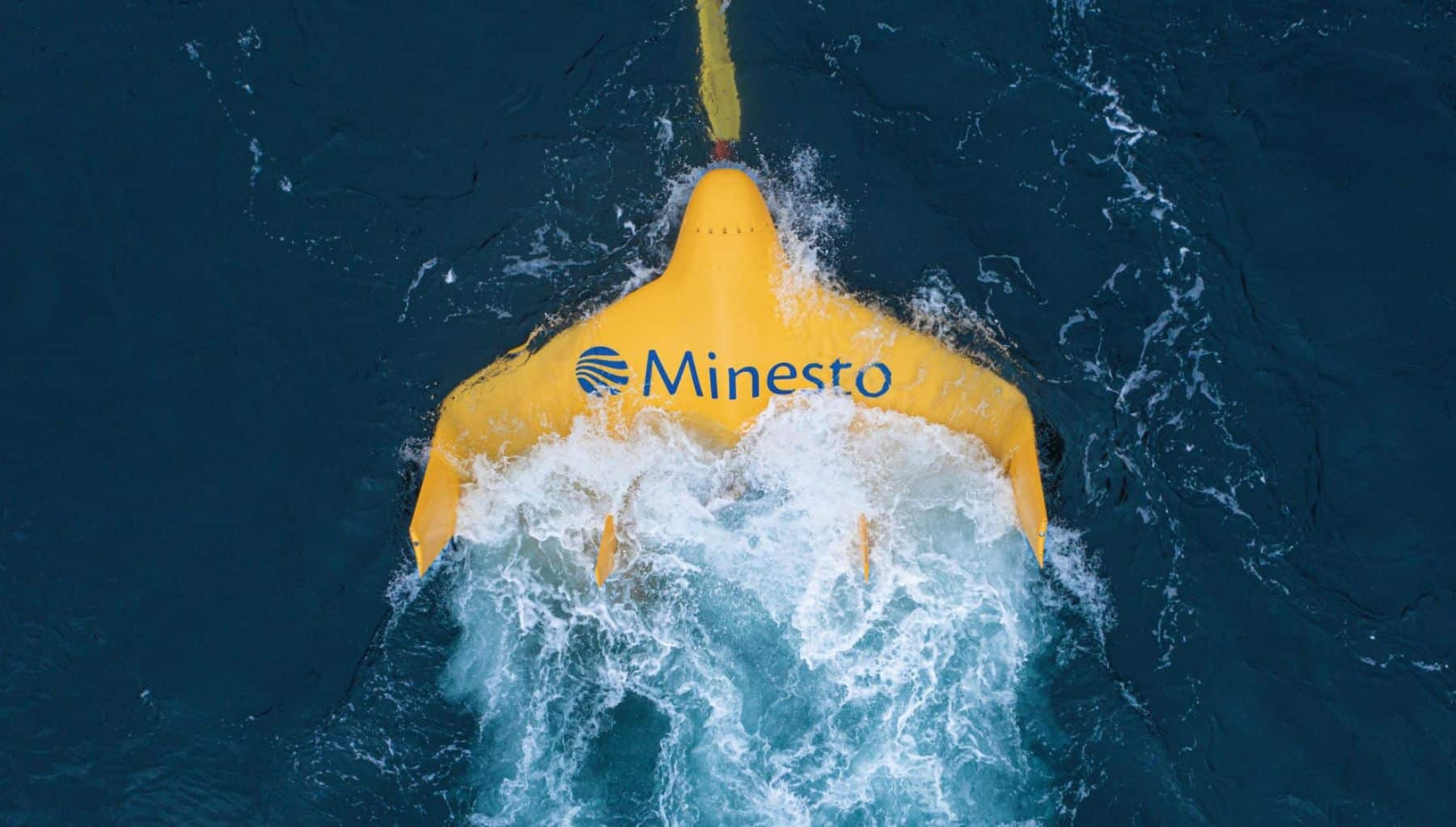
That’s where the famous Dragon comes into play! We’re talking about Dragon 12. Unfortunately, it has little to do with the winged creatures of ancient tales… even if the analogy is irresistible. We’re actually talking about a 12-meter-wingspan, 28-ton contraption developed by the Swedish startup Minesto. Now, in technical terms, its silvery body flies in figure-8 trajectories, accelerated by underwater currents. In other words, as it dances, it spins a propeller that generates electricity (just like this dragonfly-designed invention).
And she’s not alone, you see? There’s a cable connecting her to the seabed, transmitting the generated energy directly to the nearest island’s power grid. The first is already operating in the Faroe Islands, located between Scotland and Iceland, and powers approximately a thousand homes with zero emissions. Yes, the concept is simple and ingenious: instead of fighting the sea, the dragon sails with it. And because it moves faster than the current itself, it can produce energy far beyond its size.
The impacts and results of the first Dragon 12 installations
It was in February 2024 that the installation of Dragon 12 happened; this was the first time a device of this type (which has the capacity of 1.2 megawatts) was stably connected to the national grid. What we’re saying is: now we were able to generate:
- Clean energy.
- Predictable energy.
- Silent energy.
- Not generating major construction, dams, or noise.
“This is a big day for Minesto. We have reached the most significant milestone in the history of the company by producing electricity to the grid with our mega-watt scale powerplant.We are both proud and happy and more than ever look forward to the journey ahead,” said Martin Edlund, the CEO of Swedish startup Minesto.
And the plan is now ambitious: they want to create a fleet of more than 100 underwater dragons to supply up to 40% of the energy for the entire Faroe Islands archipelago. And if it worked there, where the winds are harsh and the seas are hostile, just imagine the coast of the United States, with its vast and underutilized Atlantic coastline?
Jumping to regions like Alaska, Maine, or even parts of California, which face logistical challenges and dependence on fossil fuels, this could be the perfect solution. We’ll have a network of swimming dragons, producing energy day and night, all invisible but essential. They could even combine with the new Dragonscale solar skin, which features 50,000 solar panels and an aesthetically futuristic design.