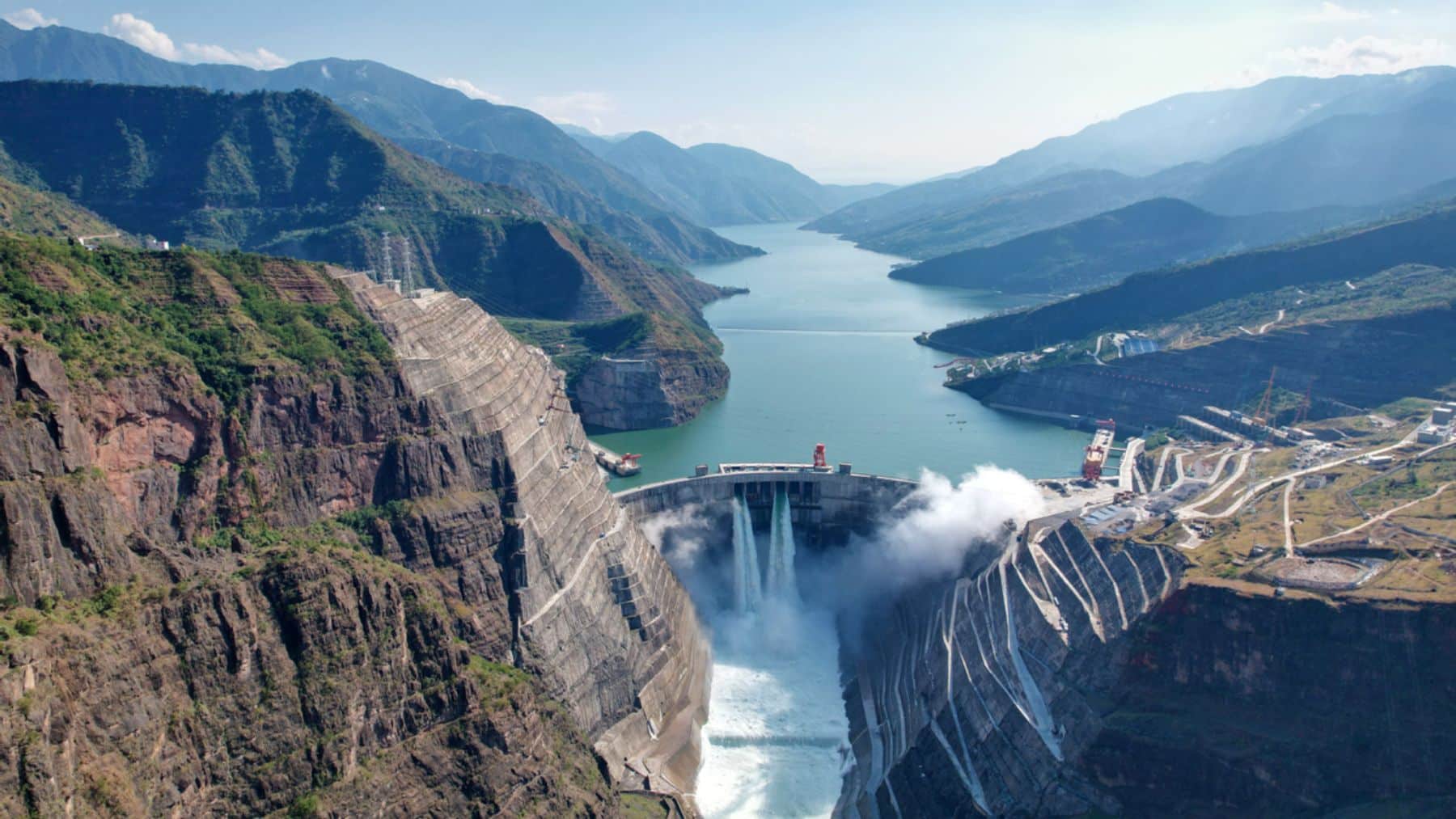
For the first time in modern history, a human construction was large enough to alter the planet’s rotation. Yes, a dam built by China not only diverted a colossal river but, according to NASA scientists, also caused a slight slowdown in the Earth’s rotation. This fact alone is almost unbelievable, but it also raises a question that goes far beyond physics: how far are we willing to go in the name of clean energy? And who pays the price when progress imposes itself on borders, ecosystems, and communities?
China’s hydropower gamble: Can the planet handle this much energy in one place?
The dam we’re talking about is a recently approved project by the Chinese government, planned for the Yarlung Zangbo River in Tibet, which flows into India as the Brahmaputra and flows into Bangladesh. The site chosen was a mountainous, geologically unstable, and politically sensitive region. Its size is also frightening, as it promises to generate 300 billion kWh per year, surpassing the iconic Three Gorges and becoming the largest hydroelectric plant on the planet.
The official justification is quite ambitious, even expected: they want to meet climate targets and expand the use of renewable sources. According to the Chinese state news agency Xinhua, the project would be “ecologically safe” and vital to achieving carbon neutrality by 2060. However, according to researchers linked to NASA, this massive redistribution of water, combined with the change in relief, caused a shift in the Earth’s moment of inertia.
When clean energy sparks conflict: Is China’s megadam a threat to its neighbors?
The dam, which seemed like a mere mega-energy project, has become an environmental and diplomatic crisis. India has even officially responded, demanding transparency, impact studies, and guarantees regarding water flow. Bangladesh, even more vulnerable due to its location at the end of the river’s course, fears water shortages, loss of agricultural sediments, and even accelerated erosion.
“Planning a dam of this magnitude in such complex terrain poses significant risks to downstream regions of India and Bangladesh, especially in the event of a mishap or if there is alteration in the water flow”, said Y. Nithiyanandam, head of the Geospatial Research Program at the Bengaluru-based Takshashila Institution.
What’s most worrying is that the risks aren’t just pessimistic predictions… This is because Tibet, where the dam will be built, recently suffered an earthquake that killed more than 100 people. In other words, the area, besides being geologically fragile, also has a history of violently repressed protests, as occurred in 2024 with hundreds of Tibetans arrested for opposing the Gangtuo Dam. From a technical point of view, hydroelectric plants are indeed a renewable source (it’s no wonder that this impressive hydroelectric project, located 3,000 meters above sea level and that generates 11 billion kWh attracts attention).
Can rivers survive borders? China’s dam reignites the global water race
Of course, behind all this movement lies something bigger than a dam; we’re talking about the struggle for control of natural resources in a world where climate change has become a real threat. Rivers that cross borders require diplomacy, agreements, and cooperation, but China hasn’t shared data, studies, or plans with India or Bangladesh. The same happened with Southeast Asian countries affected by Chinese dams on the Mekong River.
Meanwhile, India is planning its dam on the Brahmaputra, called Siang Dam, as a geopolitical counterbalance. This shows that, more than a physical construction, this dam reveals a new type of vulnerability between nations: that caused by dependence on natural flows that a single country can dam. And all this is happening as the planet warms, populations are displaced, and climate disasters become routine; it’s no wonder the Earth’s axis has already shifted.