Basically, since the Earth has been the Earth as we know it, that is, for billions of years, it has rotated around its axis with almost unshakable precision. When we would think that something we did could change this… but that is what happened, and NASA has already confirmed it. It all started with a construction site built to supply a nation with energy, until it altered the planetary balance.
How does the Earth normally move?
Before we talk about this “new” change in the planet’s rotation, we need to remember how it normally works. The Earth rotates around an imaginary axis that passes through the North and South poles. It is this movement that determines the days and nights. It is worth remembering that it is influenced by physical factors such as the distribution of mass on the Earth’s surface. This means that when immense masses are artificially moved, as in the case of dams or tsunamis, what we call the Earth’s “moment of inertia” changes, changing the speed of rotation.
This is where the impact we have on the Earth’s axis comes in: NASA scientists said that this happened recently with an engineering project that significantly modified the planet’s mass. They noticed that the Earth’s rotation slowed down slightly. How so? Well, the days became 0.06 microseconds longer. Of course, when you put it that way, this may seem insignificant, but this value is measured with high precision by satellites and astronomical instruments. And as if that wasn’t shocking enough, our planet’s poles have also moved by about 2 centimeters.
The Chinese project that changed the Earth’s axis
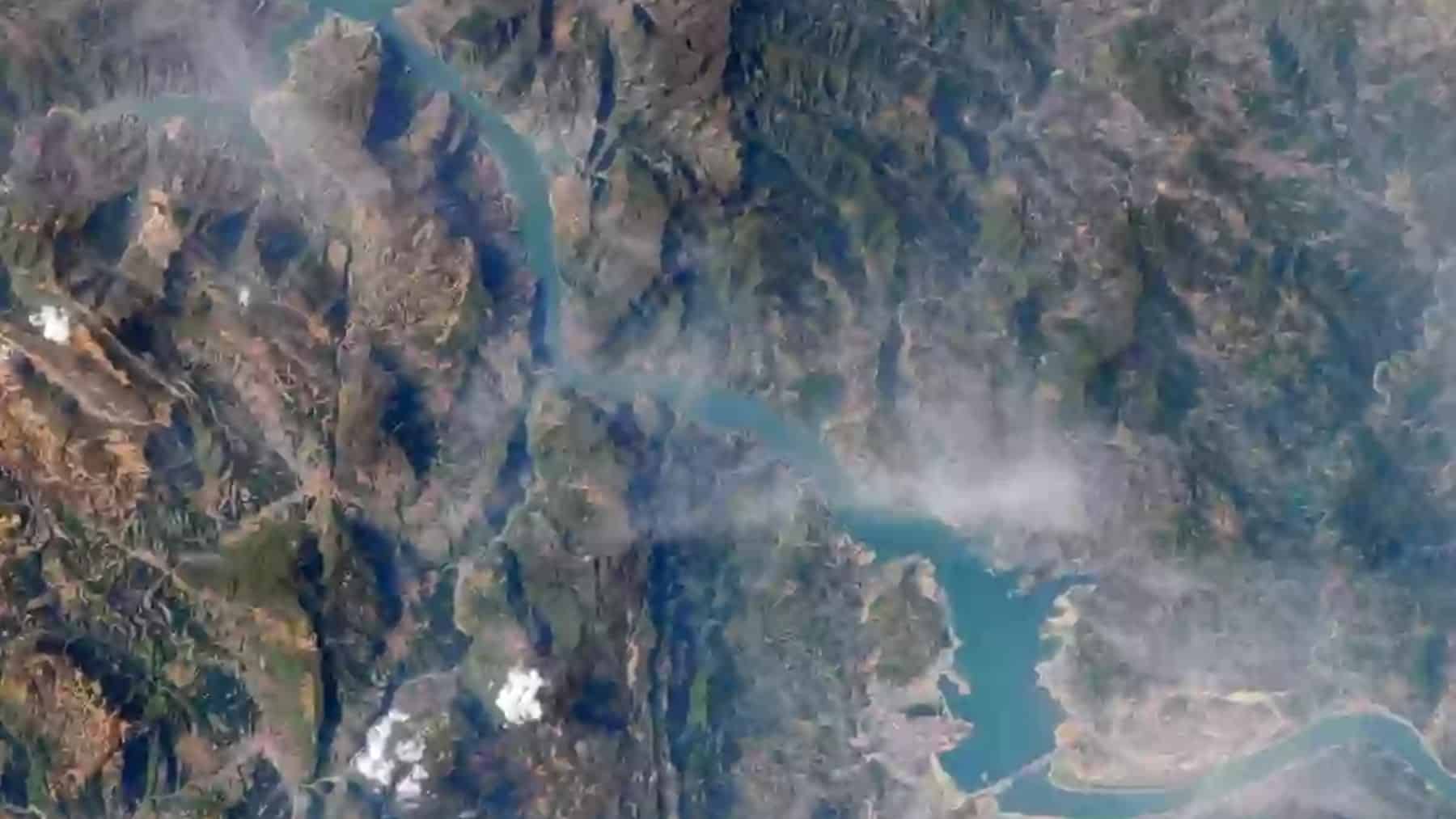
Okay, so what or who is the main cause of this change? The answer lies in the project known as the Three Gorges Dam, built on the Yangtze River in China. It is nothing more, nothing less than the largest hydroelectric plant in the world, measuring over 2 km long and 185 meters high. It is located in the middle of mountainous formations and deep valleys, and its dam took almost 20 years to complete. Today, it is a symbol of Chinese industrial power.
This construction is so impressive that the reservoir of this dam stores 39 trillion liters of water. To give you a better idea, this corresponds to a gigantic mass concentrated 175 meters above sea level. In fact, it was this elevation that contributed most to changing the Earth’s moment of inertia. This is because, according to the laws of physics, the further away from the axis of rotation a mass is, the greater the impact on the speed of the planet’s rotation.
It is also worth mentioning that the energy generated by the dam is equally impressive: more than 100 terawatt-hours per year, which is enough to supply dozens of small and medium-sized countries (it is even worth mentioning this other impressive hydroelectric project located 3,000 meters above sea level that generates 11 billion kWh).
What does this change tell us?
Well, this phenomenon alone marks a new chapter in the relationship between technology and nature. The construction of the Three Gorges Dam shows that, even though we have achieved gigantic advances in infrastructure and renewable energy, we are also shaping the planet on subtle but measurable levels.
This type of event ends up raising important questions, such as: to what extent should we consider the geophysical impacts of large-scale projects? What are the invisible risks of intervening on a planetary scale? It is time to pay more and more attention to our constructions, like this historic hydroelectric dam in the United States that is 100 years old, and only now are we realizing that it is causing a strange phenomenon.