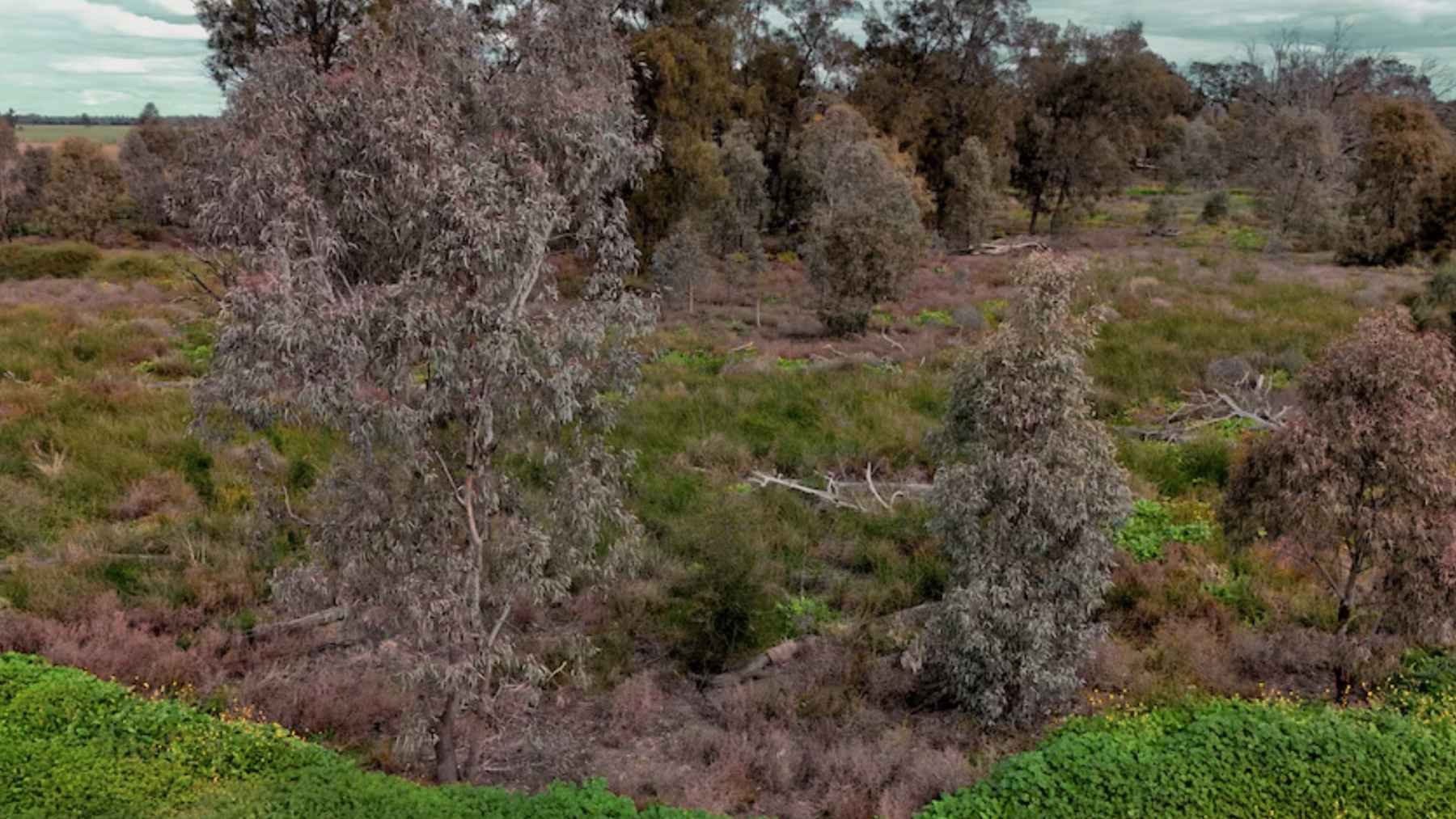
In the floodplains of northern New South Wales, scientists have just introduced the world to a tree that remembers more history than any living local. A coolabah growing in the Gwydir Wetlands has been dated to about 566 years old, making it one of the oldest known floodplain eucalypts in the state.
New research from the NSW Department of Climate Change, Energy, the Environment and Water and the University of Newcastle, Australia shows that many coolabahs and river red gums in these wetlands are at least 400 to 500 years old.(newcastle.edu.au) These long lived trees are now acting like natural archives, holding a detailed record of droughts, floods and changing river flows that began long before weather stations and irrigation channels existed.
A living time capsule on a Ramsar floodplain
The Gwydir wetlands form part of a Ramsar listed site near the town of Moree in the northern Murray-Darling Basin. They are a mosaic of marshes, waterholes and floodplain woodlands that once covered more than 200,000 hectares and now span roughly half that area after decades of agricultural development.(dcceew.gov.au) Large stands of coolabah woodland and water couch still provide crucial breeding habitat for waterbirds, fish and other wildlife.
To tap into the history stored in those trunks, researchers used dendrochronology, the science of reading tree rings, combined with radiocarbon “bomb pulse” dating linked to the spike in atmospheric carbon from nuclear testing in the mid twentieth century.(newcastle.edu.au) They extracted pencil sized cores from living trees using a reinforced steel tube and a drill, a method that leaves the trees standing while revealing their ring patterns.
Tree rings showed clear responses to hydrology. Wide rings marked years when floodwaters reached the roots for long enough. Narrow rings captured extended dry spells. Together they create a centuries long record of how the Gwydir floodplain responded as climate swung between wet and dry periods and as people altered flows with dams and diversions.
Seedling booms instead of steady replacement
One of the most striking findings is that these floodplain eucalypts do not quietly replace themselves year after year. Their regeneration happens in rare bursts.
By matching ring patterns with age structures, the team identified six pulses when seeds germinated, saplings survived and large waves of young trees joined the woodland.(abc.net.au) These “mass recruitment events” occurred in the 1500s, 1600s, 1800s and early 1900s and lined up with major shifts in flooding and hydrology.
Lead researcher Kathryn Taffs describes the oldest coolabah, which measures about 176 centimeters across, as “a really old, very magnificent tree” and “what a matriarch for the community.”(abc.net.au) She notes that successful reproduction is tied to specific flow patterns rather than a regular schedule, which means many years pass with little or no recruitment.
For modern water managers, that irregular rhythm matters. If environmental water releases only keep existing giants alive without ever creating conditions for new cohorts, the woodland can slowly age and thin. The canopy might look fine in the short term, yet there would be too few young trees to replace the elders already carrying five centuries of history in their wood.
Turning ring data into smarter water decisions
The new dataset does not stay in the lab. It feeds directly into the New South Wales Environmental Outcomes Monitoring and Research Program and into practical documents that guide how limited environmental water is shared across the Gwydir catchment.(newcastle.edu.au)
In the latest annual priorities, managers plan to use up to 35 gigaliters of held environmental water to support habitat for waterbirds and a further 10 gigaliters to help wetland vegetation recover and persist. Additional flows can be released when heavy rain triggers bird breeding or when wetlands such as Mallowa respond to earlier watering.(environment.nsw.gov.au) Those same flows also benefit coolabah and river red gum stands that anchor the floodplain.
Tree ring records help fine tune the timing and size of those releases. By comparing past recruitment pulses with historic floods, managers can identify which patterns of depth and duration actually produce new forests instead of just damp soil. That can mean waiting for the right wet year and then sending a larger, slower pulse across the floodplain rather than many small top ups that never quite reach the higher woodlands.
Associate Professor Danielle Verdon Kidd calls the work “a major step forward for Australian dendrochronology” and says that floodplain eucalypts “hold tremendous potential for understanding past climate and water conditions in parts of Australia where long term records do not exist.”(newcastle.edu.au)
A local tree with basin wide lessons
At first glance, the story of an elderly coolabah might sound like a charming local detail, something to hear on the radio while driving past irrigated fields and checking the fuel gauge. In reality, similar floodplain eucalypt forests line rivers right across the basin.
If the same techniques work in other regions, scientists can build long climate and flow histories where gauging records are short or incomplete. That kind of evidence can guide environmental watering so that it supports bird colonies, threatened ecological communities and the cultural values of Traditional Owners who have relied on these wetlands for countless generations.(dcceew.gov.au)
For households, the benefits show up less in a single water bill and more in the resilience of the landscapes that feed towns and cities. Healthier wetlands buffer floods, filter water and provide habitat for fish and birds that many communities cherish.
In the end, that 566 year old coolabah is more than an impressive survivor. It is a witness to five centuries of changing climate and human influence and a quiet adviser on how to share every scarce drop more wisely in the future.
The press release was published on The University of Newcastle, Australia.