Have you ever imagined your old home computer quietly listening for aliens while you checked email or paid the electric bill? That is more or less what happened for two decades with SETI@home.
Now, years after the iconic Arecibo radio telescope in Puerto Rico collapsed, scientists have pulled a surprising legacy from its data. Out of roughly 12 billion radio detections, they have isolated just 100 signals that are strange enough to deserve a careful second look.
A digital time capsule from a fallen telescope
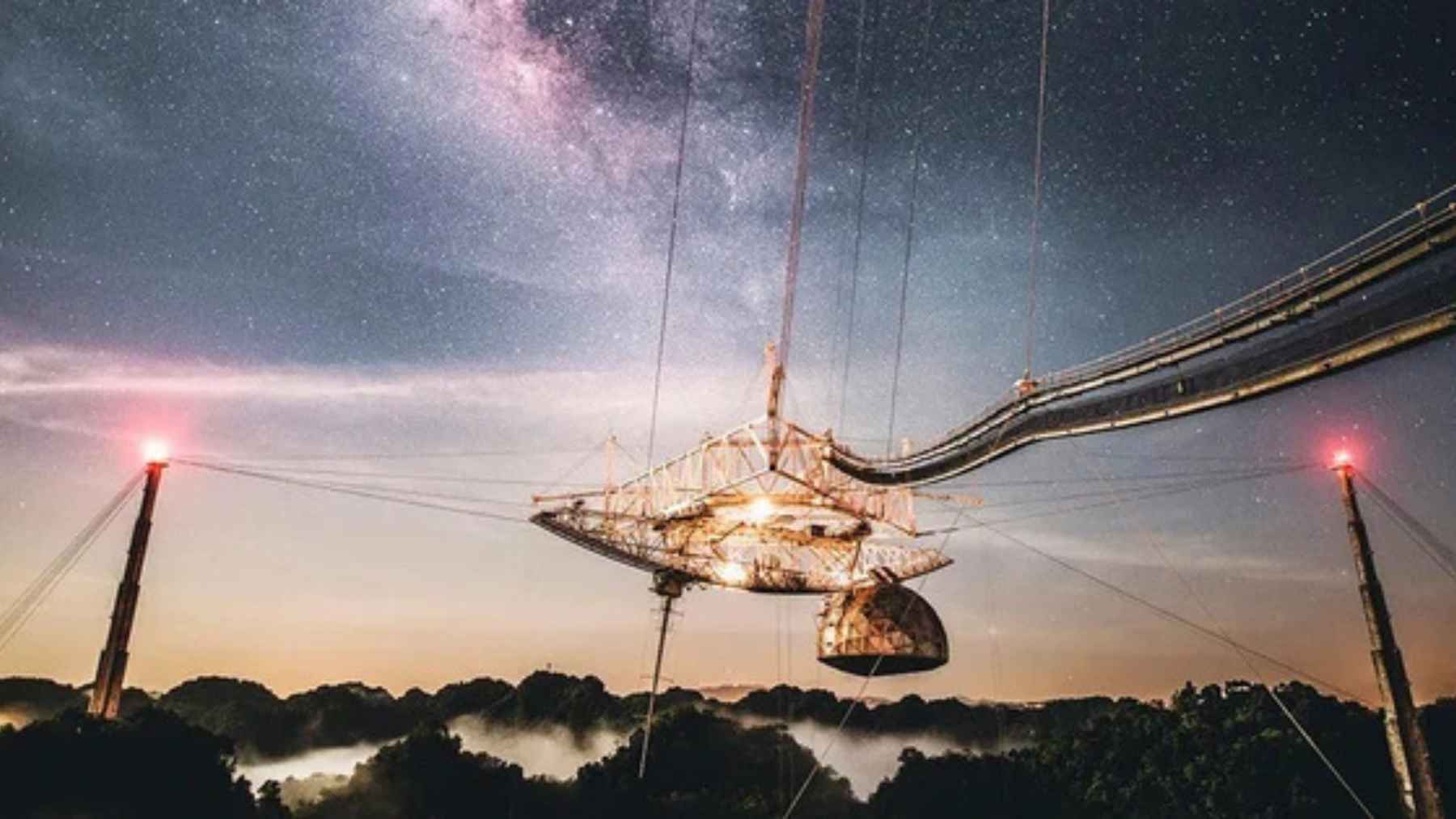
Arecibo lived in a lush, karst landscape in northern Puerto Rico, surrounded by forest and steep limestone hills. It served for 57 years as one of humanity’s most sensitive “ears” on the universe until structural damage, worsened by hurricanes and earthquakes, led to its collapse in December 2020.
Before that happened, the dish recorded enormous streams of radio data while other astronomers used it for routine studies.
SETI@home packaged those recordings into small chunks that millions of volunteers processed on their own desktops between 1999 and 2020. Together they flagged about 12 billion “signals of interest” brief bursts of energy that stood out from background noise.
From billions of blips to 100 suspects
The hard part came later. A team led by computer scientist David Anderson used a supercomputer at the Max Planck Institute for Gravitational Physics to strip out radio interference from sources such as satellites, broadcast towers and even microwave ovens.
That effort shrank the list to about one million promising candidates, then to one thousand and finally to 100 that are the most persistent and puzzling.
To a large extent, the search focused near a famous radio wavelength around 21 centimeters, which astronomers already use to map hydrogen gas in the Milky Way. Experts reason that any civilization trying to get noticed might also choose that neighborhood on the dial, where many telescopes are already listening.
None of the 100 signals is confirmed as artificial. In fact, scientists openly say they do not really expect a clear alien beacon. What they do expect is better knowledge of what they might be missing.
The project inserted about 3,000 fake test signals inside the data to measure how often real technosignatures with similar strength could slip through their filters. That kind of self check is now a reference point for future radio surveys.
Why this matters for a small blue planet
So where is the environmental angle in all of this cosmic detective work? Radio astronomers warn that our own technology is filling near-Earth space with electromagnetic noise from constellations of satellites, ground transmitters and consumer devices.
These signals already make it harder to hear the faint universe and might one day drown out the kind of technosignatures we hope to find. The same satellites that help us stream movies and check the weather also fill space with noisy radio emissions that already make life harder for radio astronomers.
In practical terms, learning to protect “radio dark” skies is part of the same conversation as reducing light pollution or safeguarding dark night reserves on Earth. It is about deciding how much interference we are willing to add to shared environments, whether that environment is a city park, a coral reef or the thin shell of radio silence around our planet.
For now, Earth remains the only confirmed world with oceans, forests, and a busy, chattering civilization. Knowing how rare or common technosignatures are will shape how we think about protecting this small blue planet in a very large and mostly silent cosmos.
The scientific heart of the story appears in two companion papers on SETI@home data handling and analysis.
The press release was published by UC Berkeley News.