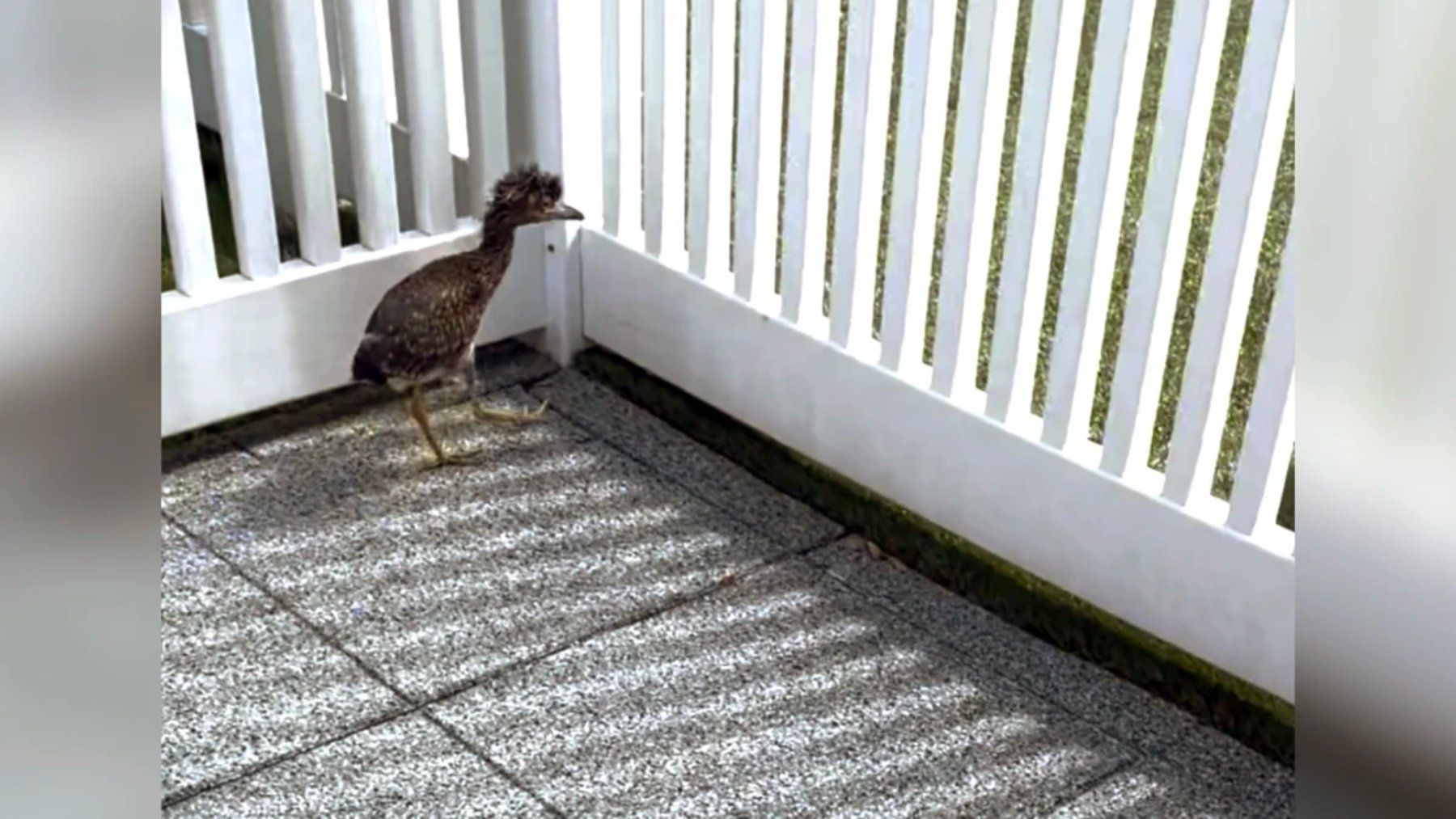
A young bird that drew comparisons to a “little dinosaur” turned up alone on the playground of a church preschool on Long Island. The director called local wildlife rescuer Karenlynn Stracher, who identified it as a yellow-crowned night heron and moved it to nearby cover rather than taking it away.
The small move gave the youngster a safer place to remain near its parents, and preschool staff later reported that the family had reunited. The important part of this rescue was not the distance traveled, but finding a way to remove an immediate danger without separating a young bird from its family.
The playground was the problem
Stracher suspected the heron had recently left a nearby nest and accidentally ended up inside the busy play area. In her assessment, the exposed location posed a threat even if the parents were still looking after their youngster on the ground.
She described a spot with no shade, no protective hiding place, and no water source. The bird was also standing on a surface that became extremely hot in the summer sunshine, leaving Stracher concerned about overheating and dehydration rather than simply the fact that it was alone.
A rescue on the other side of the fence
Instead of removing the heron from the neighborhood, Stracher chose a cooler, grassy area beyond the playground fence. It offered more shrubs and cover while keeping the bird close to where its parents could find it.
She gently picked up the youngster, set it down in the grass, and watched it run into the brush. When she later checked with preschool staff, they told her the bird had rejoined its parents and was flying around the area independently.
Stracher summed up the intervention when speaking to The Dodo. “All it took was a simple phone call and five minutes of my time,” she said, describing how little was needed to give this particular bird a chance to grow up.
Why the youngster looked prehistoric
The bird’s untidy head feathers, beak, and neck prompted the dinosaur comparison among online viewers. That was a playful description of its appearance, while Stracher identified the unexpected playground visitor as a young heron.
The Cornell Lab of Ornithology describes yellow-crowned night herons as stocky birds with large heads, thick bills, and relatively short legs. Its identification guide lists their length at approximately 22 to 28 inches, measurements for the species rather than this rescued youngster.
Juveniles look different from adults, with brown plumage, fine white spots, and streaked underparts. The namesake yellow crown and striking black-and-white head pattern belong to the adult appearance described in Cornell’s guide.
Sharing space with a wetland bird
These herons are not limited to remote marshes. Cornell’s life-history guide notes that they sometimes forage on lawns and nest above houses, roads, and driveways, bringing their daily lives into places people use, too.
That overlap can create friction, with people sometimes disturbing nesting birds to drive them away, according to Cornell. The lab also identifies habitat loss and degradation as threats, a reminder that protecting these birds involves more than responding to individual emergencies.
A bird on the ground is not always abandoned
The rescue raises a question many people face in their own yards. Does a young bird need help simply because it is outside a nest?
In its separate guidance on young wildlife, the New York State Department of Environmental Conservation explains that young birds may spend time on the ground while their parents continue caring for them. An alert, fully feathered bird that is moving around generally should be observed from a distance rather than collected.
Human attention can make the situation harder to judge because parents may stay away while people are nearby. The department also warns that inexperienced attempts to raise wild animals can interfere with their normal development and ability to survive after release.
Knowing when to make the call
That does not mean ignoring an animal in trouble. New York’s wildlife agency advises contacting a licensed wildlife rehabilitator when a young animal is clearly injured or orphaned, and its 2026 guidance recommends keeping pets indoors when young wildlife are present.
The preschool case illustrates why the surrounding conditions matter alongside the bird’s behavior. Here, Stracher judged the heat and lack of shelter dangerous enough to warrant a short move, while still making parental care central to the plan.
For readers, the practical lesson is to seek expert advice rather than assume every lone bird needs to be taken home.
The department’s wildlife safety press release was published on May 29, 2026, on New York State’s official news website.