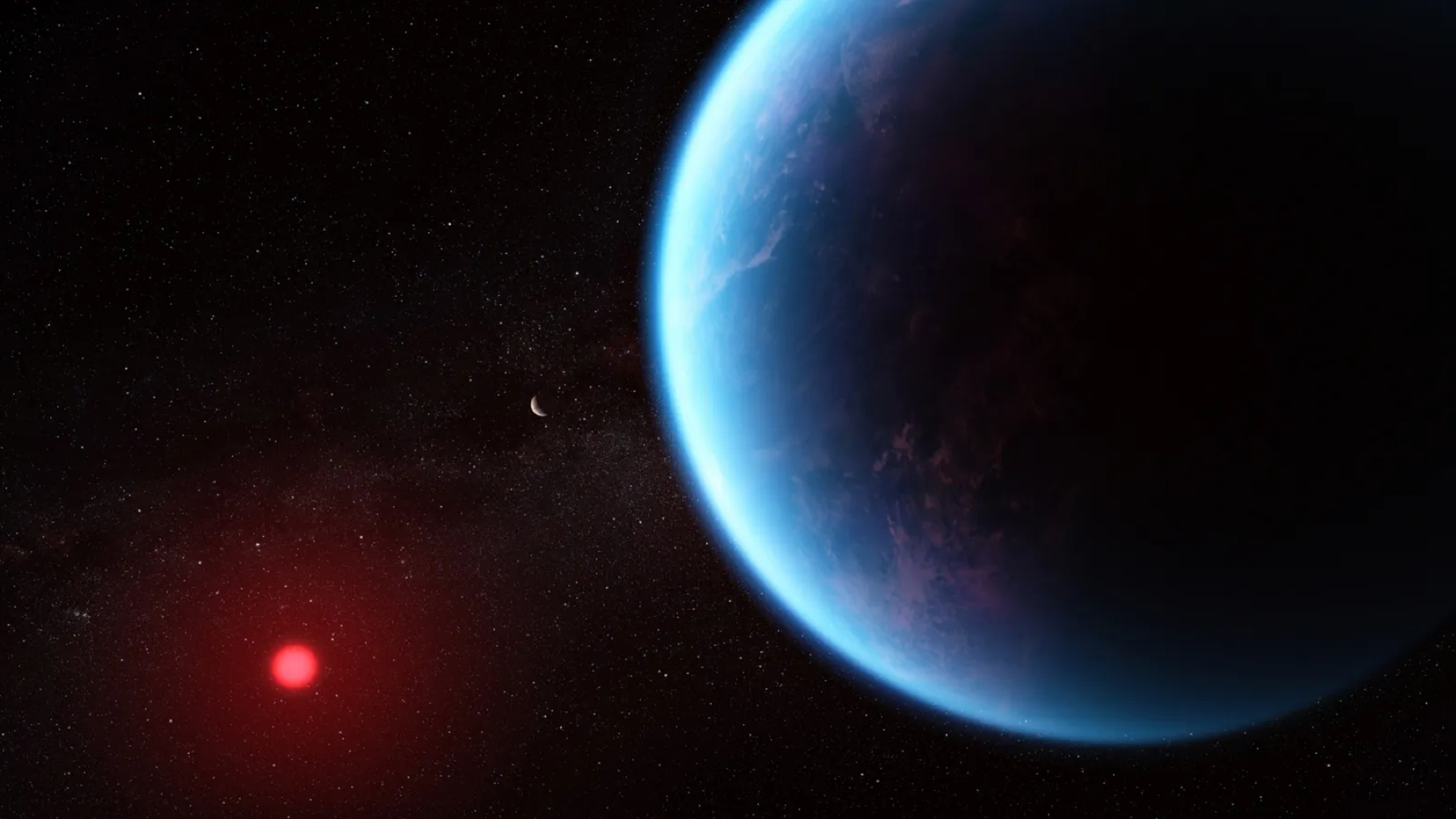
The pioneering James Webb Space Telescope (JWST) has made headlines on exoplanet K2-18b with its detection of gases – dimethyl sulphide, methane, and carbon dioxide – that “should not be there.” These findings heighten hopes of extraterrestrial life since gases are mostly associated with bio productivity.
Rare gases throw major spanners into workings on distant exoplanet
One of the stunning revelations from the James Webb Telescope is that it has detected the presence of DMS, a compound majorly produced by life on Earth-through sources such as marine phytoplankton. The presence of this gas, in addition to methane and carbon dioxide in K2-18b’s atmosphere, has left scientists wondering.
These are gases that are improbable because of the highly improbable natural formation of such combinations on a planet without life. The unusual thing here is that the scientists insist that “they should not be there” under ordinary conditions for planets.
The expression refers to the idea that DMS should in fact not exist in detectable concentrations in the atmosphere without biological processes. Methane and carbon dioxide, although not exclusively indicators of life, contribute to raising eyebrows when coupled with DMS, since it suggests some peculiar atmospheric composition that might indicate biological action.
K2-18b, because of its strategic position in the so-called “Goldilocks Zone” of its host star, may even have conditions favorable to the presence of liquid water-the third and most critical ingredient for life known to us. That hydrogen-rich atmosphere promises to be even more interesting because such environments could sustain some sort of microbial life or even truly alien life forms (such as the ‘formula of life’ which was found in the universe).
James Webb Telescope: Redefining the exploration of extraterrestrial life
The James Webb Telescope is revolutionizing the search for extraterrestrial life—capable of detecting molecular signatures from light-years away. Webb is not hist predecessors, using advanced infrared spectroscopy to analyze the chemical makeup of distant planets’ atmospheres.
It brings such breakthroughs as scientists revealing DMS onto K2-18b. With this case, JWST asks how far it can push planetary science. Studying how star light interacts with the atmosphere of K2-18b will allow the astronomer to define specific wavelengths that correlate with the chemical ‘fingerprints’ of DMS, methane, and carbon dioxide.
Such precise measurement has become possible only with Webb’s making possible a significant leap in exoplanet exploration. But against a historic discovery, the questions have already started stacking up. So, will these gases have a non-biological origin?
Are other – yet unknown – mechanisms working in K2-18b’s atmosphere? Such inquiries show how the James Webb Telescope is not really a discovery machine but a creation engine of questions for science and collaboration.
Scientists warn against jumping into conclusions on gases found on K2-18b
These gases do not prove life on K2-18b but raise the search for alien life deep into the unknown,” says DMS. Well, Earth lives on almost exclusively by living organisms. Its presence on K2-18b would be a tantalizing clue. “Should further analyses prove DMS biological in origin, it would be an extremely important breakthrough not only for planetary science but for humanity’s understanding about our place within the cosmos.
But scientists urge refrain from jumping to conclusions. One must consider other possibilities, like unknown chemical or geological processes, in developing explanations to the gases observed. At the same time, this new find encourages further exploration and investment in space science.
K2-18b is just one of countless exo-planets. The tools that have been developed to study it will be useful for many others. Collaboration among institutions and nations would be key to unraveling these mysteries, as the quest for extraterrestrial life is beyond individual scientific endeavors.
The James Webb Space Telescope finds unsought-of gases on K2-18b, wants to continue that dream of finding alien life (like this one found in the universe), and adds in questioning human perception as we understand the universe. Open curiosity and technology breakthroughs have again brought the dream closer than ever to reality.