Ever stood in front of a Mark Rothko painting and wondered why a few rectangles deserve so much attention? A useful clue lies inside the Renaissance buildings of Florence. The American painter looked to Michelangelo and Fra Angelico for ways to make art shape a viewer’s emotional experience.
That connection anchored “Rothko in Florence,” an exhibition curated by his son Christopher Rothko and Elena Geuna that ran from March 14 through August 23, 2026. Bringing together more than 70 works, the project linked Palazzo Strozzi with the Laurentian Library and Museum of San Marco. Its central idea was to consider what happens when paintings and rooms work together.
Michelangelo’s library offered more than inspiration
In 1950, Rothko entered the vestibule, or entrance hall, of Florence’s Laurentian Library, designed by Michelangelo in the 1520s. A massive staircase fills much of the compact space, while rectangular wall features suggest openings that have been closed off. Instead of welcoming the eye toward a distant view, the room seems to push it back.
“He achieved just the kind of feeling I’m after,” Rothko later said of Michelangelo, explaining the connection to his own paintings. He wanted viewers to feel enclosed, as though the room’s doors and windows had been bricked up. Rather than copying a staircase, Rothko was trying to carry its emotional pressure into paint.
Why an upscale restaurant was the wrong destination
That ambition took shape in 1958, when Rothko accepted a commission for the Four Seasons restaurant in New York’s Seagram Building. His Seagram Murals used dark reds and blacks to create an atmosphere of tension rather than easy comfort. This was not simply a matter of matching the dining room’s decor.
But Rothko ultimately withdrew from the commission and returned his fee, rejecting the restaurant as a setting for his work. He doubted that its wealthy diners would give the paintings their attention. For the Florence exhibition, two preparatory studies were instead placed inside Michelangelo’s vestibule, connecting them directly with the room that helped inspire the larger project.
Fra Angelico showed him a quieter kind of power
Elsewhere in Florence, Rothko found a different model in Fra Angelico’s frescoes at San Marco, a former monastery. The religious paintings occupied the friars’ cells, where relatively small rooms encouraged close, private encounters with the images. According to the exhibition’s curators, Rothko stayed until closing during his 1950 visit and returned the following day.
The 2026 show placed five Rothko works in former friars’ cells alongside Fra Angelico’s frescoes. The pairing highlighted a shared purpose rather than a shared subject, bringing a viewer into close, quiet contact with an image. Fra Angelico used religious figures, while Rothko relied on abstract form and color, but the curators presented both as invitations to contemplation.
What the rectangles are asking us to notice
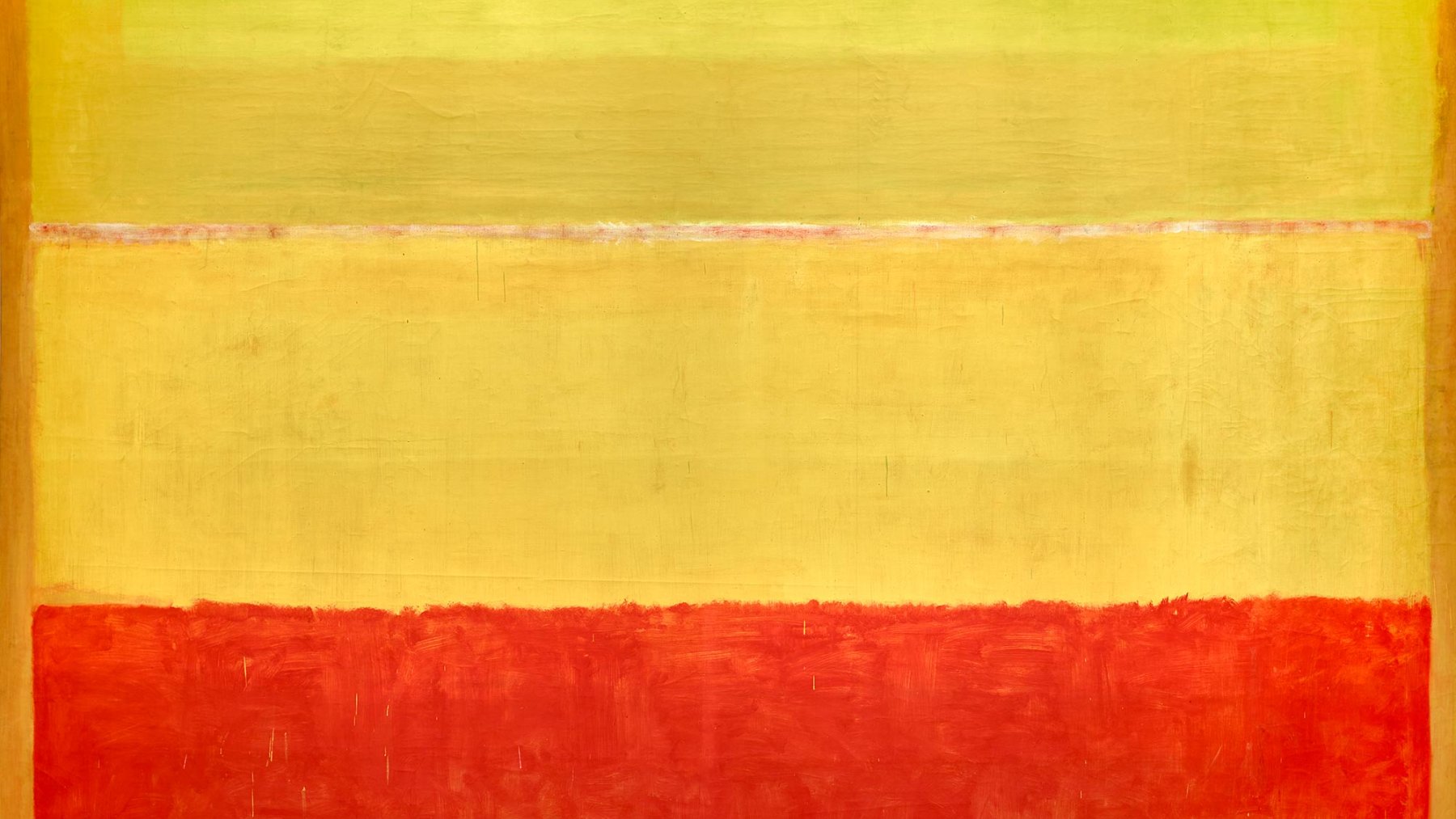
Rothko did not begin his career with the rectangles that made him famous. The Palazzo Strozzi presentation started with figurative paintings from the 1930s and 1940s, then followed his development into abstraction. Seen in that sequence, the familiar color fields become part of a longer search for how a painting can communicate without spelling everything out.
An early painting in the show, Interior, has also been linked to Michelangelo’s New Sacristy mausoleum, although that connection remains tentative. The suggested influence involves photographs rather than a firsthand encounter, since Rothko painted the work before his first visit to Florence.
Christopher Rothko writes that his father’s paintings challenge viewers to understand them “through the rather indirect avenue of what we feel.” That offers an alternative to treating every rectangle as a symbol with a correct answer. Notice the balance of colors, the size of the painting and the space around it, then give your own response a little time.
How that vision reached the Rothko Chapel
In 1964, Houston philanthropists John and Dominique de Menil commissioned Rothko to create paintings for what became the Rothko Chapel. The project gave him a setting conceived for reflection rather than restaurant conversation. He completed 14 paintings in 1967, shaping an environment in which the artwork could surround the viewer.
The nondenominational chapel describes one of its values as making space for “respite and reflection in a chaotic world.” That purpose echoes the Florentine connection, where the setting and the encounter with a painting matter alongside what appears on its surface. For a viewer puzzled by Rothko, this suggests a different starting point, experiencing the work rather than immediately trying to solve it.
The exhibition brought that relationship between painting and place into focus through the buildings that had inspired the artist himself.
The official exhibition press release was published on Fondazione Palazzo Strozzi.