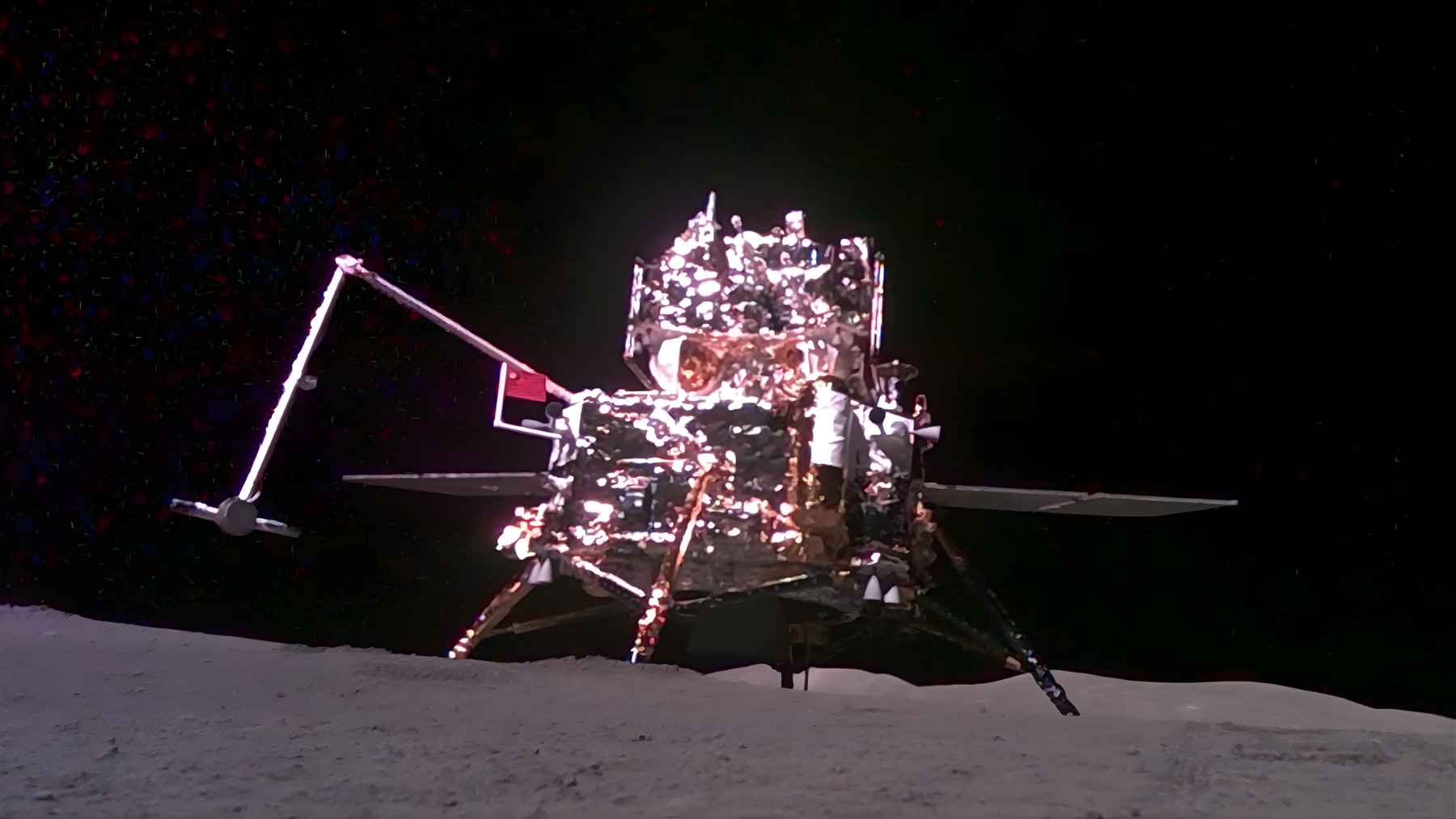
Scientists analyzing lunar dust from the far side of the Moon have spotted something that, until now, belonged only in cutting-edge labs on Earth.
In grains of soil returned by China’s Chang’e 6 mission, a team from Jilin University has identified single-walled carbon nanotubes, ultra-thin cylinders of carbon that engineers normally grow for advanced electronics and energy technologies.
The work, published in the journal Nano Letters and announced by the China National Space Administration, marks the first confirmed case of these single-walled nanotubes forming naturally rather than in human made reactors.
Using a suite of high-resolution microscopes and spectroscopic tools, the researchers tracked tiny patches of graphitic carbon within the Chang’e 6 samples and showed that some of them are hollow tubes with walls only one atom thick.
From lab made material to lunar surprise
Carbon nanotubes sound abstract, yet they already sit at the heart of many research projects aimed at better phone screens, faster chips and lighter batteries for electric cars. In simple terms, a single-walled nanotube is a sheet of graphene rolled into a cylinder only a few nanometers across, roughly 100,000 times thinner than a human hair.
On Earth, these structures are typically produced in specialized furnaces that run at very high temperatures, where metal catalysts such as iron guide carbon atoms into neat, tubular shapes.

Scientists have seen multi-walled, nanotube-like structures appear naturally in extreme environments, including coal fires and forest wildfires, where intense heat and carbon-rich smoke combine. The single-walled version is more delicate and more uniform, which is why many researchers assumed it was a purely engineered material.
The new Chang’e 6 study directly challenges that assumption. Its authors note that although carbon nanotubes were largely thought to require artificial preparation, their data show that single-walled tubes can indeed arise in nature under the right conditions.
How the Moon may have built its own nanotubes
So how did a high-tech material end up hiding in ancient Moon dust? According to the Nano Letters paper and Chinese media reports, the nanotubes are linked to a cocktail of micrometeorite impacts, early lunar volcanism and constant bombardment by the solar wind. The team found the tubes embedded in lunar soil near features created by tiny high-speed impacts.
They propose that incoming micrometeorites and charged particles from the Sun supplied carbon, which was briefly vaporized during each violent hit. As this carbon-rich gas cooled rapidly, iron bearing minerals in the soil acted as natural catalysts, helping carbon atoms knit themselves into stable, cylindrical nanotubes instead of disordered soot.
Chemical fingerprints in the samples, combined with the presence of unmistakably lunar minerals, also argue strongly against contamination from Earth during collection or handling. In other words, the nanotubes appear to be genuine products of the Moon’s own history, not hitchhikers from our planet.
A more active Moon than the textbooks suggested
This is not the first time lunar dust has rewritten the story of carbon in space. In 2024, many of the same researchers reported naturally-formed few-layer graphene in soil from China’s Chang’e 5 mission on the Moon’s near side, again linked to high temperature processes involving iron-rich minerals and solar wind carbon.
Comparing the new far side samples with those earlier Chang’e 5 grains, the team noticed that the far-side carbon structures show more defects, which they connect to a harsher history of micrometeorite bombardment on that hemisphere.
Put together, the graphene and nanotube discoveries suggest that the Moon is not just a frozen ball of rock. To a large extent, it behaves like a slow motion chemical reactor shaped by impacts, volcanism and the constant stream of particles from the Sun.
Why ecologists and engineers are paying attention
At first glance, this might sound like pure space trivia. Yet the finding touches directly on how we might build greener technologies at home. Single-walled nanotubes and related nanomaterials are promising ingredients in high-efficiency solar cells, long-lasting supercapacitors and lightweight components for electric vehicles, all of which can help shrink the electric bill and reduce fossil fuel use if they reach large-scale production.
Producing these materials today can be energy intensive and often relies on fossil based feedstocks as well as mining for metal catalysts. By watching how the Moon assembles nanotubes from sparse carbon gas under extreme but natural conditions, researchers hope to glean new ideas for lower-impact manufacturing on Earth.
In the much longer term, some scientists even imagine lunar bases that use local soil as feedstock and space itself as a kind of nanofactory, trimming the need to launch heavy equipment and polluting industry from our own atmosphere.
For now, the nanotubes in the Chang’e 6 grains are tiny and rare, so no one is about to mine them. The real impact is conceptual. It reminds us that seemingly lifeless worlds can host subtle, sophisticated chemistry, and that nature still outperforms our best reactors in more places than we expect.
The study was published in Nano Letters.