What if the most energy efficient way to travel between stars was not a giant metal starship, but a chunk of ice already racing through the galaxy?
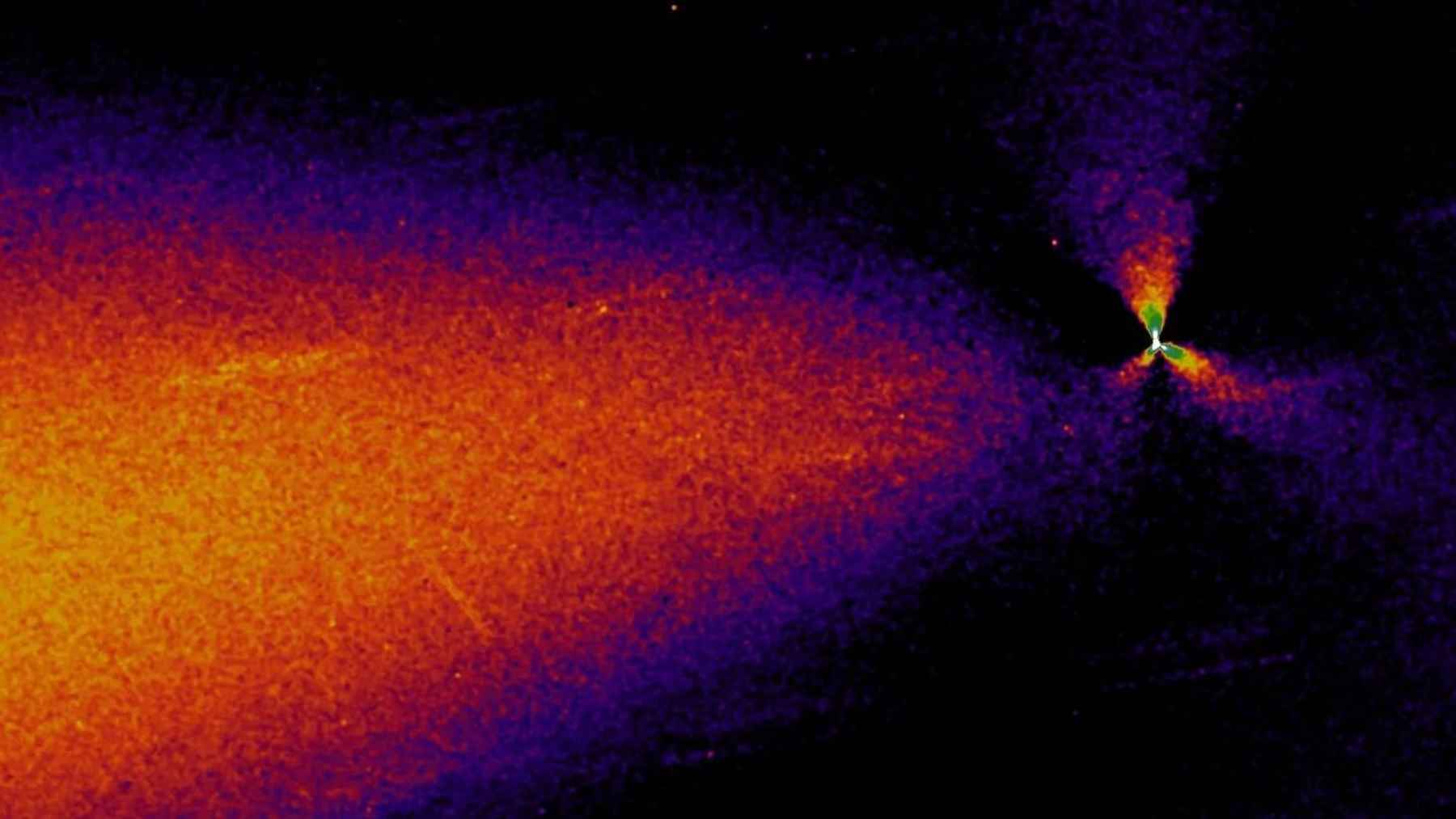
That is the provocative idea some scientists are exploring as interstellar comet 3I/ATLAS hurtles through our solar system, spraying water and organic molecules into space and offering a rare close look at material from another planetary system.
A wet visitor from another star
3I/ATLAS is only the third confirmed object known to come from outside our solar system, after 1I ʻOumuamua and 2I Borisov. Its orbit is open rather than closed, so when astronomers trace its path back in time they find that it does not belong to the Sun at all.
Discovered in July 2025 by the ATLAS survey telescope in Chile, the comet appears to have a solid icy core somewhere between roughly 440 meters and 5.6 kilometers across. It is moving at more than 130 thousand miles per hour relative to the Sun, fast enough to cross the disk of the Milky Way in less than a billion years.
Space observatories quickly turned toward this traveler. Missions managed by NASA and by the European Space Agency as well as ground telescopes have watched 3I/ATLAS near the Sun and from the vantage point of Mars. Their data paint a picture of a very active object that behaves differently from many comets born in our own planetary neighborhood.
Water like a cosmic fire hose
One of the biggest surprises is just how much water the comet is losing. Using ultraviolet fingerprints of hydroxyl an Auburn University team found that 3I/ATLAS was already venting about 40 kilograms of water every second while it was still nearly three times farther from the Sun than Earth is. The lead scientist compared it to a fire hose running at full blast.
Later, the SOHO spacecraft detected an enormous cloud of hydrogen around the comet. From that hydrogen researchers inferred that roughly 13.5 million metric tons of water escaped over a single month of observations after perihelion.
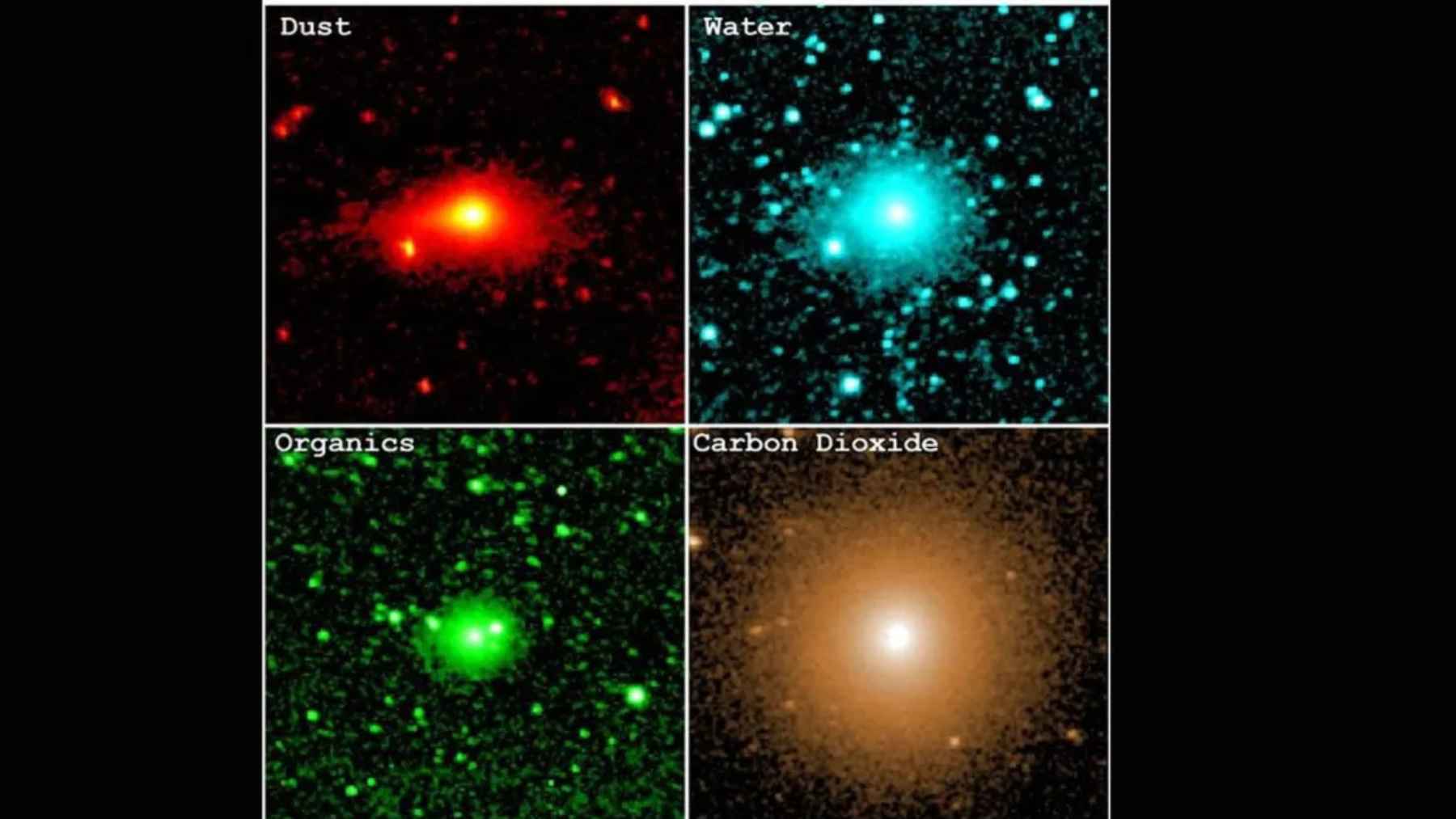
For planetary scientists and ecologists alike, this is a striking reminder that water and the basic ingredients for chemistry of life are not limited to our own solar system. Additional observations by the SPHEREx mission revealed organic molecules such as methanol and methane in the coma of 3I/ATLAS, again suggesting that thebuilding blocks for life are widespread in the galaxy.
On Earth we argue over reservoirs and shrinking glaciers. Out between the stars, icy boulders casually shed oceans worth of water while they cruise through deep space.
The hitchhiking idea
That abundance of ice is what inspired astrophysicist Avi Loeb to push a bold thought experiment. In a recent essay he suggested that water-rich interstellar objects like 3I/ATLAS could serve as natural vehicles for travel between star systems, either for advanced civilizations or for our own distant descendants.
The logic is simple in outline. If you can rendezvous gently with a fast comet that is already on a trajectory through the galaxy, you do not need to spend the enormous energy required to accelerate a starship from rest.
You could embed a technological payload inside the ice, then mine part of that ice for rocket fuel. Through electrolysis the water would be split into hydrogen and oxygen, which are the same propellants used in many of the most powerful chemical rockets.
In practical terms that would turn the comet into something like a naturally built interstellar stage. Small thrusters would not try to match the speed of light. They would only tweak the trajectory, steering the object toward planetary systems of interest and trimming its orbit much like a driver drifting a car into a highway exit rather than slamming on the brakes.
Loeb and colleagues also note that a civilization could hide its technology inside the dusty icy shell, so distant observers might mistake such a vehicle for an ordinary comet. They speculate about possible telltale signs such as unusual heat sources, symmetric jets or small probes separating from the main body.
For readers used to worrying about the electric bill or gas prices, it may sound like pure science fiction. Yet the underlying tools energy from fusion or advanced solar power, artificial intelligence to pilot an automated outpost, in situ use of water for hydrogen fuel are all extensions of technologies scientists already discuss for sustainable exploration of the Moon and Mars.
Natural comet, not alien craft
It is important to separate this kind of forward-looking engineering thought from claims that 3I/ATLAS itself is already a disguised spacecraft. Some papers and essays have floated that possibility and listed a series of statistical or geometric anomalies.
However, detailed analyses by independent teams show that the comet’s orbit, brightness and chemistry can be explained within the range of behavior expected for an unusual but natural interstellar comet.
A recent update from NASA and other groups underscores that observations so far are consistent with a natural icy body, not with an alien machine under active control. In other words, most experts see 3I/ATLAS as a valuable scientific messenger rather than a visiting starship.
Why ecologists care about a comet
So where does all this connect back to life and the environment? Interstellar comets like 3I/ATLAS probably formed around other stars, then were kicked out during the early, chaotic stages of planet building.
Their ices preserve a frozen record of those alien environments. The surprising mix of water, carbon dioxide and complex organics in this comet hints that many planetary systems may have access to rich chemical inventories for oceans and atmospheres.
On the young Earth objects like this may have helped deliver part of our planet’s water and some of the organic material that later fed biology. Studying 3I/ATLAS is therefore not just a curiosity about a distant snowball. It is a way to test how typical our own blue world really is, and whether habitable environments such as oceans, soils and air might emerge on countless other planets.
The hitchhiking concept also resonates with a broader sustainability mindset. Instead of building ever larger hardware from scratch, future explorers could reuse natural structures, tap local resources such as ice and rely on efficient fuels like hydrogen. The same principles show up at home when we talk about recycling, circular economies and cleaner energy systems.
Whether or not anyone ever rides an interstellar comet, 3I/ATLAS is already reshaping how scientists think about water, life and travel on the largest scales we can imagine.
The study was published on arXiv.