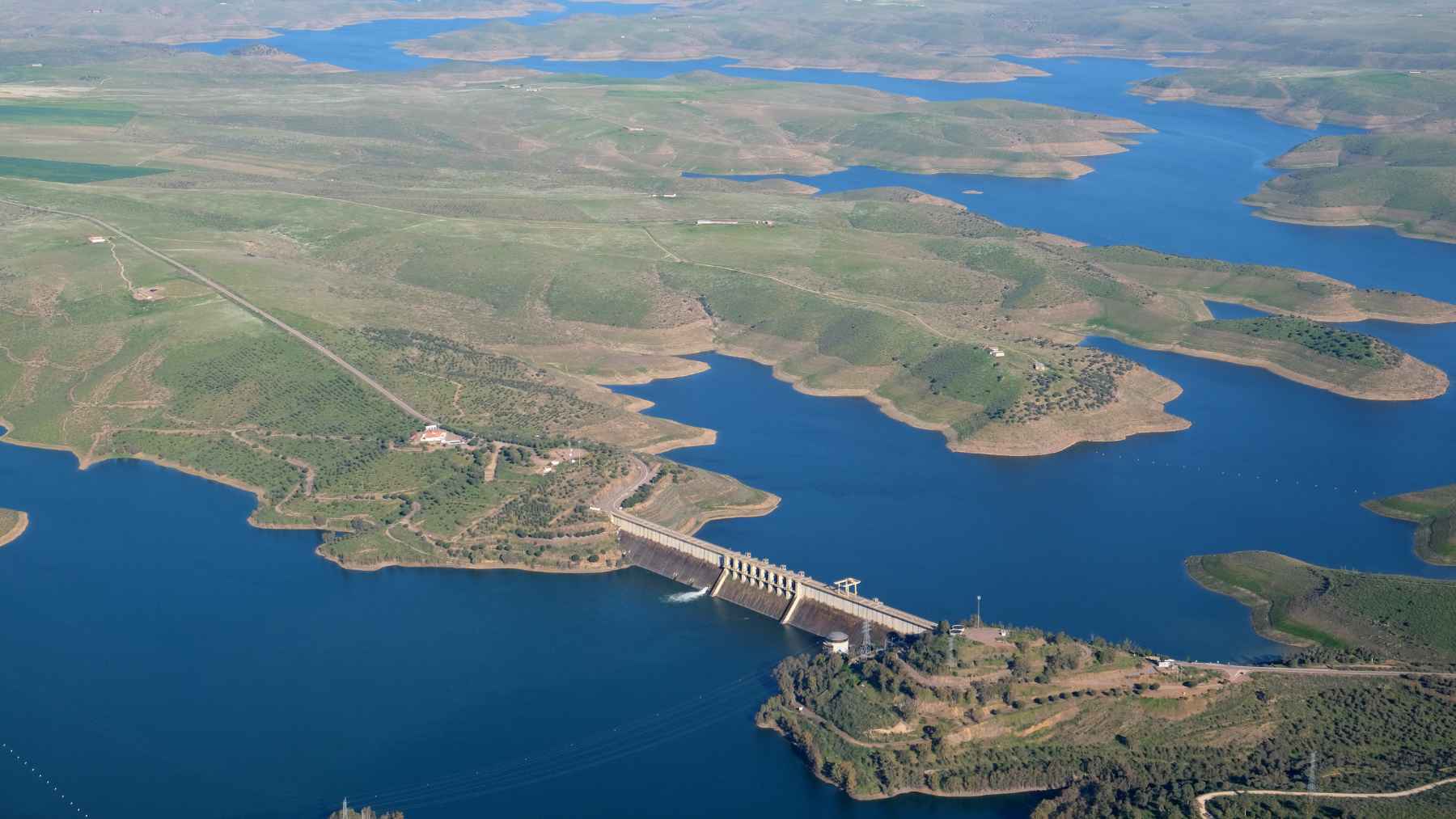
The biggest reservoir in Spain has done something it almost never does. After weeks of powerful Atlantic storms, the La Serena reservoir has opened four of its floodgates, sending part of its stored water on a controlled journey downstream.
Managed by the Confederación Hidrográfica del Guadiana, the release began around midday on Monday, February 9, once the reservoir reached about 92 percent of its capacity. At that point La Serena held roughly 2,981 cubic hectometers of water, so technicians authorized an internal transfer toward the nearby Zújar reservoir at a rate close to 180 cubic meters each second.
Officials describe the move as a safety measure that creates room for more rain while keeping river levels under control.
Why La Serena matters for Spain’s water
La Serena is not just another dam in western Extremadura. With a maximum capacity of about 3,219 cubic hectometers, it is the largest reservoir in the country and the third largest in Europe, only behind Portugal’s Alqueva reservoir and Greece’s Kremasta reservoir.
Spread over nearly 14,000 hectares, the reservoir regulates the flow of the Guadiana River and secures water for irrigation, towns and hydropower across a large part of inland southwestern Spain. That huge volume helps smooth out dry years and shields communities from sudden floods when heavy rain hits.
Only a year ago, La Serena was a symbol of drought rather than abundance. In early 2025 it sat below half of its capacity, around 48.8 percent, despite several winter storms that had already passed over the Iberian Peninsula.
At the end of the day, this swing from worry over empty banks to concern about an overflowing giant shows how quickly the water story can flip.
A rare opening in 35 years of service
Since it was completed in the late 1980s and formally inaugurated in 1990, La Serena has almost never needed to open its floodgates. Records from the basin authority and regional media show only three previous episodes, in 1997, 2013 and 2014.
This winter’s maneuver is the fourth in roughly 35 years of operation, which underlines how exceptional the current situation is. As the latest storms pushed the reservoir toward its maximum level, engineers chose a gradual, planned release rather than waiting for water to spill automatically over the safety structures.
For people living nearby, the roar of water rushing through the gates is both impressive and unsettling. Many still remember earlier openings and the years of flooding or road closures that followed in some low-lying areas.
An internal transfer to the Zújar reservoir
The water now leaving La Serena is not being dumped straight into the open river. Instead, it is flowing into the Zújar reservoir, a dam completed in 1964 that today acts as a counter reservoir in the same Guadiana system. After La Serena was built inside its basin, Zújar’s capacity settled at about 309 cubic hectometers, giving managers extra room to juggle volumes between both structures.
The Guadiana authority calls this an “internal release” because, for now, the operation stays within the Serena Zújar complex. Even so, Zújar has also increased its own discharges, which has already led to precautionary traffic cuts at places like the low water crossing near Entrerríos as river levels rise
Downstream towns such as Mérida have received red alerts that warn of possible surges in the Guadiana and its tributaries. Authorities urge residents to stay away from riverbanks and footpaths close to the water, since flows can change quickly while reservoirs continue to adjust their releases.
Storms, floods and everyday life downstream
The opening of La Serena’s gates is tied directly to the storms that have swept the peninsula in recent weeks. Successive systems brought intense rain that caused floods and evacuations in parts of Andalusia, especially in the province of Cádiz and mountain towns such as Grazalema and Ubrique. For many families, that meant wet basements, disrupted commutes and a nervous eye on local rivers.
To a large extent, big reservoirs are built to absorb exactly this kind of shock. Spain has more than 370 dams that together can store around 56,000 cubic hectometers of water, with another giant, the Alcántara reservoir, close behind La Serena in capacity. When storms line up back to back, though, even this network needs careful, almost daily fine tuning.
For people far from the dam, these decisions show up in quieter ways, from possible changes in irrigation schedules to the long-term stability of tap water supplies and even future electric bills. Experts say episodes like this one fit a pattern where long droughts are followed by short, intense bursts of rain, which makes smart use of every reservoir even more important.
The main official information has been published by the Confederación Hidrográfica del Guadiana.