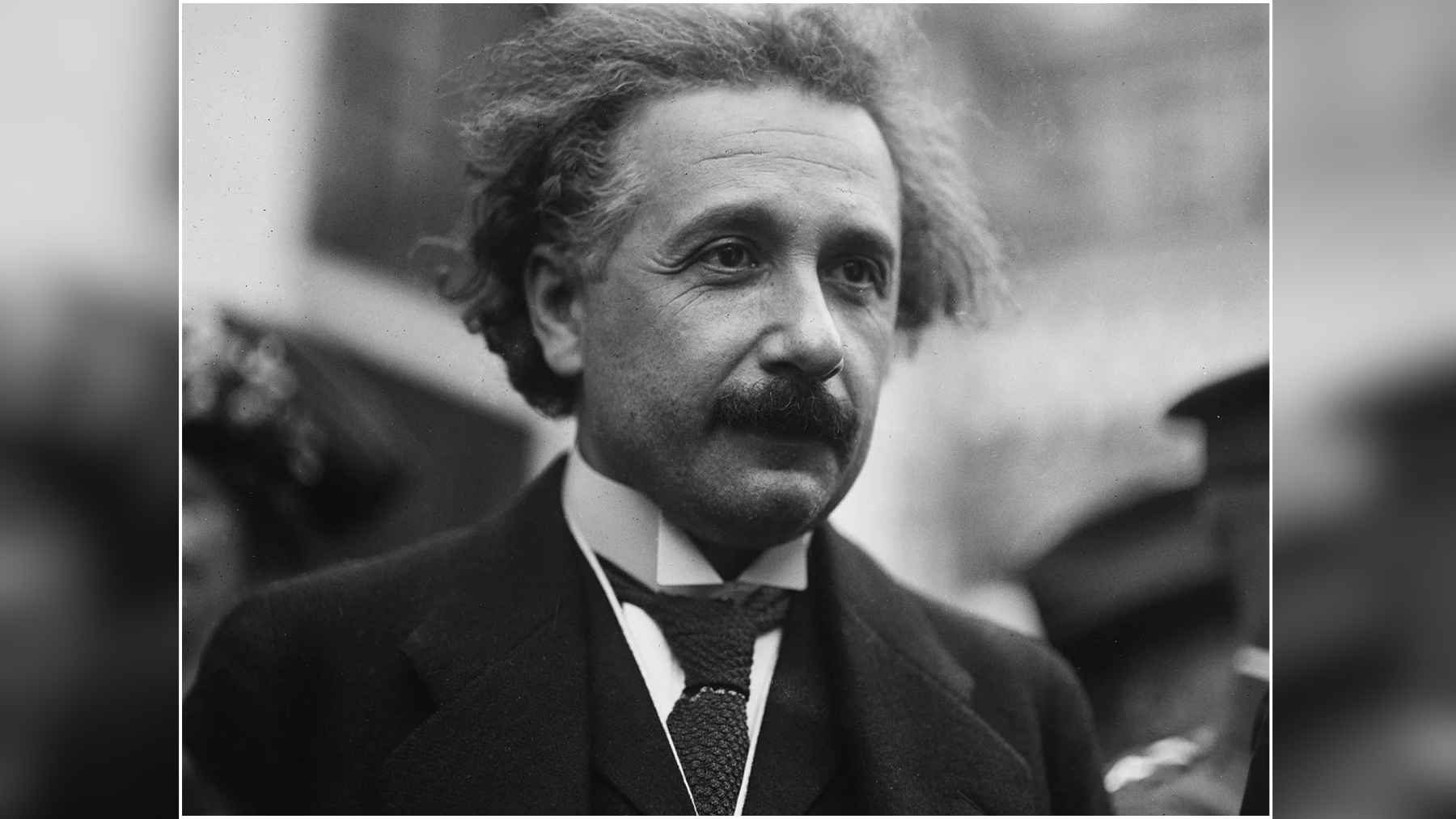
A century ago, Albert Einstein predicted that massive objects that orbit each other would send tiny ripples through space itself and slowly spiral together. Now astronomers are watching that process unfold, step by step, in a pair of dying stars about 4,000 light years from Earth.
Their slow-motion collision is not just cosmic drama. It is giving scientists one of the clearest chances yet to check whether the universe really behaves the way Einstein’s equations say it should.
A death spiral only 4,000 light years away
The system is known as ZTFJ2130. It sits in our own Milky Way and contains two stellar remnants locked in a tight embrace. One star is a white dwarf, the dense core left behind when a sunlike star sheds its outer layers. The other is a hot subdwarf, a compact, helium-rich star nearing the end of its life.
They are so close that they whirl around each other in just over 39 minutes. For comparison, many of us spend more time than those stuck in traffic on the way home. The gravity between them has stretched the subdwarf out of shape, and material from its surface is already spilling toward the white dwarf neighbor.
At first glance it sounds like a distant curiosity. But this short orbit and intense gravity are exactly what turn ZTFJ2130 into a natural laboratory for fundamental physics.
Einstein’s ripples in space, measured by a tiny time shift
When massive objects orbit quickly, they are expected to emit gravitational waves, very small vibrations in the fabric of space. Those waves carry away energy. In practical terms, that means the orbit should shrink a little every year and the time the stars take to complete a lap should get ever so slightly shorter.
A team led by researchers working with telescopes at Hamburg Observatory in Germany and the Calar Alto Observatory in Spain decided to see whether they could actually track that change.
Using ultrafast cameras on modest one-meter-class telescopes, they repeatedly watched the system between August 2024 and September 2025, timing the brightness variations that mark each orbit. When they compared all those observations, they found that the orbital period is shrinking by about two trillionths of a second every second.
That sounds ridiculously small. It is far less than the time it takes to blink. Yet the team measured this change with about two percent precision. Their result lines up almost perfectly with the value predicted if gravitational waves are the only thing draining energy from the system. In other words, within the current error bars, Einstein’s theory still holds up.
From small telescopes to future space antennas
ZTFJ2130 is part of a growing family of ultracompact binaries that constantly hum with low-frequency gravitational waves. These systems are too quiet for observatories such as LIGO, which listen for short, loud bursts from colliding black holes and neutron stars. Instead, they will be prime targets forLaser Interferometer Space Antenna (LISA), a planned space-based detector that will listen to the gentle background of waves throughout the galaxy.
In the new analysis, the team modeled how ZTFJ2130 will appear in LISA data and found that the mission should be able to measure a key property known as the chirp mass with about five percent precision. That parameter essentially tells scientists how the total mass of the system drives the speed of its orbital decay.
If future space-based measurements ever disagree with today’s telescope timing in a clear way, it could hint that something besides clean gravitational wave emission is at work, for example extra effects from accretion or even new physics beyond general relativity. For now, everything fits the textbook picture, but astronomers are keen to keep checking.
What happens when the stars finally meet
So where is this all heading? According to earlier detailed models, the hot subdwarf will eventually turn into a white dwarf, and the two stellar cores will merge in roughly 17 million years. On cosmic timescales that counts as soon, although it is obviously not something that will threaten life on Earth any time in our species’ future.
When the merger finally happens, the system may explode as a thermonuclear supernova or leave behind a single massive white dwarf. Either outcome would help scientists better understand where some types of supernovae come from. Those explosions are used as distance markers in cosmology, so pinning down their origins feeds back into how we measure the expansion of the universe.
Why this distant drama matters at home
It can feel hard to connect two faint stars thousands of light years away with everyday concerns like the electric bill or the next heat wave. Yet the same theory that explains ZTFJ2130 also underpins GPS satellites, climate monitoring from orbit, and the precise timing used in modern communications. If gravity worked even slightly differently, our technologies and our models of Earth’s environment would need serious revision.
By tracking a time shift of just a few trillionths of a second per second, astronomers have turned ZTFJ2130 into a kind of cosmic reference clock. It supports the idea that general relativity still describes gravity accurately, even in some of the most extreme stellar systems we can observe.
At the end of the day, that makes this obscure pair of stars surprisingly important. They are quietly confirming that the same laws of physics that govern a high-speed binary orbit also shape the larger universe we all live in.
The study was published on arXiv.