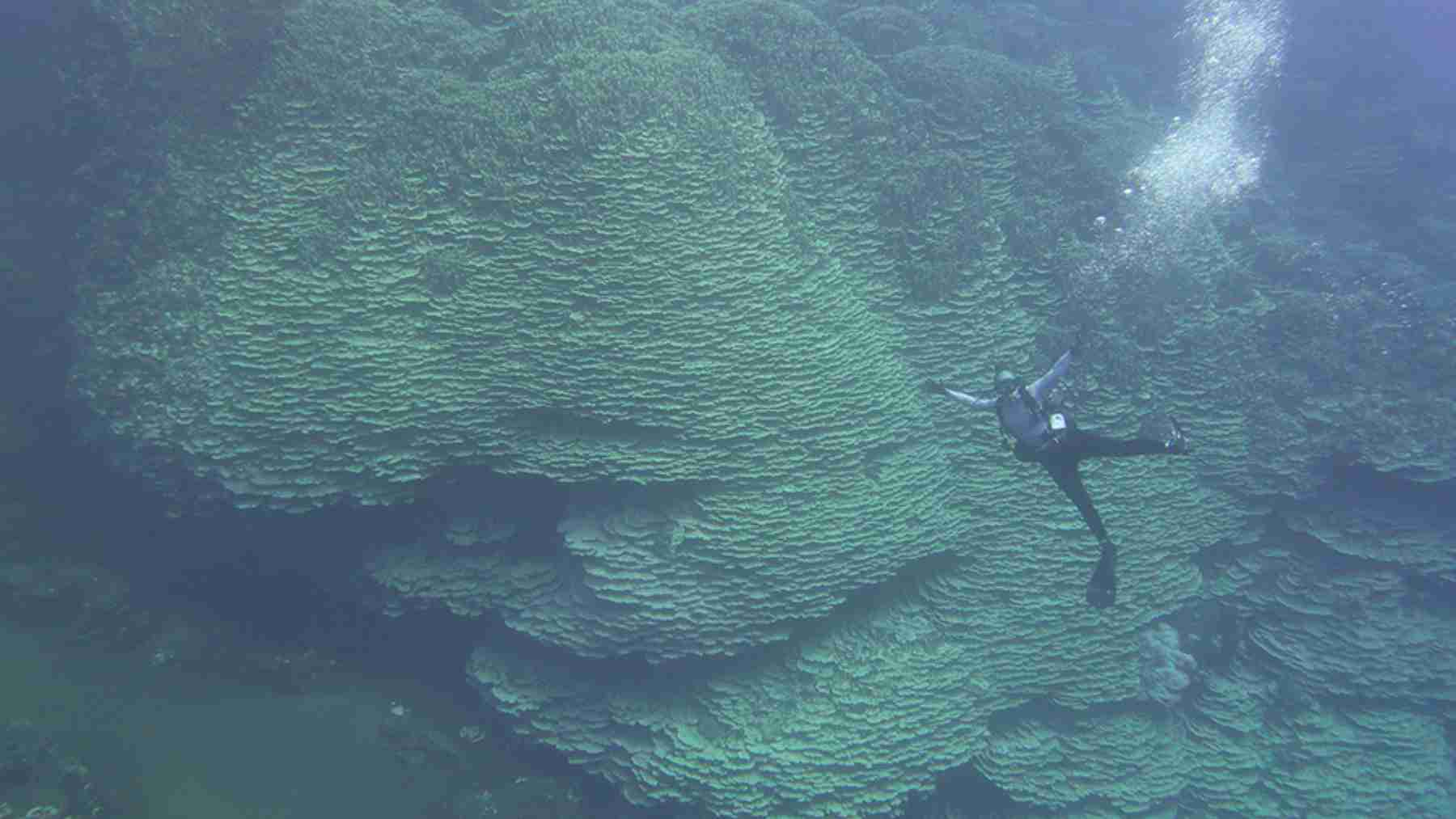
NOAA researchers working in the Mariana Islands have measured a colossal stony coral inside the crater of an underwater volcano, and it may be more than 2,000 years old. Built by colonies of Porites rus, the formation covers roughly 14,500 square feet and spans about 200 feet across at its base, making it the largest Porites coral ever reported.
The headline number is jaw dropping, but the setting is the real twist. The coral sits in the Maug caldera, where carbon dioxide vents create naturally acidic seawater nearby, offering a rare look at how reef life might respond as oceans absorb more CO2. What can a 2,000-year survivor tell us about the reefs we may lose in our own lifetime?
A record-setting coral in the Mariana Islands
People in the area had known about the giant coral for years, but NOAA scientists only recently took the first approximate measurements during the 2025 National Coral Reef Monitoring Program surveys. “This coral was so big, we actually couldn’t easily measure it due to dive safety restrictions,” said Thomas Oliver, a chief scientist with the program.
Measurements suggest the colony stretches more than 100 feet across at the top and covers about 14,500 square feet, which is roughly the size of three pro basketball courts. NOAA says it is about 3.4 times larger than the massive Porites colony documented in American Samoa in 2020, which helps explain why researchers are calling this a standout find.
How old can a coral get
Dating this coral is tricky because it does not leave clear growth bands. Hannah Barkley, a chief scientist with NOAA’s monitoring program, said “it is difficult to tell the true age of this coral because it doesn’t produce growth bands like other corals.”
Instead, the team uses a rough outward growth estimate of about four tenths of an inch per year, and NOAA says the colony could be more than 2,050 years old. It is an estimate, not a final number, but it still hints at something rare, a reef builder that has persisted long enough to preserve century-scale clues about changing ocean conditions.
The surprise is where it lives
The Maug Islands are an uninhabited volcanic group in the Commonwealth of the Northern Mariana Islands about 450 miles north of Guam. During earlier NOAA expeditions, researchers described carbon dioxide bubbling from vents so constantly that it felt like “swimming in a glass of champagne.”
NOAA calls the caldera a “natural laboratory” because the vents create acidic conditions within only a few yards of the source. Barkley said it is “remarkable” to see “a resilient and thriving mega coral, and a dead zone near the carbon dioxide vents” in the same area, with the giant coral thriving a few hundred yards away.
That close-range contrast lets scientists compare reef communities under elevated CO2 with those nearby in more typical seawater. NOAA researchers have said Maug is a unique in-the-water lab in U.S. waters, and that rising carbon dioxide in seawater makes it harder for corals to build skeletons.
A bright spot against a tough global backdrop
The discovery lands at a tense moment for reefs because heat stress can drive bleaching and mass die-offs. NOAA reports that the third global bleaching event from 2014 to 2017 brought bleaching-level heat stress to more than 75 percent of global reefs, and nearly 30 percent faced mortality-level stress.
So this “megacoral” is a clue, not a promise, since reefs can still be declining even when a few extraordinary colonies survive. NOAA’s monitoring work in the Marianas is described as a routine ocean health check, and it has also pointed to major losses, including findings that suggest about half of the region’s coral has been lost over the past two decades.
What this giant coral could teach us next
The discovery raises practical questions that matter for conservation, such as what makes this coral so resilient and how far that resilience goes. Pinning down its exact age would take more detailed work than surface measurements, and NOAA scientists have used instruments and coral core samples at Maug in past studies to track chemistry and growth over time.
Protection is part of the story too, since the coral sits inside the Mariana Trench Marine National Monument, established in 2009, and NOAA says an advisory council is working on a culturally appropriate name that honors Indigenous Chamorro and Carolinian heritage. Healthy reefs also protect everyday life along coasts, and NOAA estimates coral reef services in the United States are worth over $3.4 billion each year and can absorb up to 97 percent of a wave’s energy.
Maug has drawn researchers for decades, with NOAA noting work there that includes seafloor mapping in 2003, ocean chemistry studies in 2014, and monitoring visits in 2017, 2022, and 2025.
The official statement was published on ‘NOAA’s National Ocean Service’.