On December 22, 2032, a building-sized asteroid called 2024 YR4 has a small but very real chance of smashing into the Moon. If it does, the impact would release energy similar to several million tons of TNT, carve out a crater about a kilometer wide, and create a flash in the lunar night as bright as a planet for a few minutes.
Earth itself is safe, according to NASA, which has ruled out any impact on our planet for 2032 and beyond. Instead, the new studies focus on the Moon and on what happens to the debris that blast into space if 2024 YR4 hits.
That debris could trigger intense meteor storms around Earth and pose a temporary but serious risk to the satellites that keep our phones, maps, and streaming services running.
From city killer scare to lunar target
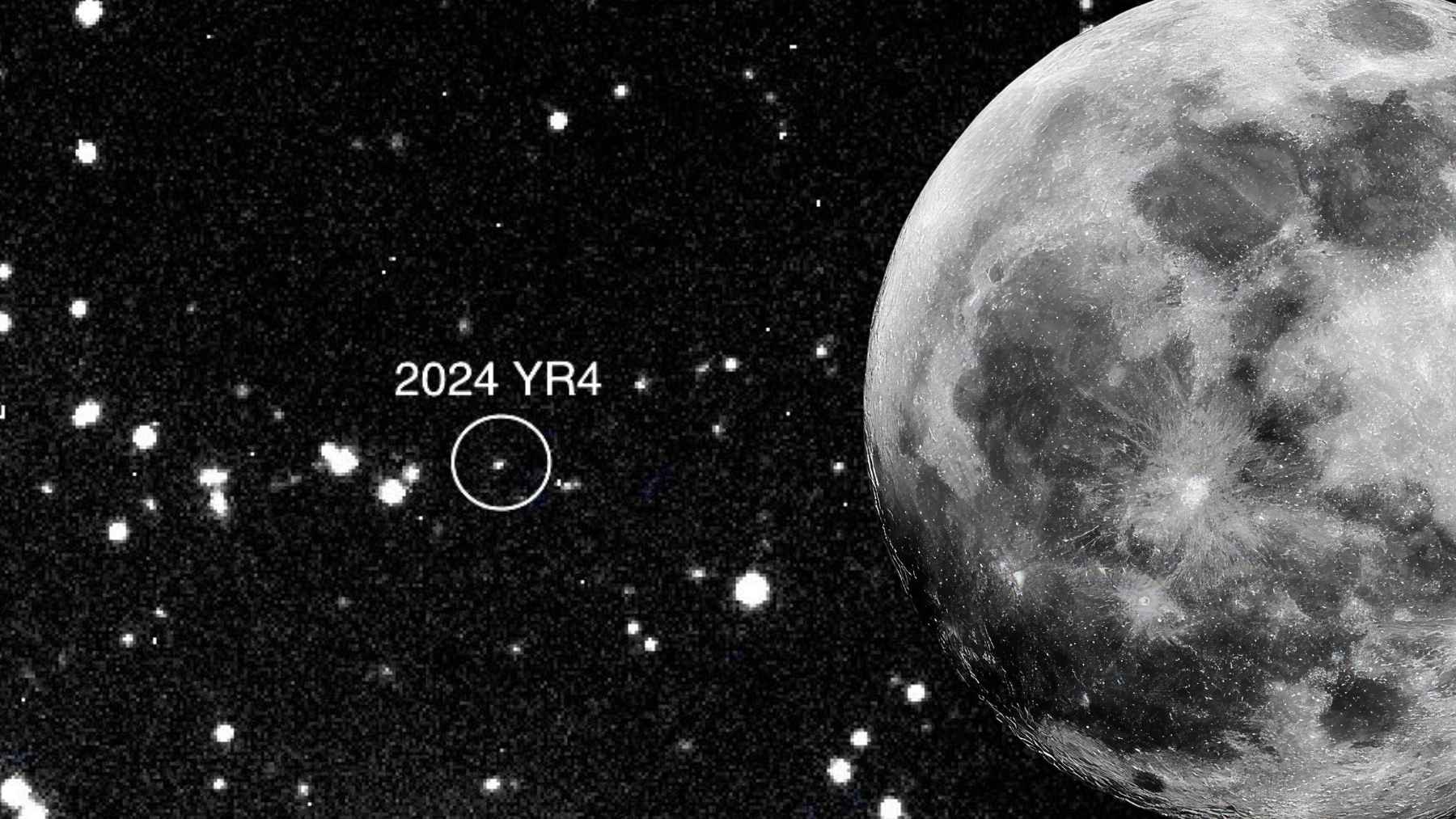
Asteroid 2024 YR4 is a near Earth asteroid about sixty meters across, roughly the height of a fifteen-story building. It was discovered on December 27, 2024, by the ATLAS survey in Chile and quickly flagged because early calculations gave it about a 3.1% chance of hitting Earth in 2032, the highest recorded impact probability for an object of this size.
Follow up observations with large ground telescopes and the James Webb Space Telescope refined its orbit and removed the danger to our planet. Today, scientists say 2024 YR4 poses no significant risk to Earth, but refined models show roughly a 4.3% chance that it could strike the Moon on the same date instead.
At that speed and size, the impact would release around six and a half megatons of energy and create a crater about one kilometer across, likely the most energetic lunar impact seen in human history.
A 2026 study led by Yifan He used ten thousand computer simulations to map where on the Moon the asteroid is most likely to hit. The team found a corridor about three thousand kilometers long, running along the southern half of the near side and passing just north of the famous Tycho crater.
A flash as bright as Venus in the night sky
If 2024 YR4 hits, the first thing people on Earth would notice is a sudden point of light on the Moon that brightens and fades over a few minutes. On the astronomical brightness scale, the flash is expected to reach between magnitude minus 2.5 and minus 3, similar to the way Venus looks when it blazes in the evening sky.
For a casual skywatcher, that means a brief, sharp sparkle on the lunar surface that stands out clearly from the background.
The best views would go to observers around the Pacific basin, including places like Hawaii and western North America, where the waning gibbous Moon will be high in a dark pre-dawn sky. In much of Europe and South America, the event would happen in daylight, so people there would need to rely on telescope networks and live data feeds rather than looking up over breakfast.
After the optical flash fades, molten rock in the new crater would keep glowing in infrared light for hours as it cools from temperatures near two thousand Kelvin to a few hundred. Telescopes sensitive to heat could watch the afterglow slide down that temperature curve, giving scientists a rare look at how fresh lunar lava cools and how the surface around the crater responds.
The Moon shakes, and space fills with fast-moving grit
The impact would not just light up the sky. Simulations predict a moonquake of roughly magnitude five, with seismic waves ringing through the whole Moon for tens of minutes.
Any modern seismometers placed by future Artemis missions or robotic landers would record a textbook example of how the lunar interior responds to a large impact, something geologists can only dream about right now.
At the same time, the collision would blast out roughly one hundred million kilograms of lunar rock into space. A study led by Paul Wiegert estimates that, in favorable cases, up to ten percent of that material could be pulled toward Earth within a few days, especially if the impact happens on the trailing side of the Moon along its orbit.
Seen from the ground, that debris would show up as extreme meteor storms, far stronger than normal meteor showers and lasting several days.
For satellites, those storms could feel more like flying through a sandblaster. Tiny fragments as small as a millimeter and up to a centimeter wide would race through near Earth space at several kilometers per second, fast enough to punch holes in spacecraft walls or damage exposed cables.
Wiegert and colleagues calculate that in the worst case, satellites could receive the equivalent of years or even a decade of typical meteoroid hits squeezed into a short window, a serious headache for operators of crowded constellations in low Earth orbit.
Lunar meteorites and mini asteroids on our doorstep
Not all of the debris would burn up as shooting stars. The impact simulations by He and co-authors show that chunky boulders blown off the Moon would break apart in Earth’s atmosphere, with a small fraction reaching the ground as meteorites.
In the most favorable configuration, they estimate about four hundred kilograms of lunar meteorites would fall in the first year, mainly along a diagonal belt that crosses South America, North Africa, and the Arabian Peninsula, regions where dry deserts make space rocks easier to find.
Some fragments would not fall at all, at least not quickly. Meter-scale boulders could remain in Earth’s neighborhood for decades, looping around our planet on elongated paths.
The study suggests that wide field surveys such as the Legacy Survey of Space and Time at the Vera C. Rubin Observatory could detect a few dozen of these “lunar origin mini asteroids” over the following century, giving astronomers an unexpected population of nearby targets to track and study.
For future museum visitors, that means some rocks in glass cases might come with an unusually precise label. Scientists would be able to say not only that a meteorite came from the Moon, but from a specific crater and a specific night in 2032 when the lunar surface briefly flared in the sky.
A rare natural experiment in planetary defense
For researchers, the real prize is the chance to watch every stage of a predictable impact from start to finish. Yifei Jiao, a postdoctoral scientist now working at the University of California, Santa Cruz, described the scenario to Live Science as “a rare natural experiment” and “a forecastable small body impact whose signatures could be scientifically rich and operationally relevant.”
His team’s work on the observation timeline lays out how telescopes, lunar orbiters, and seismometers could work together to squeeze as much information as possible from the event.
The broader planetary defense community is also paying close attention. Current strategy documents from NASA focus mainly on stopping objects that could hit Earth, but Wiegert’s group argues that the dangers clearly extend to the shared space between Earth and the Moon, where satellites, lunar bases, and future astronauts will all be exposed to impact debris.
In practical terms, that means rehearsing how to protect space hardware from short, intense bursts of natural “space junk,” not just planning how to deflect rare, planet-threatening rocks.
The odds are still on a quiet night, since a 4.3% impact probability means the most likely outcome is that 2024 YR4 misses the Moon entirely when it swings by in 2032.
Yet scientists will track it closely during a key observing window in 2028, because if the collision does happen, it will turn the Earth-Moon system into a one-time laboratory for understanding impacts and protecting the technology we now depend on every day.
The main study has been published on the arXiv preprint server.