Every glass of water on your table carries a mystery. For decades, scientists have argued over where Earth’s vast supply of water really came from. Comets and icy asteroids were the usual suspects. Now a new study suggests the real action may have happened deep inside the planet, in places no drill will ever reach.
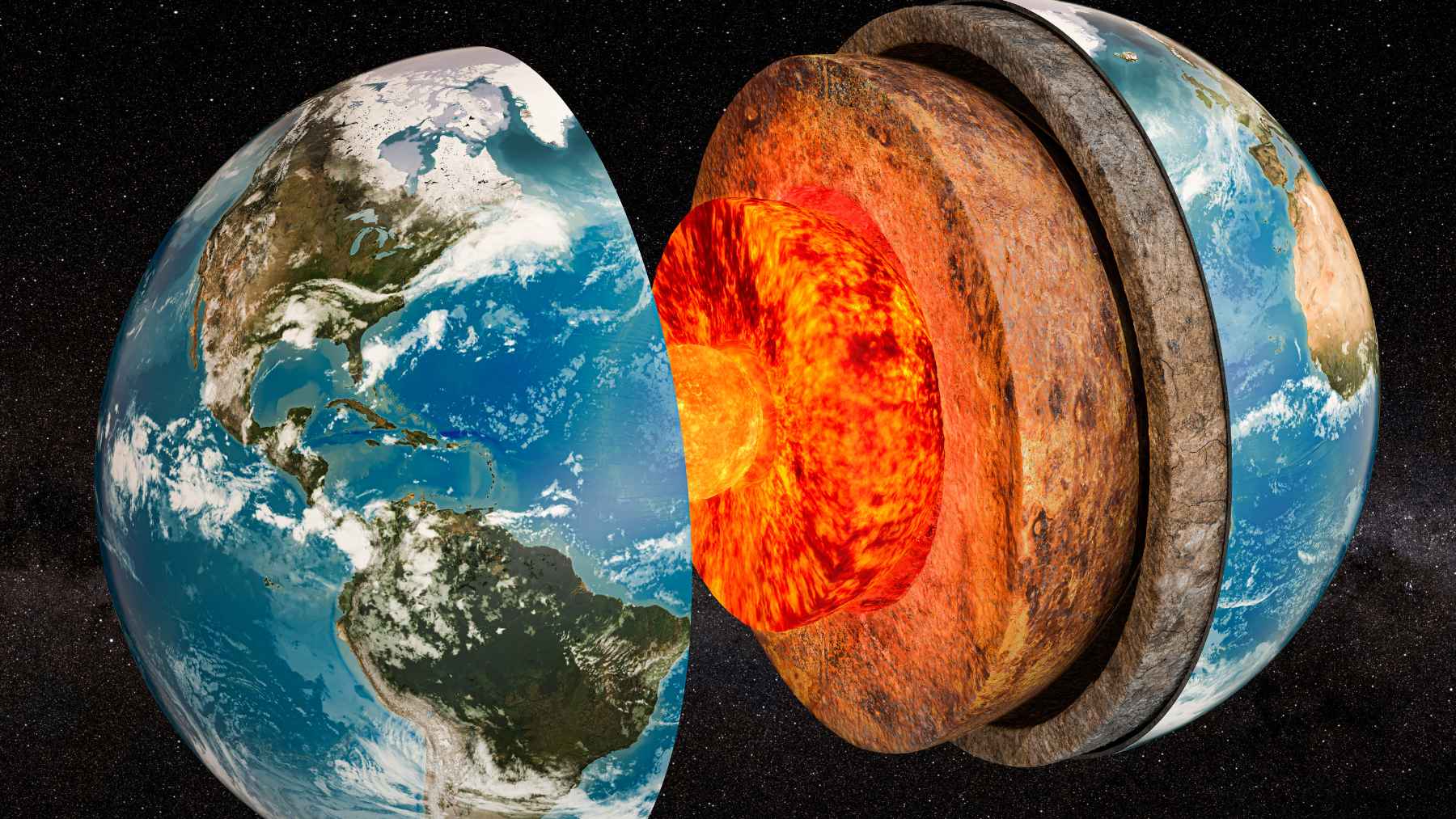
Researchers from Peking University and ETH Zurich have shown that Earth’s core may store between nine and forty five times more hydrogen than all the planet’s oceans combined. In the extreme heat and pressure more than three thousand kilometers below our feet, that hydrogen is locked inside metallic iron along with silicon and oxygen.
If it were to combine with oxygen as water, it would amount to dozens of “hidden oceans” buried at the center of the planet.
Simulating the center of the Earth
To probe this invisible reservoir, the team squeezed tiny samples of iron and hydrous silicate glass in diamond anvil cells, reaching pressures above one hundred gigapascals and temperatures above five thousand kelvin. Those conditions mimic the young Earth when a global magma ocean overlapped with a forming metallic core.
After the samples melted and then cooled, scientists used atom probe tomography to map individual atoms in three dimensions. They found nanoscale structures rich in silicon, oxygen, and hydrogen embedded inside the iron.
The ratio of hydrogen to silicon was close to one to one. Since the silicon content of the core is already constrained, that ratio let the team estimate that hydrogen makes up about 0.07 to 0.36 percent of the core’s mass, enough to rival or exceed the oceans at the surface.
A new story for Earth’s water
If so much hydrogen sank into the core while Earth was still forming, then a large share of our water likely arrived early, as the planet grew from dust, rocks, and planetary embryos orbiting the young Sun. That picture sits awkwardly with the older idea that most water showed up later, delivered by icy comets that slammed into a finished planet.
In practical terms, this deep store of hydrogen will not solve any droughts or lower anyone’s water bill. It is far beyond reach. What it does offer is a powerful clue about how habitable worlds assemble, both here and around other stars. If Earth could build up water from within, rocky exoplanets with similar building blocks might do the same.
Big implications, and big uncertainties
The authors stress that their numbers carry real uncertainties. Measuring hydrogen under such extreme conditions is notoriously difficult, and other studies hint the core might hold even more of the element. Yet, for the most part, different lines of evidence now point to a planet that is “wetter” on the inside than we ever imagined.
At the end of the day, that buried hydrogen links the quiet drip of a kitchen faucet with violent processes in Earth’s deep past, when a molten world was still deciding how much water life would get to work with.
The study was published in Nature Communications.