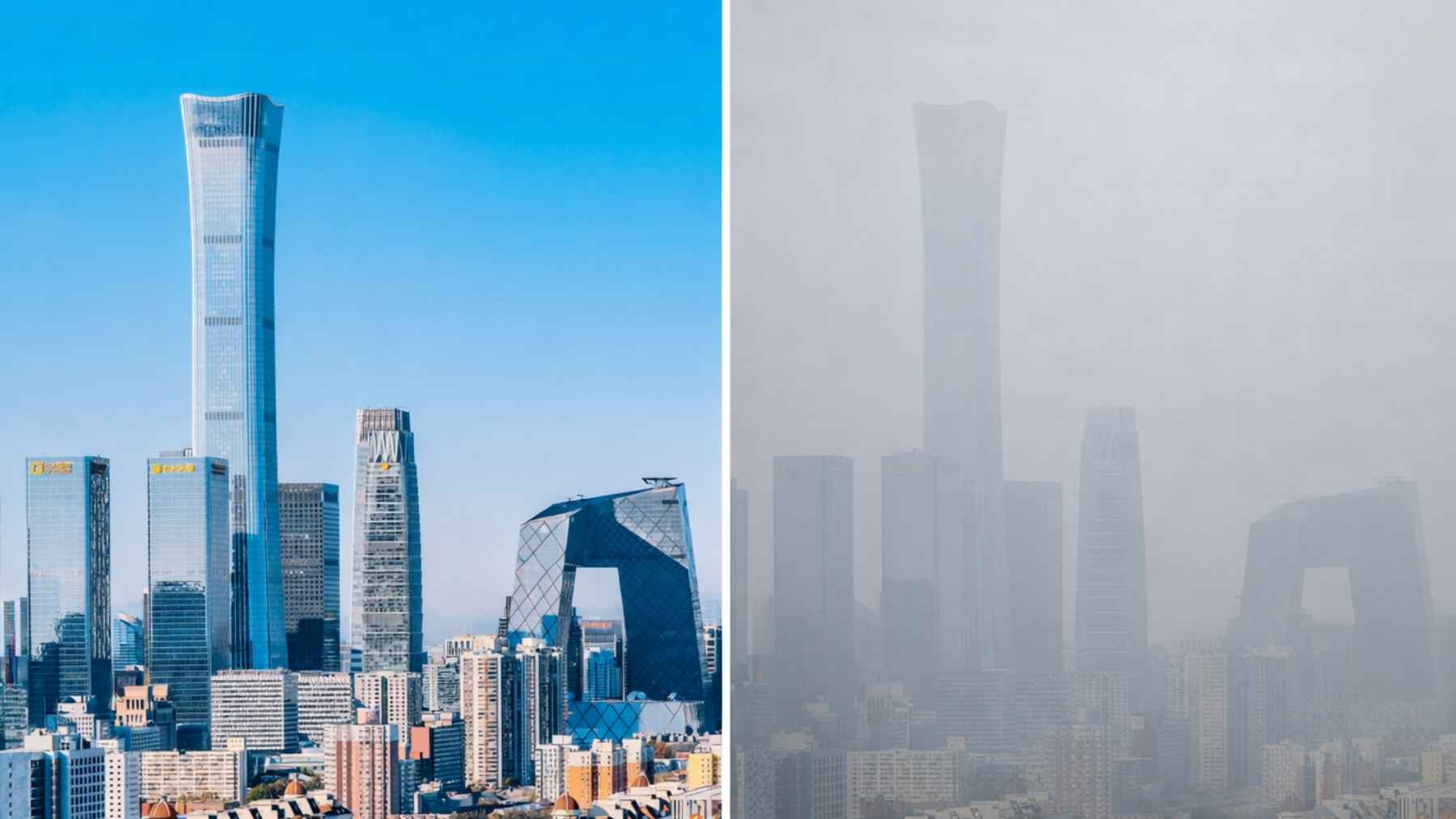
Beijing’s annual average PM2.5 fell to 27 µg/m³ in 2025, the lowest since monitoring began, and the city logged only one day of heavy pollution. Residents also saw 311 days of good or moderate air quality, a record high that would have sounded impossible back when smog regularly blurred the skyline.
The numbers come from official reporting tied to the city’s 2025 environmental review, and they show a real, measurable shift in what people breathe every day.
But here’s the twist. Just as Beijing gets a grip on soot and tailpipe pollution, researchers are detecting a new kind of urban haze: a cloud of microplastics and nanoplastics that floats above big cities and may travel farther than anyone expected. Beijing’s progress is worth studying, but it also highlights a bigger truth: “clean air” is no longer a single problem with a single solution.
A 12-year slide downward in dirty air
The city’s turnaround starts in 2013, when PM2.5 levels averaged 89.5 µg/m³ and public pressure intensified around health risks and visibility-crushing smog. By 2025, that annual average had dropped to 27 µg/m³, a fall of about 70 percent in just over a decade. It is the first time Beijing has crossed below the 30 µg/m³ threshold used in China’s own standards.
The improvement is not just in averages. In 2025, good or moderate days rose to 311, while severe pollution episodes nearly vanished, with only one “heavy pollution” day recorded by the national air quality index. That kind of change matters in everyday life, from kids’ recess to whether people feel safe jogging after work.
Beijing’s latest ecological report also points to broad declines in other pollutants, including PM10 and nitrogen dioxide, while ozone remains a stubborn seasonal issue.
That’s a useful reminder that air quality is a moving target, and cities often end up playing whack-a-mole with different pollutants depending on weather and emissions sources.
Health gains are real, but the bar is still higher
PM2.5 is a health red flag because these tiny particles can reach deep into the lungs and even enter the bloodstream. So yes, fewer “stay inside” days is a big win, especially for older adults and anyone with asthma or heart disease. But Beijing is still well above global health benchmarks.
The World Health Organization’s 2021 guideline recommends 5 µg/m³ as the annual target, and the U.S. annual standard is 9 µg/m³. Beijing’s 27 µg/m³ is far better than it used to be, but it still represents a level of long-term exposure that public health experts would like to see fall further.
The policy mix that moved the needle
Beijing’s progress did not come from a single “silver bullet.” Authorities steadily tightened industrial emissions, phased out older vehicles, and pushed new cars toward cleaner standards comparable to Euro 6. They also used traffic controls like odd-even plate restrictions during bad episodes, which is inconvenient, but it does cut pollution fast when the air turns dangerous.
Just as important, the city expanded public transit and nudged people away from private cars for daily trips. In practical terms, that means fewer tailpipes idling in traffic jams and less particulate pollution from the steady grind of stop-and-go driving. It’s not glamorous policy, but it shows up in the air monitors.
Electric mobility is helping, and the grid has to keep up
A big part of Beijing’s story is the rapid electrification of mobility, from buses and taxis to private cars. Beijing’s report highlights the push toward new energy vehicles in key sectors and a citywide buildout of charging points. That helps explain why pollution drops can accelerate once policies start rewarding cleaner choices on the street.
Still, the city does not get to pretend the problem is “solved” just because it moved somewhere else. If electricity is generated from dirty fuels, pollution can shift from the boulevard to the power plant, so the air story and the energy story stay linked. That is why cleaner grids and renewable growth matter just as much as cleaner cars.
National numbers show how quickly the supply side is growing. The China Association of Automobile Manufacturers reported about 16.5 million new energy vehicle sales in 2025, up from the year before, which helps explain how large cities can electrify at speed when they choose to.
A “plastic cloud” problem is coming into view
While Beijing’s air is getting cleaner in one sense, scientists are finding a new category of pollution in city air that traditional monitors barely track.
A 2026 Science Advances paper described a method that can detect plastic particles as small as 200 nanometers and reported airborne concentrations as high as 180,000 microplastics per cubic meter in Guangzhou. That is about 5,100 particles per cubic foot, which is a lot to picture in a single lungful.
The same study also measured nanoplastics and pointed to road-dust resuspension and wet deposition as major drivers, which means traffic does not just emit exhaust, it may also help churn plastic fragments back into the air.
We do not have all the answers yet, but it does mean “clean air” is no longer just a story about soot and sulfur, and cities may need to update what they measure as quickly as they update what they regulate.
What other cities should learn from Beijing
Beijing’s story suggests that steady policy plus tight measurement can change the trajectory of a megacity in about a decade. But the job is never “done,” especially as climate change intensifies heat, wildfire smoke, and ozone chemistry, and as new pollutants like airborne plastics enter the picture. A cleaner future will depend on keeping the pressure on the old sources while expanding the monitoring toolbox for the new ones.
At the end of the day, the most important lesson may be that air quality management is a marathon with a moving finish line. Beijing has shown that rapid progress is possible, but the next phase will require governments and scientists to keep asking hard questions about what is floating over our cities and what those particles are doing inside our bodies.
The official statement was published on Beijing Municipal Ecology and Environment Bureau.