What looks like a quiet green arc in northeastern China is, in fact, the mark of a violent collision from space.
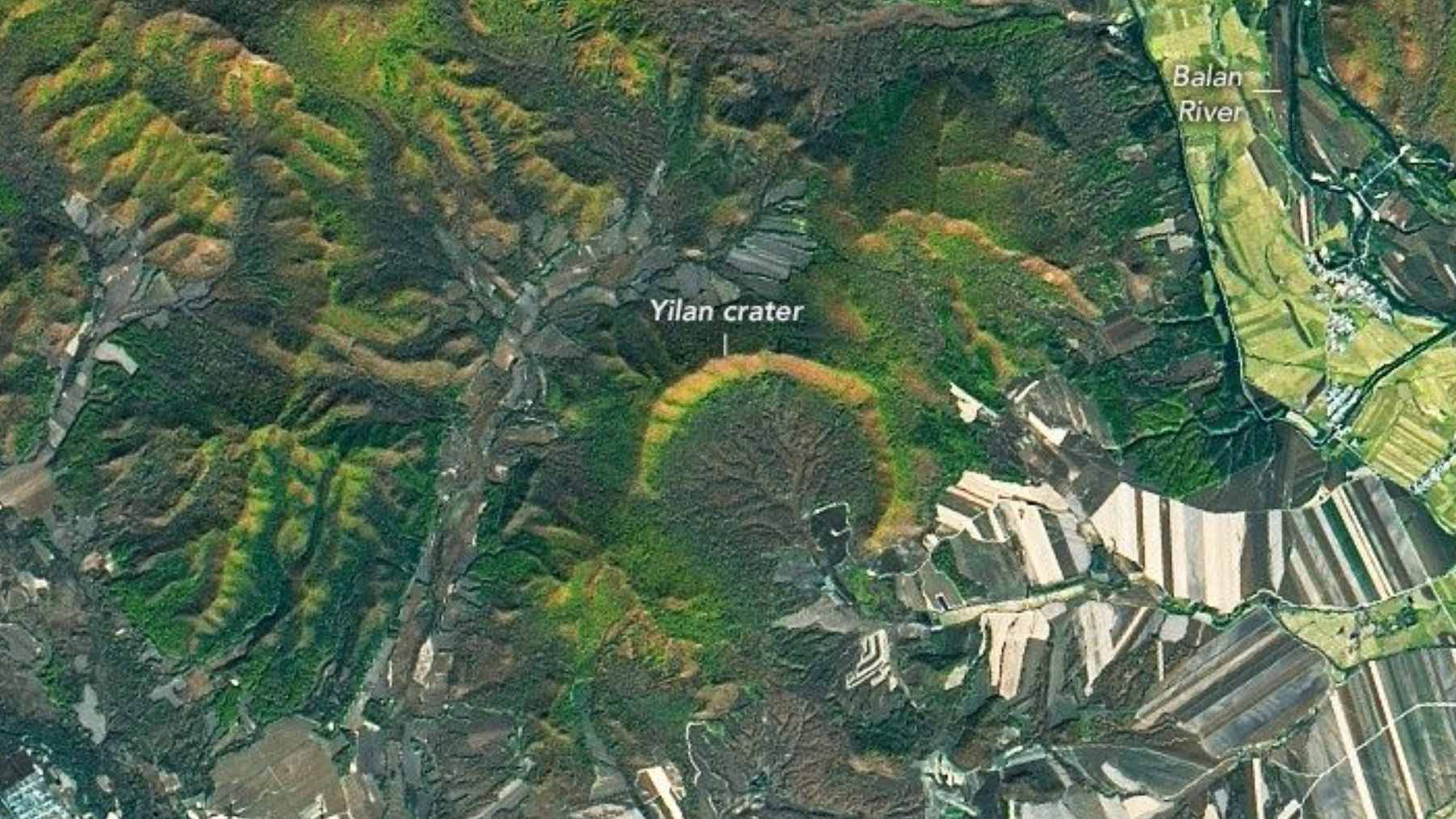
NASA’s Earth Observatory has highlighted the Yilan crater in Heilongjiang Province, a 1.85 kilometer wide (about 1.15-mile-wide) impact structure that scientists say formed between 46,000 and 53,000 years ago and now ranks as the largest known crater on Earth that is younger than 100,000 years.
That alone would make it remarkable. But the part that really grabs attention is this question. How did something this large stay hidden for so long beneath forest, wetlands, and farmland, with local people knowing it only as a strangely circular ridge rather than as a scar left by an asteroid strike?
A crater hidden in plain sight
The Yilan crater sits in the heavily forested Lesser Xing’an mountain range, where the landscape looks calm and ordinary from the ground. For years, local residents referred to the formation as “Quanshan,” or “circular mountain ridge,” which says a lot about how natural it seemed before geologists took a closer look.
A Landsat 8 image helped make the outline easier to read from above. The northern rim is still well preserved and rises about 150 meters (roughly 490 feet) above the crater floor, while the southern third of the rim is missing, giving the structure its distinctive horseshoe shape.
The proof came from deep below the forest floor
The real confirmation did not come from the satellite image alone. Researchers drilled about 438 meters into the center of the crater and found shocked quartz, melted granite, gas-bubble-rich glass, and tear-shaped glass fragments, the kind of materials that form only under extreme pressure and heat after a major impact.
Radiocarbon dating of charcoal and organic lake sediments placed the event between 46,000 and 53,000 years ago. In practical terms, that means Yilan is not just unusually young for a crater of this size, it is also larger than Arizona’s Barringer Crater, which is of a similar age but only about 1.2 kilometers across.
New research is revealing what the crater still holds
Scientists have not stopped with the first identification. A 2025 study in Communications Earth & Environment used 220 seismic nodes and several imaging methods to map what lies beneath the surface, revealing a bowl-shaped structure filled with loose sediments and impact-fractured rock.
That newer work also suggests the impact released around 1 × 10^17 joules of energy, which the authors say likely places Yilan among the most significant impact events. So while the forest did a good job hiding the crater from casual view, the ground underneath still carries the signature of an enormous blast.
A living landscape shaped by an ancient collision
There is an environmental angle here that makes the story even more interesting. NASA notes that the crater interior now includes swamps, forest wetlands, and farm fields, and the presence of lakebed sediments suggests the rim stayed intact long enough for a lake to form and leave behind thick deposits on the bottom.
That is why Yilan matters beyond astronomy. It shows how ecosystems can soften and mask the traces of ancient disasters, even while preserving them, and how satellite observation paired with field geology can uncover pieces of Earth’s history that are easy to miss in everyday landscapes.
By the current scientific count, only nearly 200 impact craters are documented worldwide, so each confirmed site adds an important chapter to the story of how our planet has changed over time.
Why Yilan could change how scientists search for craters
For the most part, impact craters are found where rock is bare and the shape is easier to recognize. Yilan is different because it shows that dense vegetation does not erase an impact feature – it just makes it harder to read until satellites, drilling, and subsurface imaging are brought together.
That is a useful reminder in a warming world where landscapes are constantly being watched from space.
The same tools used to track forests, wetlands, fires, and land use can also reveal much older stories, including the moment when a cosmic object slammed into what is now a quiet stretch of northeastern China and left behind a crater that hid in plain sight.
The most recent scientific study discussed here was published in Communications Earth & Environment.