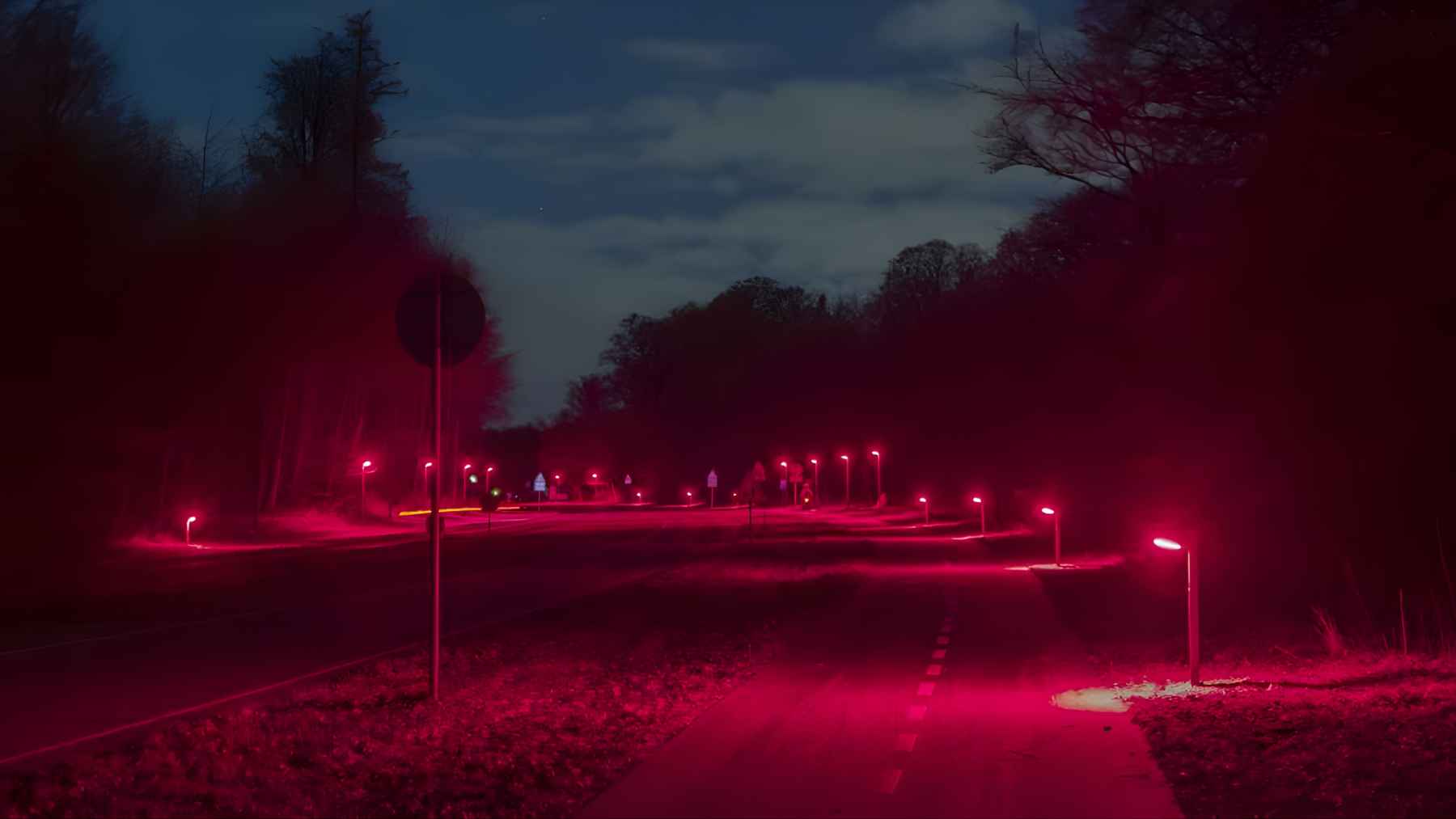
On February 8, 2026, drivers entering Gladsaxe, just outside Copenhagen, found part of a busy road washed in a deep red glow. Frederiksborgvej looked almost unreal, like someone had laid a red filter over the street.
It was not a light show or a one-night stunt. Why would a town turn a road red? The new streetlights are a targeted attempt to cut light pollution while keeping the road usable for people, especially in a spot where suburbia meets thick greenery.
A road that suddenly glows red
For motorists, the first impression is simple. The familiar bright white LED streetlights are gone, replaced by red LEDs that paint the pavement and nearby trees in the same steady color.
The change is concentrated near a known bat corridor, according to a local description of the bat colony and lighting upgrade. That targeted placement suggests this is about wildlife and safety, not decoration.
Light pollution, explained
Light pollution is artificial light spilling into the night. It brightens the sky, creates glare, and makes truly dark places harder to find.
For humans, it can mean harsher nights and worse sleep, because bright light can tug at the body’s internal clock. For animals that depend on darkness to feed and move, it can reshape where they can live, even if the buildings and trees stay the same.
Why bats are at the center of the decision
Bats are night hunters that rely on dark routes between where they rest and where they feed. Many species avoid bright open areas that make them easier targets, which is why a streetlight can act like a wall.
An official press release about the lighting work says seven bat species have been recorded near Frederiksborgvej. It also notes that none of those seven are listed as threatened, but some are considered more vulnerable to disruption from roads.
The same press release highlights two local bat species as especially at risk from road impacts, including the most common bat in the area. If the light becomes a barrier, their usable habitat can shrink, and the loss is easy to miss from behind a windshield.
How the “bat-friendly” lighting is engineered
The design is not just about swapping a bulb. A project description from the design team describes a roughly 0.4-mile stretch of Frederiksborgvej and a nearby cycle route using 30 low bollards about 3.3 feet tall, spaced about 100 feet apart.
That spacing is intentional. Instead of flooding the corridor with light, the system creates alternating pools of red light and darker gaps, which can help wildlife move through without being fully exposed.
The lighting designer Philip Jelvard from Light Bureau argues the color can work as a signal as well as a tool. He said the red light should make passersby aware “this is a special natural area which the municipality wishes to protect and preserve.”
What science says about red light
Streetlight color is really about wavelength, meaning the type of light our eyes register as different colors. White LEDs often contain more blue-rich light, and that shorter-wavelength light tends to scatter more, making the glow travel farther.
In 2017, a field experiment led by Kamiel Spoelstra at the Netherlands Institute of Ecology compared bat activity around lights with different colors. Spoelstra said “we’ve found these bats to be equally active in red light and in darkness,” while white and green light reduced activity for more light-sensitive species, according to the institute’s research summary.
The peer-reviewed paper describing the study also points to a practical twist. Brighter white and green lights can attract more insects, which may draw some bats in, but red light tends to attract fewer insects and can keep the night environment closer to normal.
A small stretch of road with big-city implications
The red segment is the attention-grabber, but it is tied to a wider upgrade. The press release says Gladsaxe is switching about 5,000 fixtures, working with Andel Lumen, and linking the work to the European Union-funded Lighting Metropolis – Green Mobility program, which also includes partners in Sweden.
A program overview says participants expected energy savings of at least 7.2 million kilowatt-hours, and it notes that only about one-fifth of municipal light sources had been converted to LED at the time of reporting. For cities, that energy angle is not abstract, because lighting hits budgets and maintenance, and it feeds into the climate numbers.
Urban growth is part of the pressure here. The United Nations Development Programme says 55% of the world’s population lived in cities in 2018 and projects continued growth, while cities account for 60 to 80% of energy consumption, according to its Sustainable Development Goal 11 data. A Danish Road Directorate guide commissioned from Hans J.
Baagøe and Julie Dahl Møller at the Natural History Museum of Denmark at the University of Copenhagen describes how roads can fragment bat habitat and lays out ways to reduce harm in planning and design, including lighting choices, in Flagermus og stoerre veje.
The main press release has been published by Gladsaxe Kommune.