The oldest clues about home life are not always found in grand tombs, giant monuments, or rare tools. Sometimes they are hidden in ash, crushed shells, and thin layers of dirt under an ancient floor.
A new study of Molino Casarotto, a Middle Neolithic settlement in northern Italy, suggests that people living there roughly 6,500 years ago had organized homes, regular cooking routines, cleaning habits, and planned places for trash.
In other words, long before vacuum cleaners, garbage bags, and the electric bill, people were already doing the basic work that keeps a household running.
A home beneath the soil
Molino Casarotto sits near the Fimon valley in the Veneto region of northeastern Italy. The site is especially valuable because it preserved layers linked to daily life, not just scattered objects left behind after a settlement disappeared.
The main study was carried out by Cristiano Nicosia, Federico Polisca, and Gregorio Dal Sasso, with work connected to the University of Padova and the National Research Council of Italy. The research was also part of the GEODAP project, funded by the European Research Council.
Reading dirt like a diary
The key method here is micromorphology, which sounds complicated but is fairly simple to explain. Researchers take undisturbed blocks of ancient soil, slice them into very thin sections, and study them under a microscope.
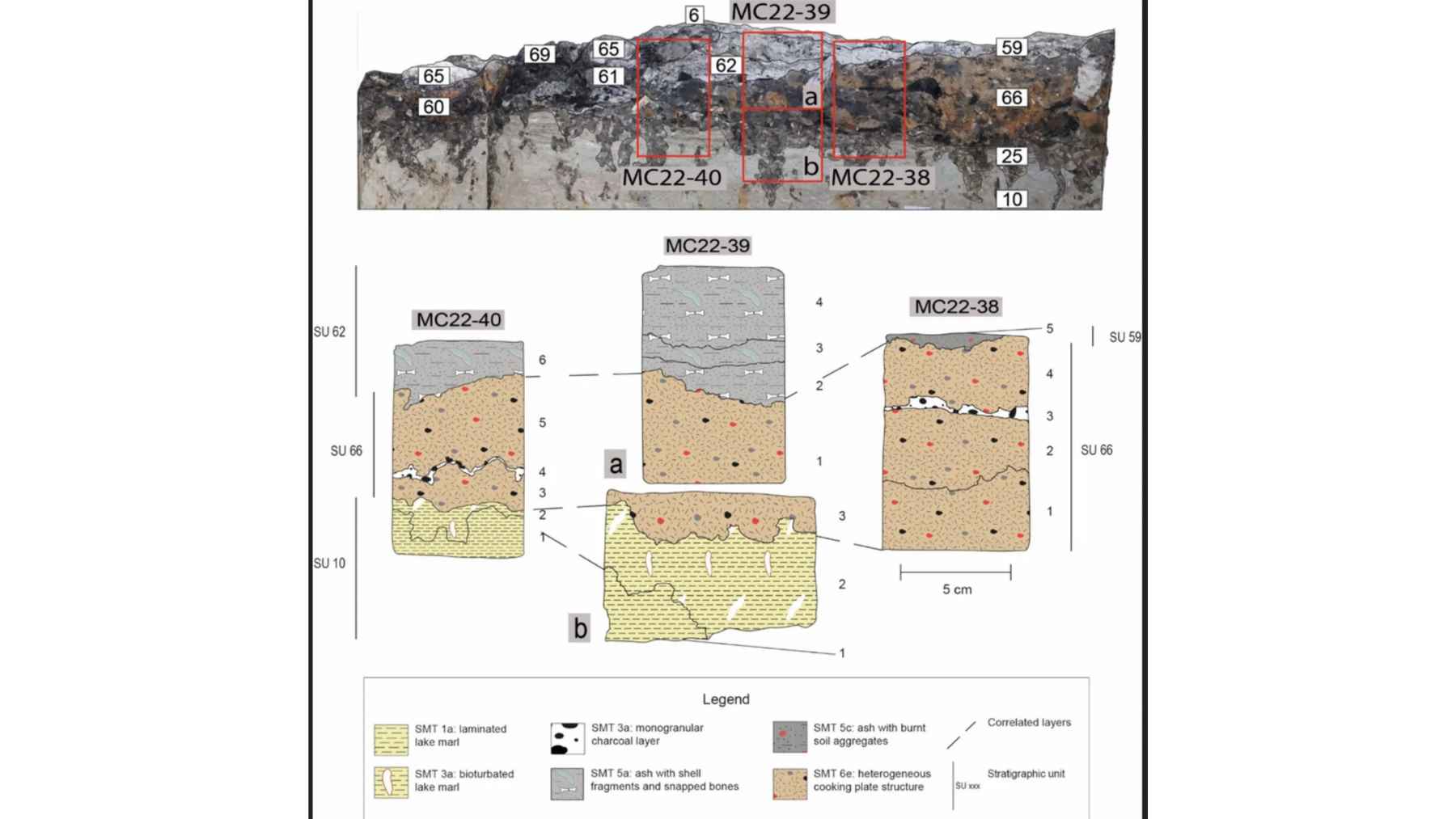
That microscope view can reveal details too small to see during a normal dig. Tiny ash layers, crushed shells, burned bone, fish remains, and compacted soil can show where people cooked, walked, cleaned, and dumped waste.
In practical terms, the floor became a diary. Not a written one, of course, but a record of repeated actions that built up slowly, day after day.
Cooking was organized
One of the clearest findings concerns cooking. The team identified built cooking surfaces, sometimes called cooking plates, along with ash, charcoal, heated stones, burned bones, shells, and fish traces.
One cooking plate found during the 2022 excavation was circular and measured about 3.6 feet across. It was surrounded by limestone blocks, which suggests the feature was not random but carefully arranged for repeated use.
What were they eating? The evidence points to meat, mollusks, and fish, with fish perhaps more important than earlier methods had shown. That matters because small fish bones can be easy to miss unless the soil is studied at a very fine scale.
Shellfish and hot stones
The study also looked closely at shells from the site. Many came from shell middens, which are piles of discarded shells and other remains left after meals.
The researchers found that some mollusks were probably boiled or roasted at low heat, possibly with heated stones. In plain language, people may have used hot rocks to cook food without burning it, a practical trick that would still make sense around a campfire today.
The shells from trash deposits did not show the same heavy heat damage as shells found inside ash layers. That difference suggests some shells were heated later, after they had already been thrown away and covered by new fires.
Cleaning kept homes usable
Here is where the story starts to feel familiar. The cooking areas were cleaned from time to time, although probably not every day.
The evidence comes from ash deposits, relighting traces, compacted layers, and removed fireplace material. Think of it as the Neolithic version of scraping out a grill, sweeping near the stove, and making sure the kitchen can still be used tomorrow.
The study also found signs of rapid and continuous sediment buildup in a protected or sheltered space. That points away from a place used only briefly and toward a more stable domestic setting where people kept returning to the same household routines.
Trash went somewhere
Taking out the trash may not sound like history, but it is one of the strongest signs of organized living. At Molino Casarotto, waste did not simply pile up in a chaotic mess inside the living area.
Instead, discarded shells, ash, charcoal, and food remains built up in specific deposits near the cooking zones. The location and structure of those layers suggest that people separated living spaces from discard spaces, much as families today keep trash away from where they sleep or prepare food.
A shell midden might look like a pile of old refuse, but to archaeologists it is much more than that. It can show what people ate, how they cooked it, and how they managed the mess that came afterward.
A year-round picture
The researchers also argue that Molino Casarotto was likely occupied throughout the year, not only during a short hunting or gathering season. Continuous sediment buildup helped support that idea.
That finding fits with related work on the site, which has pushed scholars to rethink Neolithic life in northern Italy. A 2025 Scientific Reportsstudy described Molino Casarotto as part of a more flexible world, where farming, herding, hunting, fishing, and gathering could all exist side by side.
So the old picture of the Neolithic as one simple farming revolution looks a little too tidy. Real life was messier, more local, and probably shaped by the landscape as much as by any single new invention.
Why it matters
The big takeaway is not that Neolithic people were just like us in every way. They lived in a very different world, with different tools, risks, foods, and social rules.
But the study does show something deeply recognizable. People cooked in chosen spots, maintained their living areas, handled waste, and repeated those chores often enough for the soil itself to remember.
At the end of the day, housework is not a modern invention. It is one of the quiet engines of human life, and at Molino Casarotto, that engine was already running thousands of years before written history began.
The main study has been published in Archaeological and Anthropological Sciences.