On the hottest afternoons, a bus stop can feel like a stove. Asphalt throws heat upward, traffic adds noise and exhaust, and the shade, if there is any, barely seems to help.
A new design called ‘bloc’ takes a smaller, more local approach to that problem. Created by Andrin Stocker and Luc Schweizer, the modular terracotta system is designed to cool places like transit stops, plazas, and schoolyards by as much as 16°F using water, clay, and solar power instead of electricity from the grid.
Why city heat feels so harsh
City heat is not just about the number on a weather app. The European Commission’s Joint Research Centre found that urban surface temperatures can sometimes run 18° to 27° hotter than nearby rural areas during summer, based on satellite data from cities around the world.
This is called the urban heat island effect. In simple terms, dark roofs, pavement, and concrete soak up the sun during the day and release that stored heat later, which is why some neighborhoods stay sticky and uncomfortable long after sunset.
Heat is not just uncomfortable. The World Health Organization says studies show about 489,000 heat-related deaths each year between 2000 and 2019, while the U.S. Environmental Protection Agency identifies heat as the leading weather-related cause of death in the United States.
How the cooling brick works
The idea behind bloc is surprisingly old-fashioned. Terracotta is porous, which means it can absorb and hold water, and when warm air moves through wet clay, some of that water evaporates and carries heat away.
That same basic process is used in evaporative coolers, which the U.S. Department of Energy explains can lower air temperature by passing outdoor air over water-soaked material. It works best when the air is dry, though humidity can reduce the effect.
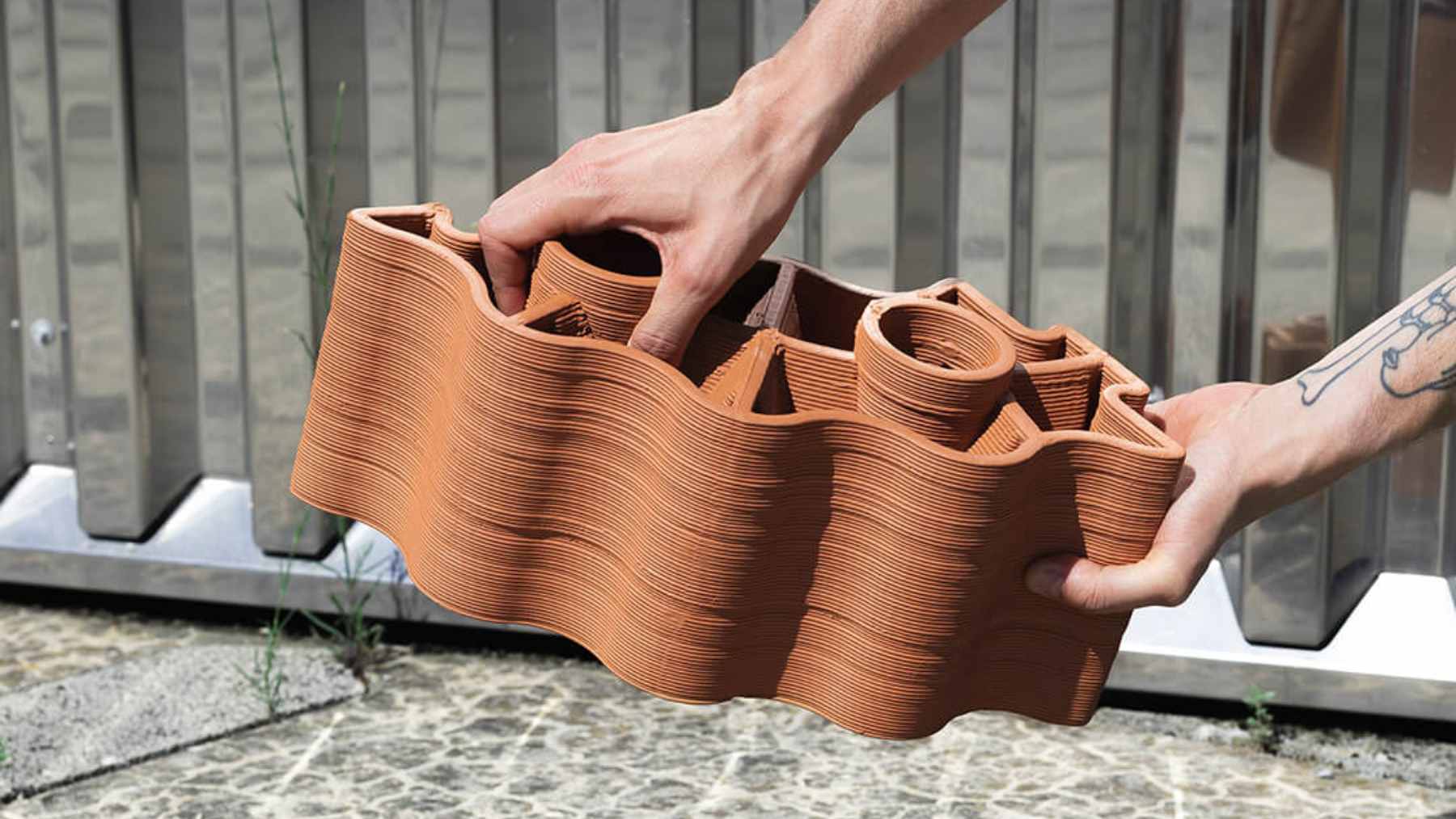
Each bloc unit is made from 3D-printed terracotta and uses solar-powered airflow to pull warm air through its damp ceramic body. According to the official project description, the system can run with about 15 gallons of water on days above 86°, while a shaped top can collect roughly 6 gallons of rainwater per day.
Designed for streets, not labs
The project came out of the industrial design program at Zurich University of the Arts, where the designers developed it as a bachelor’s thesis. The goal was not to build another air conditioner, but to rethink what ordinary street furniture could do during heat waves.
That matters because people do not experience heat evenly. A delivery worker, a student waiting outside a school, or an older person standing at a bus stop may need cooling exactly where they are, not several blocks away.
Bloc is shaped like a low wall, so people can lean against it or stand near it while it moves cooler air through the space. Its curved surfaces also create small patches of shade and help guide airflow through the wet terracotta.
Old cooling ideas, new shape
The design borrows from older cooling traditions, including clay jars, wind towers, and natural patterns seen in cacti and termite mounds. These systems are not magic, they simply use shade, airflow, and evaporation well.
Related engineering research suggests the material choice has real potential. A 2025 paper in Applied Thermal Engineering found that terracotta tube systems can reduce air temperature and may offer a low-energy cooling option in hot, dry climates.
Another study published in Physical Science International Journal tested a lab-scale terracotta tube cooler and reported temperature reductions ranging from about 11° to 28°. That does not prove bloc will perform the same way on a busy sidewalk, but it supports the basic cooling principle behind the design.
Why passive cooling matters
In practical terms, bloc is meant to cool small public hot spots instead of entire neighborhoods. That can be useful in places where installing full air conditioning outdoors would be unrealistic, expensive, or wasteful.
The design also avoids refrigerant gases, which are used in many mechanical cooling systems. It still needs water and maintenance, but it leans on terracotta, evaporation, and a small solar-powered fan rather than pulling power from the grid.
That could help in communities where electricity is limited or where cooling costs already strain household budgets. After all, during a heat wave, relief should not depend only on who can afford the electric bill.
What happens next
The designers say the next step is testing a full-scale prototype in real urban settings. That is important because sidewalks are messy places, with changing wind, dust, vandalism risks, humidity, and long periods of hard use.
Bloc will not replace trees, shade structures, reflective surfaces, or broader climate planning. But it could become one more tool, especially in the spots where people wait, work, and sweat through the worst hours of the day.
At the end of the day, the promise is modest but meaningful. A brick wall that breathes cooler air will not solve extreme heat by itself, but it may make the next bus stop feel a little less punishing.
The official project description has been published by the James Dyson Award.