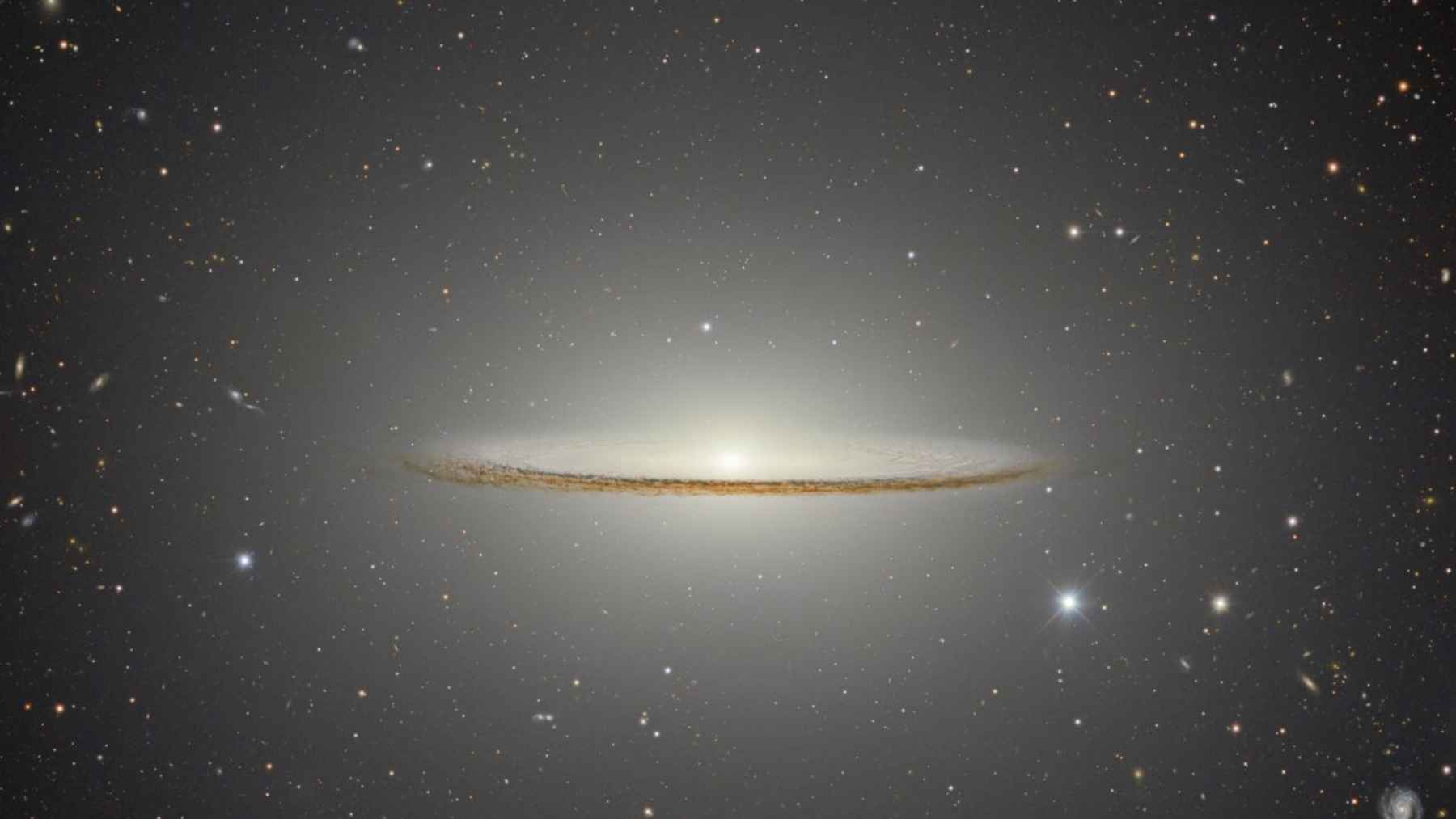
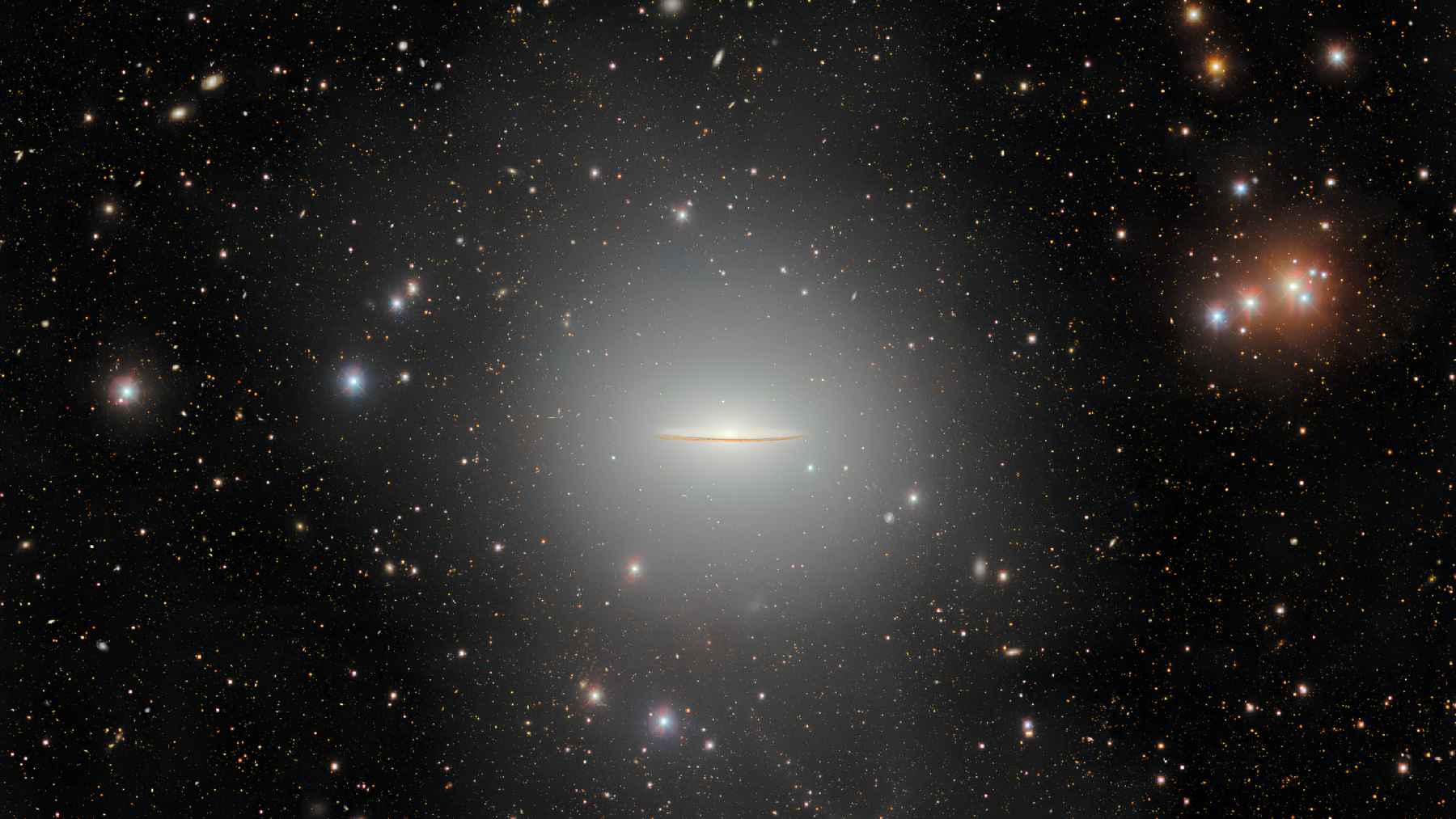
Most people know the Sombrero Galaxy for its clean hat shape, a bright central bulge with a dark band cutting across it like a brim. Now, a newly released image has pulled attention away from that famous center and toward something much harder to see, a vast, faint halo of stars around the galaxy.
The image, released April 24, 2026, shows that this outer glow reaches roughly three times farther than the visible galaxy itself. It also captures a delicate stream of stars pouring from one side, a sign that the Sombrero may carry scars from an old collision with a smaller galaxy.
The visible galaxy is estimated to be about 50,000 light-years across, so the wider halo turns a familiar target into a much larger system.
A famous galaxy gets wider
Messier 104, also called M104 and NGC 4594, sits about 30 million light-years from Earth, far beyond the naked-eye view but still close enough for professional telescopes to study in detail. NASA says the galaxy can be spotted with small telescopes, and French astronomer Pierre Méchain discovered it in 1781.
From Earth, we see it almost from the side. That angle makes its dark dust lane look like a band across a glowing hat, which is why the nickname stuck so easily. It is one of those space objects that look almost too neat, until the outskirts start telling a different story.
What DECam captured
The new view came from the Dark Energy Camera, known as DECam, a 570-megapixel instrument mounted on the roughly 13-foot Víctor M. Blanco Telescope at Cerro Tololo Inter-American Observatory in Chile. Its strength is not just sharpness. It can collect very faint light across a wide patch of sky.
That wide-field reach is the key difference here. The outer halo is not bright like the core, so seeing it is more like hearing a whisper at the edge of a crowded room. Live Science reported that DECam captured both the intense nucleus and the dim outer structures in one image.
What the halo means
A stellar halo is not a solid shell. It is a loose, spread-out population of stars around a galaxy, often left behind by past mergers, meaning collisions and slow gravitational takeovers between galaxies.
So what does this ghostly light actually tell us? Dark matter itself does not shine, absorb, or reflect light, but NASA explains that it makes up about 27% of the universe and shapes galaxies through gravity.
That distinction matters. The new image is not a photograph of dark matter, but the faint stars can help scientists compare real galaxy outskirts with models of invisible mass. The better the map of the stars, the better the test of the hidden gravity around them.
Signs of an old collision
The star stream is the messier clue. Streams can form when a larger galaxy pulls apart a smaller companion and leaves its stars in stretched ribbons, a bit like crumbs trailing behind a moving cart.
This idea is not new for the Sombrero. In 2021, David Martínez-Delgado of the Instituto de Astrofísica de Andalucía (IAA-CSIC) and colleagues reported a large tidal stream around the galaxy, while Javier Román of the Instituto de Astrofísica de Canarias helped explain how advanced image processing made the feature stand out.
What changes now is the scale and clarity of the new public view. It places the bright disk, the broad halo, and the stellar stream in a single frame, making the old collision story easier to picture.
Why Hubble and Webb still matter
Hubble and Webb did not fail to see the Sombrero. They looked at it differently, and earlier Hubble work showed that its halo contains more metal-rich stars than expected, with Paul Goudfrooij of the Space Telescope Science Institute calling it “a bit of a weird galaxy.”
In astronomy, “metals” are elements heavier than hydrogen and helium. Finding many metal-rich stars in a halo is unusual because halos are often expected to contain older, simpler stars.
NASA’s James Webb Space Telescope later studied the galaxy in infrared light. In 2025, its near-infrared view showed dust in the outer ring blocking starlight and highlighted roughly 2,000 globular clusters near the center.
A global astronomy effort
The image is also a reminder that astronomy is rarely done by one country or one telescope. The Dark Energy Survey describes itself as an international project with more than 400 scientists from 25 institutions in seven countries.
Brazil has a place in that wider story. The University of São Paulo says DES-Brazil includes researchers from Observatório Nacional, Universidade Federal do Rio Grande do Sul, Universidade de São Paulo, and other institutions, connecting Brazilian teams to the survey methods behind modern wide-field astronomy.
What comes next
The next step is comparison, not one magic image. The National Science Foundation–Department of Energy (NSF-DOE) Vera C. Rubin Observatory, also in Chile, is designed for a decade-long survey of the night sky, with dark matter and dark energy among its central science goals.
For the Sombrero, the point is simple. The more astronomers map faint stars at the edge of the galaxy, the better they can rebuild its past and test how gravity shapes galaxies. That does not solve dark matter overnight, but it gives researchers a cleaner place to look.
The official image release has been published by NSF NOIRLab.