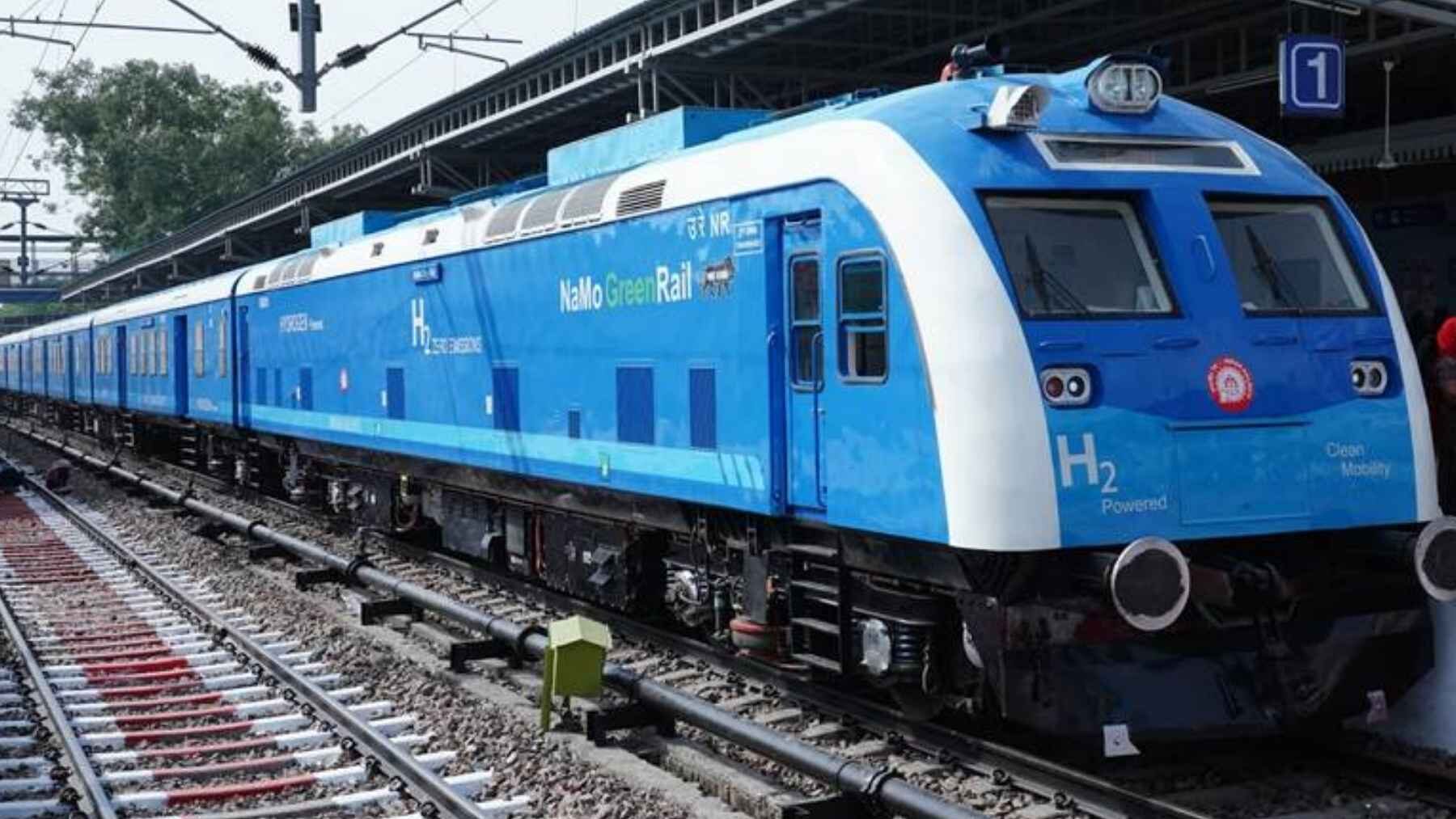
India’s first indigenous hydrogen passenger train has moved beyond the ribbon-cutting stage. By July 25, eight days after it was flagged off between Jind and Sonipat, the 10-coach train had traveled more than 1,200 kilometers and avoided more than 3,200 liters of diesel use, according to India’s Ministry of Railways.
That early record is promising, but the bigger story sits behind the train. India has built an entire hydrogen rail system, from onboard fuel cells and batteries to on-site production and high-pressure refueling, and the next test is whether it can deliver safe, reliable, affordable, and verifiably low-emissions service at scale.
A power station on wheels
So, how does a hydrogen train move without burning fuel? A proton exchange membrane fuel cell combines hydrogen stored onboard with oxygen from the air, producing electricity for the traction motors while water vapor and heat come out of the reaction.
Think of it as a compact power station on wheels. The Indian train has two driving power cars, one at each end, rated at 1,200 kW apiece for 2,400 kW in total, plus eight passenger coaches and space for around 2,600 people.
Built for a busy regional route
The pilot runs on the roughly 89-kilometer Jind-Sonipat corridor in Haryana, linking Jind Junction, Gohana Junction, Sonipat, and intermediate stops. It is approved for 75 km/h in service, while its design speed is 110 km/h.
For passengers, the most obvious difference should be what is missing. There is no diesel smoke at the train, no tailpipe carbon dioxide, and less engine noise, while electricity is generated onboard instead of being drawn continuously from overhead wires.
Why green hydrogen matters
Water vapor at the train does not tell the whole climate story. The Jind plant produces hydrogen through electrolysis, and the Railway Ministry describes the fuel stored there as green hydrogen, but the emissions benefit still depends heavily on the electricity used to split water.
The International Energy Agency says the emissions intensity of electrolytic hydrogen is determined by its power source. In practical terms, renewable electricity can make this a genuinely low-emissions system, while fossil-heavy grid power would weaken the climate advantage even though the train itself remains smoke-free.
The refueling station is the real breakthrough
A hydrogen train cannot simply pull into an ordinary rail yard and top up. Indian Railways built a dedicated facility at Jind that produces hydrogen on site, stores nearly 3,000 kilograms, compresses it to as much as 500 bar, and dispenses it at 350 bar.
Two dispensers can refuel the driving power cars at the same time, cutting turnaround delays. This may sound like background plumbing, but it is the part that turns a showcase vehicle into an operating transport system.
Safety comes in layers
Hydrogen is highly flammable, so the safety case matters just as much as the clean-energy headline. The train and plant use leak, flame, heat, and smoke detection, continuous ventilation, automatic fuel shutoffs, and live system monitoring in the driver’s cab.
The storage and dispensing site received the required license from India’s Petroleum and Explosives Safety Organisation. Officials also say the system follows NFPA-2 and ISO 19880 standards and underwent an independent safety assessment by TÜV SÜD.
The first numbers are encouraging
By July 25, the ministry said the train had completed more than 1,200 kilometers of running without interruption and displaced over 3,200 liters of diesel. That is a useful early signal, especially for a technology still being tested in only a small number of countries.
Still, eight days of running cannot answer every question. The July 25 update did not publish hydrogen consumption per trip, operating cost per passenger, long-term fuel-cell durability, or load factors, so the pilot’s real economic performance remains to be demonstrated.
Hydrogen will not replace every electric train
More than 99 percent of India’s broad-gauge network is already electrified, which changes the role hydrogen is likely to play. That suggests hydrogen may fill targeted gaps rather than replace the electric network, especially where installing overhead wires would be difficult, visually intrusive, or costly.
Indian Railways has already pointed to heritage routes, including Kalka-Shimla, as possible future applications. That is a clue that hydrogen could become a specialized tool rather than a universal replacement for conventional electric rail.
Delhi could be the next test
The Railway Ministry said a trial on a Delhi route would begin soon after the successful Jind-Sonipat operation, although it did not announce a date. A longer or busier test could reveal more about refueling time, range, reliability, and how the system behaves under everyday passenger pressure.
Prime Minister Narendra Modi also acknowledged that the work is not finished, saying India would keep researching “how to reduce costs” and “how to increase efficiency.” That may be the most important part of the launch, because a clean train only becomes transformative when its fuel, infrastructure, and maintenance can compete over many years.
A pilot with national implications
India’s first hydrogen train is already doing something valuable by replacing diesel at the point of use and giving engineers real-world data. The harder task now is proving the full chain, including renewable power supply, hydrogen production, storage, safety, operating cost, and dependable daily service.
For commuters, the promise is simple enough. A train arrives, people board, and the platform is spared the familiar cloud of exhaust, but whether that experience spreads beyond Haryana will depend on what the next months of evidence show.
The official press release was published on the Press Information Bureau.