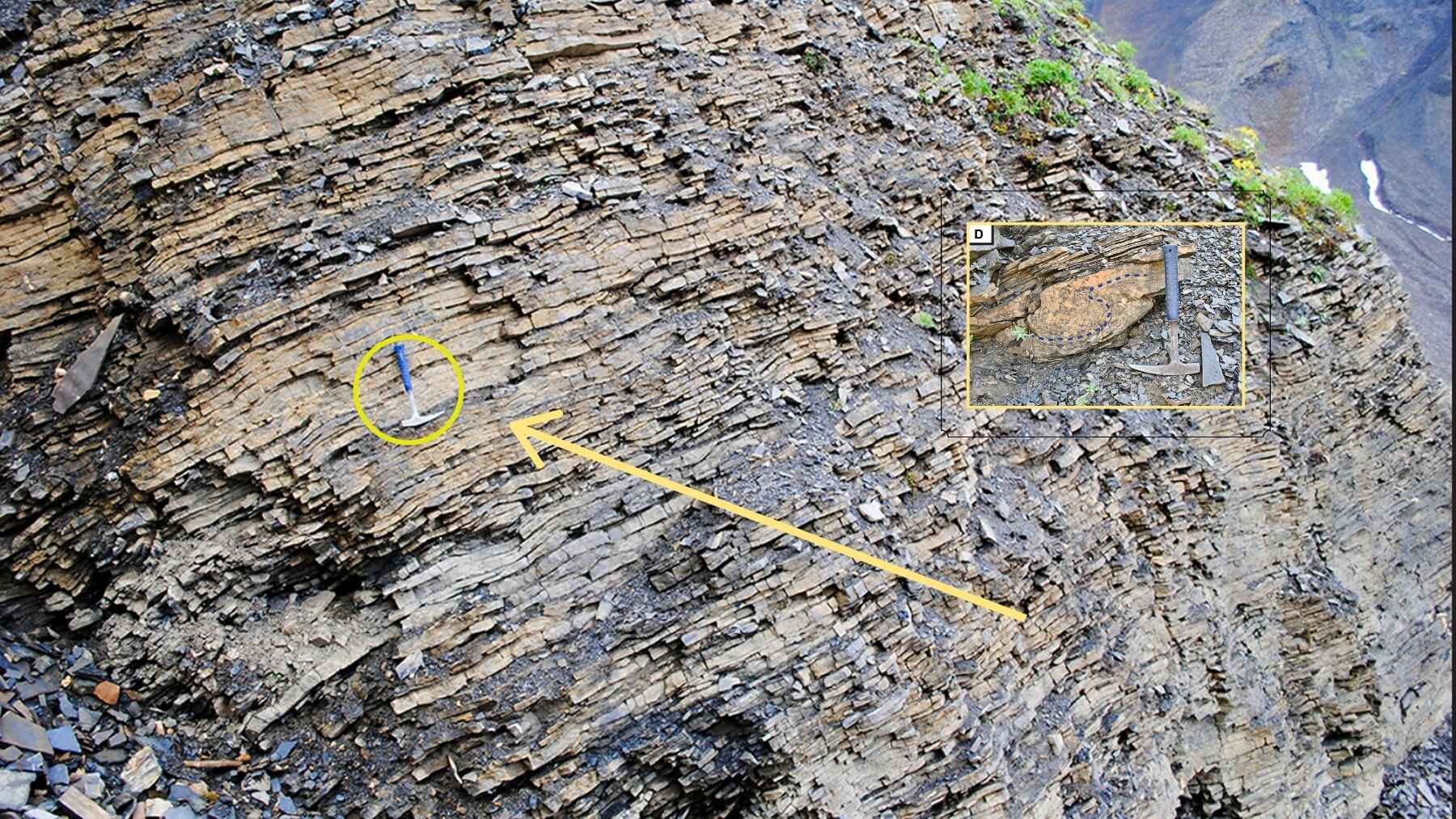
Long before shells, bones, or familiar body plans became common, soft creatures were already crossing an ancient seafloor in what is now northwestern Canada. A newly described fossil community suggests animal movement, bilateral bodies, and sexual reproduction were established 5 to 10 million years earlier than comparable evidence had indicated. Earlier than expected, in other words.
The site in the Mackenzie Mountains contains more than 100 Ediacaran fossils, including six groups never previously recorded in North America. But the biggest surprise is not just their age. These creatures lived in deep offshore water, a setting that may have offered early animal life unusual stability.
A rare view of early animals
The Ediacaran biota included soft-bodied marine organisms shaped like discs, fronds, tubes, and ribbed ovals. Strange-looking? Absolutely. But their fossils provide some of the earliest direct evidence of multicellular animal life, including creatures capable of moving across the seafloor and reproducing sexually.
The problem is that this record is frustratingly incomplete. Most of these organisms lacked shells or bones, so they vanished without a trace unless unusually favorable sedimentary conditions preserved an impression of their bodies at just the right moment.
The fossils are older than expected
Paleontologists often organize Ediacaran communities into the Avalon, White Sea, and Nama assemblages. White Sea organisms were generally placed between about 559 million and 550 million years ago. Yet some Canadian specimens appear to be roughly 567 million years old and overlap in time with the older Avalon assemblage.
Does that tell us exactly when the first animal appeared? No. What it does is move the minimum known age of several important behaviors and body plans, showing they were present earlier than the better-known fossil sites had suggested.
A North American first
The fossils came from ancient rocks in the Mackenzie Mountains of Canada’s Northwest Territories, on the traditional lands of the Sahtú Dene and Métis. Community members provided the researchers with guidance and permission to enter and study the remote area.
Researchers recovered more than 100 specimens and documented six groups not previously known from North America. That makes the site much more than a collection of unusual shapes in stone. It connects Laurentia, the ancient continent that included North America, to a wider story once reconstructed mainly from distant regions.
Dickinsonia moved without a mouth
One of the finds is Dickinsonia, a flat, divided organism that traveled over the seafloor even though it had no mouth. How did it eat? Scientists think it absorbed bacteria and algae through its underside, almost like a living mat slowly feeding as it moved.
Its presence matters because it records active behavior, not just anatomy. In other words, this fossil community preserves animals interacting with the seafloor in ways that a body imprint alone would never reveal.
Funisia records early reproduction
Funisia looked very different. It was a stationary, tube-shaped organism that lived in clusters of similarly sized individuals. That pattern is interpreted as the oldest known fossil evidence of sexual reproduction.
The likely process resembled the synchronized release of eggs and sperm seen in modern corals. Picture it for a second. A quiet seafloor suddenly fills with reproductive cells drifting through the water, an ancient strategy that could help a population spread without parents ever moving from the spot.
Kimberella changes the body-plan story
Kimberella may be the most consequential fossil in the group. It moved with a muscular foot and scraped food from the seafloor. Researchers widely interpret it as an early relative of mollusks and potentially the oldest known motile bilaterian.
Bilaterians have a clear front and back, a top and bottom, and matching left and right sides. Sound familiar? That basic layout now runs through most familiar animals, from worms and insects to fish and people, so finding it this early pushes a foundational chapter of animal evolution deeper into time.
A deep-sea nursery
White Sea fossils had usually been associated with shallower marine environments. The Canadian specimens, however, came from a deep-water continental slope. That supports the idea that some early animal innovations appeared offshore before spreading toward coastal habitats.
Why might life begin there, in a place that sounds so inhospitable? Deep water is dark, but it can also be steadier than the coast, with fewer swings in temperature and oxygen. That relative stability may have sheltered fragile experiments in larger bodies and new behaviors, although the evidence does not prove that all animal life began there.
Evolution was not a neat handoff
The new dates blur the tidy picture in which Avalon communities disappeared and White Sea communities simply replaced them. Instead, the two assemblages may have overlapped in time and occupied comparable deep-water settings. So the transition may not have been nearly as clean as it once appeared.
That is the larger lesson from this Canadian mountainside. Fossil categories are useful maps, but nature rarely follows the borders scientists draw. Especially when the available record comes from only a handful of exceptional sites scattered across a planet-sized seafloor.
More discoveries may be waiting
The fossils are expected to join the permanent collection of the Prince of Wales Northern Heritage Centre in Yellowknife, where they will remain available for future research. And there may be more. Hundreds of feet of overlying rock could hold additional specimens, while the broader region stretches across parts of Yukon, the Northwest Territories, and British Columbia.
For now, the site shows that recognizable animal behaviors were underway by about 567 million years ago, hidden in a world where hard body parts were still uncommon. Movement, however, was not.
The study was published in Science Advances.