Atolls can take up to 30 million years to develop, yet their future depends on changes unfolding much faster. About a million people live on these coral islands worldwide, making their survival a question about communities as well as extraordinary geology.
But the danger is not simply that every island will disappear beneath the waves. Research shows that some atoll islands have gained land despite rising local sea levels, while flooding and contaminated freshwater can still make life harder. An island remaining on the map does not necessarily mean it remains a safe home.
Why staying above water is not enough
Much of the land on low-lying atolls sits only about 3 to 7 feet above sea level. That leaves communities exposed to storm surges, coastal erosion, and seawater entering drinking-water supplies, even without permanent submergence.
For residents, the consequences can be as basic as finding reliable water for drinking and cooking. U.S. Geological Survey research shows that waves washing across islands can carry salt into freshwater stored underground, and repeated flooding can prevent that supply from recovering between events.
The surrounding reefs face their own pressures. NOAA explains that warmer ocean water can trigger coral bleaching, while acidification reduces coral growth and structural strength, threatening the living framework on which atolls depend.
What makes an atoll different
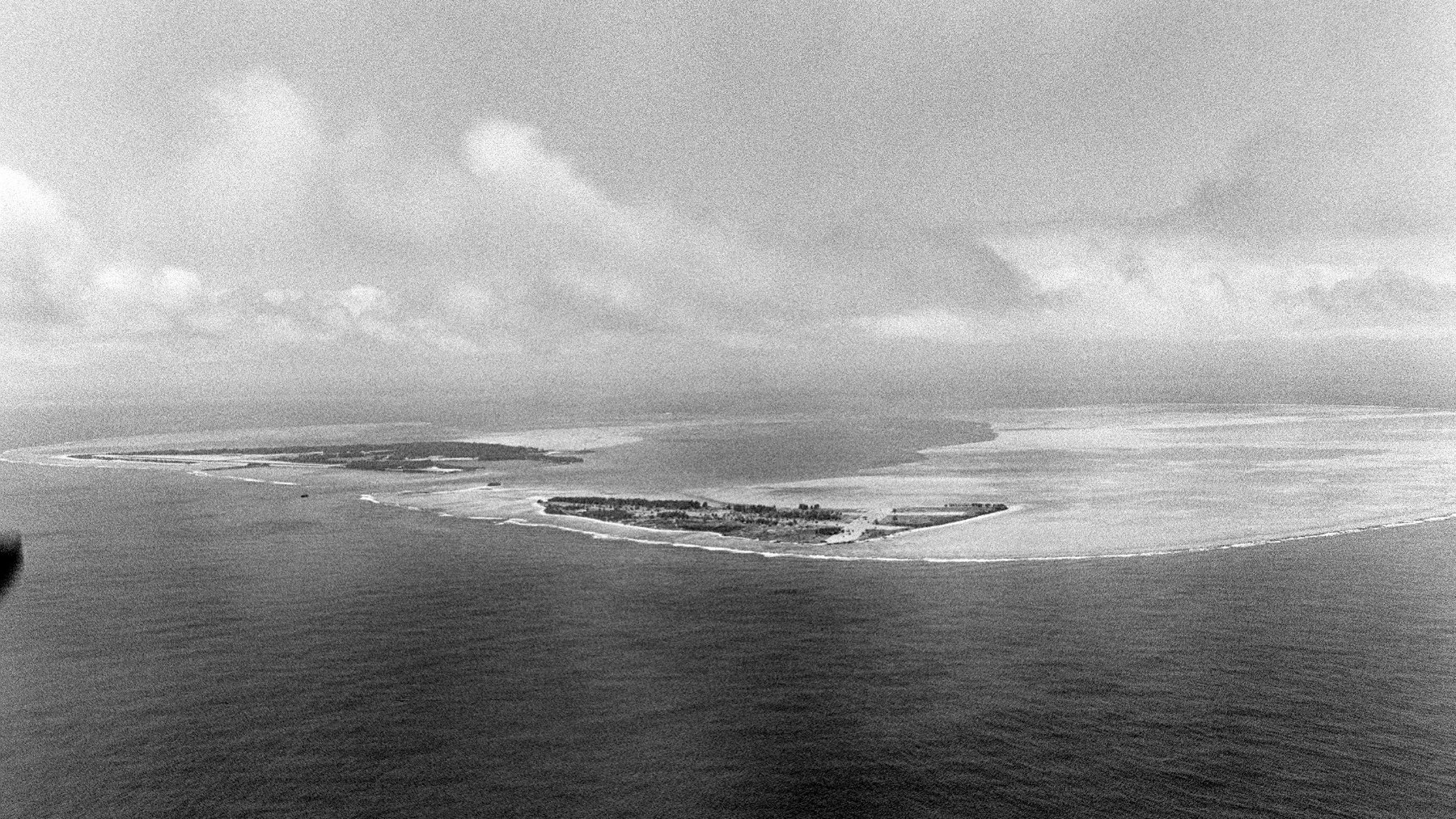
An atoll is a ring-shaped reef surrounding a lagoon, often with several small islands scattered along its rim rather than one continuous strip of land. These formations occur in tropical and subtropical waters where reef-building corals can grow.
One atoll is therefore not necessarily one island. A 2023 satellite-based census identified 494 oceanic atolls and 104 continental atoll systems worldwide, although totals vary depending on the definitions used.
Size can be deceptive, too. The Great Chagos Bank in the Indian Ocean covers approximately 4,880 square miles overall, yet only a few square miles of its footprint are dry land.
How a volcano can leave a coral ring
Charles Darwin proposed his subsidence model in 1842, describing a remarkable transformation from volcanic island to coral atoll. In this explanation, an underwater volcano builds upward until it emerges from the sea, and corals establish a fringing reef around its shores.
As the volcanic island sinks and erodes, coral continues growing upward if conditions allow it to keep pace. A lagoon separates the reef from the remaining land, creating a barrier reef before the volcanic peak disappears and leaves an atoll. The multimillion-year timescale describes the broader geological development, not the age of every sandy island sitting on top.
But Darwin’s model is not the only explanation. A review by André Droxler and Stéphan Jorry describes an alternative called the “antecedent karst model,” in which rainwater dissolves exposed limestone during periods of lower sea level, hollowing out its interior. When the sea rises again, the depression floods and coral grows along the raised rim.
Why some islands are actually growing
So how can an island expand while the ocean rises around it? A 2020 study in Geophysical Research Letters found that Jeh Island in the Marshall Islands formed through the merging of at least two smaller islands between 1943 and 2006, with continued expansion afterward.
Researchers combined aerial photographs, satellite imagery, and sediment dating to show that newly produced reef material was helping build the island. Their findings demonstrate that island growth is possible where sediment production and delivery remain healthy, not that every atoll is protected from future sea-level rise.
Taken together with the freshwater research, this points to an important distinction between gaining land and maintaining a livable community. A larger shoreline footprint alone cannot tell residents whether drinking water, homes, and essential infrastructure will withstand repeated flooding.
Tiny islands with a huge role for seabirds
People are not the only ones depending on these narrow strips of land. A study published in 2024 estimated that 31.2 million seabirds nest on atolls, representing roughly one-quarter of the world’s tropical seabirds.
Researchers identified 37 breeding species, with bird numbers ranging from a few dozen to more than 3 million per atoll. For 14 species, more than half of their global populations nest there, giving these small islands an ecological importance far beyond their size.
“Our findings reveal the global importance of atolls for tropical seabirds,” the researchers wrote, calling for protection and restoration in the face of global change.
The study was published in Nature Ecology & Evolution.