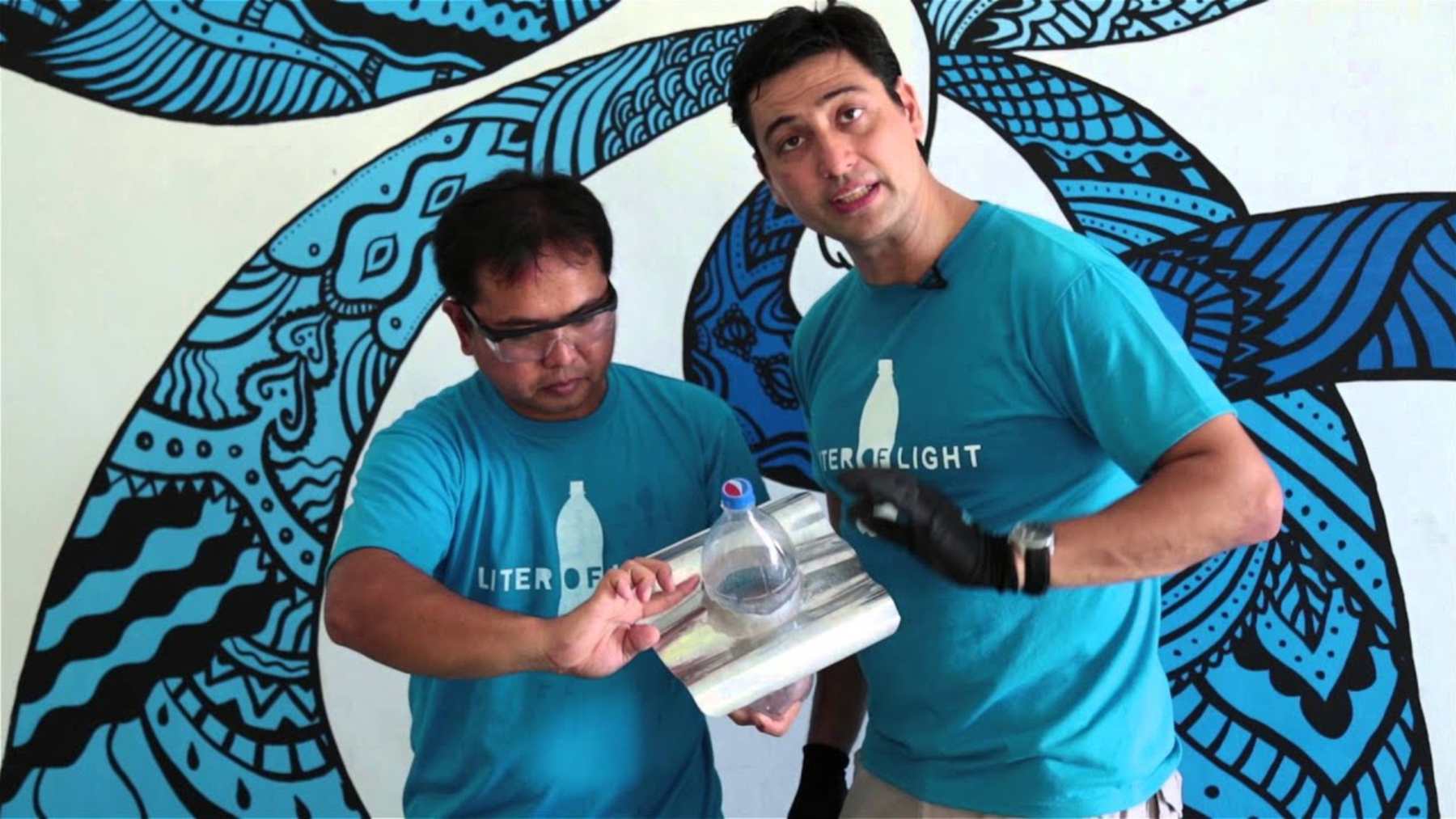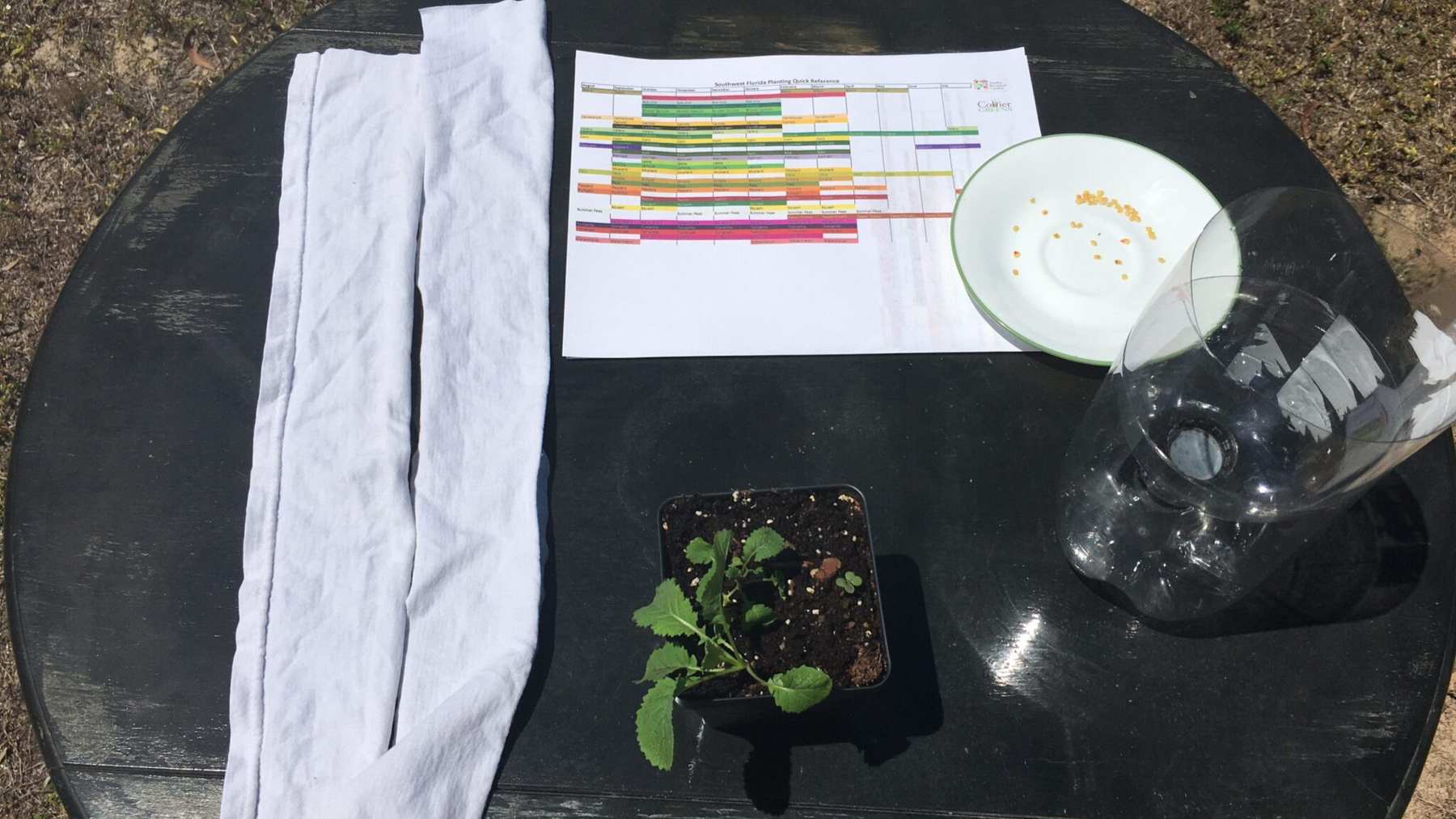
“Have you ever wanted to grow herbs and vegetables, but you’re worried about remembering to water them? There is a solution for that: a self-watering planter!” That’s the pitch on a how-to page from Naples Botanical Garden in Florida, and the parts list is short. “A plastic bottle, such as a 2-liter soda bottle,” yarn, twine or a “strip of cotton fabric,” soil, “a seed or seedling,” and water.
A wick of wet yarn or cloth does the watering, pulling from a reservoir in the bottom half of the bottle. A University of Kentucky extension guide on the same idea says capillary action can move water about 4 inches (10 centimeters) above the water line in a wicking container.
The bottle splits into a pot and a reservoir
The garden “loans EarthBox self-watering planters to schools as part of the Collier Greens program, but you can also make your own small planter at home,” its guide to a homemade version says.
Step 1 is one line. “Remove the label, and carefully cut the bottle in half using a box cutter or scissors.”
Danielle Combs, an Ohio State University Extension educator in Highland County, wrote up nearly the same build for 4-H kids in 2020 and spelled out what happens to the two halves: “Take the upper piece of the bottle (spout end) and turn upside down and place inside the lower half of the bottle. This will create the planter and water basin/reservoir.”
Then comes the wick, and Naples gives two ways to make it. “If you have a drill, or a hammer and hole punch or awl, you can make a hole in the cap of the bottle. This will then allow you to thread twine or yarn through the hole. After threading the twine or yarn through the cap, you will then tie a knot on the inside to keep it from sliding out. You should have roughly 6-8 inches of string on either side.”
Lost the cap? “Another method is using a piece of scrap cotton fabric,” the page says. “Cut a piece that is at least 12 inches long by about 4 inches wide. At the halfway point, tie a knot and then thread it through so the knot is blocking the top of the bottle.” In metric, that’s a strip of about 30 by 10 centimeters, or 15 to 20 centimeters of string on each side of the cap.
Combs uses four pieces of twine knotted about two inches (5 centimeters) from one end. “The knot should stick/rest in the spout of the 2-liter bottle, with the short ends touching the bottom of the water reservoir,” she wrote.
The wick has to run through the soil
“Wet the yarn, twine, or cloth, which is now the wick for your self-watering planter,” reads step 3. Step 4 is the soil, with a warning attached: “make sure to hold the wick so that it doesn’t get buried at the bottom of the soil. You want the wick to run through the soil so that it can provide moisture to the plant through capillary action.”
Combs tells kids the same thing her own way. “Fill the upper piece one-third of the way full of potting soil, while making sure the twine pieces stay away from one another.”
“Capillary action is how plants pull water from the soil through their roots into their stems and leaves. This planter will mimic that process by using the wick to pull water from the bottom basin into the soil, where the plant’s roots will be,” the Naples page explains.
There’s a catch. “After filling the top, wet the soil so that the capillary action will work. If the soil ever dries out, the tension will be broken, and the capillary action won’t occur until you re-wet the soil by watering from the top,” the guide warns. Seeds and cuttings still get watered gently from above “just until the seed germinates or the plant is established.”
The Ohio worksheet ends with questions, not answers: “What do you think the twine is for?” and, a few lines later, “Do you see roots? Where are the roots going? How do the roots compare in size to the plant above the soil?”
Capillary action lifts water against gravity
Steve Higgins, of the Department of Biosystems and Agricultural Engineering at the University of Kentucky, wrote the school’s extension guide to self-watering wicking containers. His containers are muck tubs with perforated pipe and peat moss, a lot bigger than a soda bottle, though he describes the same physics.
“Capillary action or capillarity is the rise of liquid created by increasing surface tension, which allows water to defeat gravity and move up. The smaller the particle, the greater the ability to defeat gravity,” Higgins writes. “So even though the water table may be at the level of the drain hole, capillary action will move water up approximately 4 inches above this.”
He also spells out the payoff. “The greatest benefit of the system is that it provides the plant with control of its water supply, which helps free up more of the gardener’s time,” he writes, and “overwatering, underwatering, or forgetting to water is buffered by the ability of plants to self-regulate their water requirement.”
Research shows wicks can cut water use
Niranjani Semananda, James Ward and Baden Myers of the University of South Australia went through the published research on capillary irrigation for a review in Horticulturae, where they note these systems are widely used for ornamental and nursery plants grown in glasshouses.
Wicks, capillary mats and ebb and flow systems “have been shown to produce higher crop yields and use less water than conventional irrigation methods,” the authors write. They also cut down on leachate, the fertilizer-laden water that drains out the bottom of a pot.
One 2004 study they cite, by Yeager and Henley, found that “capillary wick irrigation systems reduced water use an average 86% and 81% when compared with overhead and capillary mat irrigation, respectively.” That work was not done with a soda bottle on a windowsill, so the figure tells you about wicks in general.
Herbs fit and tomatoes and succulents struggle
Naples suggests the bottle for seeds “that will later need to be stepped up and planted in a larger container or those that can grow in the space provided, like herbs or small vegetables that will fit in the bottle planter.”
Tomatoes are too thirsty. In the Australian review’s words, “water drawn up from the reservoir via a capillary wick may not be sufficient to meet the evapotranspiration rate of larger vegetable plants popular in small-scale agriculture, such as tomatoes.” Evapotranspiration is the water a plant loses through its leaves plus what evaporates off the soil.
Cacti and other succulents hate it for the opposite reason. Aaron Steil of Iowa State University Extension and Outreach writes in a guide to succulent problems that “oxygen levels in water-logged soil are lower causing roots to die,” and that “setting up a wet-dry cycle where the soil is completely wetted and then allowed to completely dry out is the best way to avoid root rot in succulents.” With a wick in the water, that soil never really dries.
Most plastic bottles still aren’t recycled
According to the Environmental Protection Agency, Americans generated 35.7 million tons of plastics in 2018 (about 32.4 million metric tons) and recycled roughly 3 million tons, an 8.7 percent rate. PET bottles and jars, the category that covers PET beverage bottles like soda bottles, did better at 29.1 percent, and landfills still took in 27 million tons of plastic that year (about 24.5 million metric tons).
The University of Maryland Extension makes a similar point about buckets in its own self-watering container guide: “The ubiquitous five-gallon plastic bucket is considered by some to be the most useful tool on earth, particularly in poor countries. Thousands are buried in landfills or burned each day in the U.S.”
Bottles have had odd second lives before, like a Brazilian mechanic’s water-filled solar bottle bulb, and a Florida homeowner did something similar with old cardboard boxes and a dead lawn. Labs are trying the high-tech route with a reactor that turns bottles and bags into hydrogen, and there are separate questions about what bottled water may contain.
The reservoir still needs checking
Self-watering doesn’t mean you can walk away for a month. “Remember, you will need to fill the reservoir every few days, so put it in a place where you can see it and remember to refill the bottom reservoir,” the Naples guide says.
Higgins mentions mosquitoes. “An open fill tube may attract mosquitoes. A simple solution is to create a cap that can be removed when filling the reservoir,” he writes about his tubs; in a bottle, the upside-down top covers most of the water.
Food runs short in a tiny pot. “Because each pot has limited soil and nutrient holding capacity, planting multiple plants in one pot may require more frequent fertilization and watering,” according to Higgins.
The Australian group points out that wick systems “tend to be limited to supporting small pot sizes or small non-fruiting crops because the amount of nutrients and water that it can supply is limited,” and for bigger wicking beds they found “no published research providing design recommendations” or comparing them with other ways of watering.
The capillary irrigation review was published in Horticulturae.
The last step on the Naples page is just “Find a place for your planter,” somewhere you’ll actually see it when the water in the bottom gets low.
Photo: Naples Botanical Garden