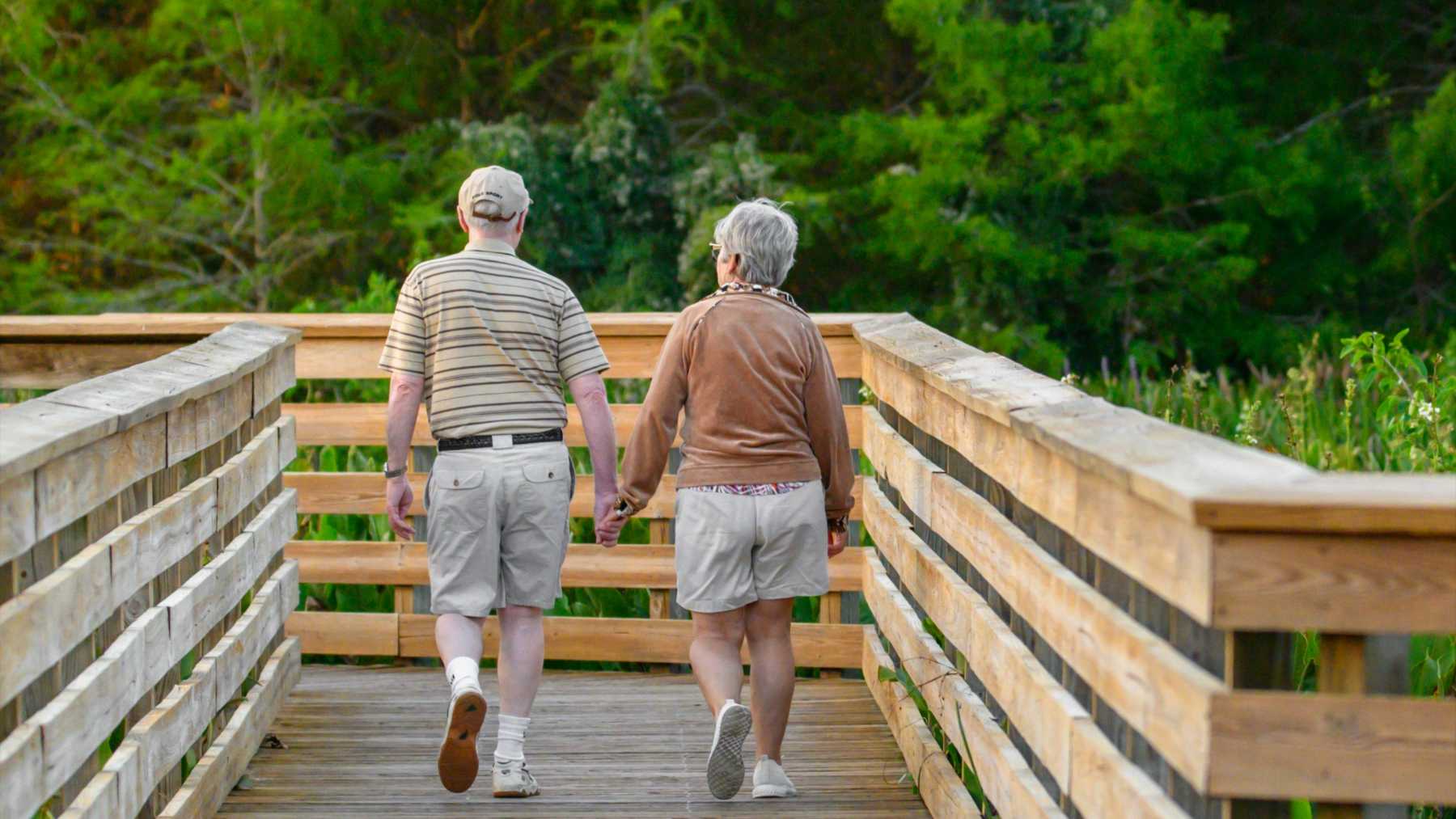
Brisk walking or jogging came out at or near the top for bone density in a review of 124 randomized trials that pooled results from 18,429 adults aged 40 and older, published in The BMJ on September 9, 2026.
The amount that seemed to matter was about 2 to 3 hours a week. Changbo Lu of the 940th Hospital in Lanzhou is the first author, and Xiaojiang Yang of Nanjing Jinling Hospital, part of Nanjing University, is the corresponding author.
Six kinds of exercise, three spots on the skeleton
The team put each program in one of six groups: mixed aerobic exercise, resistance training, aerobic and resistance work combined, brisk walking or jogging, mind-body exercise like tai chi and yoga, and whole body vibration. They then compared bone scans of the lower spine, the hip as a whole and the femoral neck, the narrow piece of thigh bone just below the hip joint.
The result runs against a line many bone researchers have repeated for years. “Often, just walking is not enough for bone health and we hope that this encourages more women to perform high-impact exercise,” Gallin Montgomery, a sport and exercise biomechanics lecturer at Manchester Metropolitan University, said in 2019, after a study of jumping exercises in women.
Walking isn’t enough to build stronger bones, Kerri Winters-Stone, an exercise physiologist at Oregon Health & Science University, told The Washington Post in 2025. “You have to surprise the bone,” she said. “You have to do something different.”
Walking did best at the hip
At the lower spine, walking or jogging tied with combined aerobic and strength work. At the femoral neck it came first again, and at the total hip it was the only one of the six groups that made a significant difference.
On paper the gains look tiny, between 0.009 and 0.021 grams per square centimeter more than in the control groups. The hip result also leans on just three trials with 68 people, and the authors warn that “several small trials evaluating brisk walking or jogging reported outsized effect estimates.”
Their explanation is impact. Each brisk step or jogging stride lands with a force of “1.5 to 2.0 times bodyweight,” they note, and walking “may have been underappreciated” when older reviews lumped it in with other impact exercise.
Belinda Beck, a professor at Griffith University in Australia who runs The Bone Clinic in Brisbane, has argued for years that bone needs impact, and she sets the bar higher than a brisk walk. “We know from animal studies that bone only responds to high-intensity activity, but we worry about advising that for people with low bone mass, so instead we give them medications,” she said in 2020.
Wendy Kohrt, a professor of geriatric medicine at the University of Colorado, told the Chicago Tribune back in 2012 that a vigorous endurance program of running, jogging, stairs or plyometrics “can have similar increases in bone density” as resistance training.
Why a hundredth of a gram counts
From about 40 on, people tend to lose 1 to 2 percent of their bone each year. The team used that as its yardstick, so a program counted as clinically meaningful if it won back 1 or 2 percent of someone’s starting bone density, roughly a year’s worth of normal loss. Reaching those small thresholds “is far from negligible,” the authors write.
“Any intervention that slows that loss or mitigates it is better than nothing,” Jocelyn Wittstein, an associate professor of orthopedic surgery at Duke University School of Medicine, told The Washington Post in 2025, and “any load-bearing activity on your legs is better than being sedentary.”
Bones aren’t the only thing that changes with regular exercise. In one lab study, ten weeks on a treadmill reshaped the nerve hubs that control the heart in rats.
Where the 2 to 3 hours come from
The weekly target is counted in MET-minutes, which multiply how long an activity lasts by how hard it is. Across all six kinds of exercise, benefits started to show at around 600 MET-minutes a week, which the authors put at “about 2-3 hours of brisk walking or jogging.”
For walking or jogging alone, the numbers were 427 MET-minutes for the spine, 753 for the femoral neck and 789 for the hip. Across all six kinds of exercise, the gains flattened out past roughly 900 to 1,000 MET-minutes a week.
Not everyone is sold on 600 as a bone target. “MET-minutes estimate energy expenditure, whereas bone responds to mechanical loading,” Lu Wenjie, a clinician at Shaoxing TCM Hospital, wrote in a letter to the journal. The authors call their thresholds approximations meant to line up with WHO guidelines, “rather than definitive mechanical or clinical cut-offs.”
Kohrt raised the dose question more than a decade ago. “Our current physical activity guidelines are probably not adequate for reducing hip fracture risk,” she said at a 2011 talk at Southern Methodist University.
Fewer answers on broken bones
Only 26 of the trials kept track of fractures, covering 11,132 people. Mixed aerobic exercise and mind-body exercise were linked to fewer fractures, with low certainty, while the result for walking or jogging could have been chance.
Gunjan Vyas, a consultant physician in Udaipur, India, pointed out in a letter that the big drop for mixed aerobic exercise “came from a mere 119 participants.” No kind of exercise raised fracture risk, according to the review, though any claim that it prevents fractures “must be interpreted with caution.”
A separate 2025 study of 348,334 people in the UK Biobank found a 22 percent lower hazard of fractures in people who said they walked briskly than in those who walked at an average pace. That was an observational study, so like a recent UK Biobank look at loneliness, isolation and healthy habits in 277,489 adults, it can show a link but not cause and effect.
Mostly women, and no way to blind
Ninety of the 124 trials enrolled only women, and just 10 were limited to men. People in a jogging group know they’re jogging, so the trials couldn’t hide who got what, and 37 were rated at high risk of bias. Swimming, cycling and racket sports didn’t get categories of their own, and the programs lasted anywhere from 12 weeks to four years.
One part of looking after bones
The authors describe exercise as “one pillar” of osteoporosis care, next to medication, nutrition and fall prevention.
“It is better for your bones to be as active as possible and build more strengthening and impact slowly into your daily life,” Dawn Skelton, a professor of aging and health at Glasgow Caledonian University who chaired a 2022 UK consensus on exercise for osteoporosis, said when it came out.
The National Institute of Arthritis and Musculoskeletal and Skin Diseases counts brisk walking as weight-bearing exercise and advises people with low bone density, osteoporosis or other physical limitations to “talk to a health care provider before starting an exercise program.”
How much people move varies a lot, and not only with age. A smart-ring study in Singapore found university students moving 100 minutes less per day than adults in their 70s.
The full study was published in The BMJ.