Anyone who has used a 3D printer knows the messy little secret. Failed prints, support pieces and strings of purged plastic pile up fast, and most of that plastic ends up in the trash.
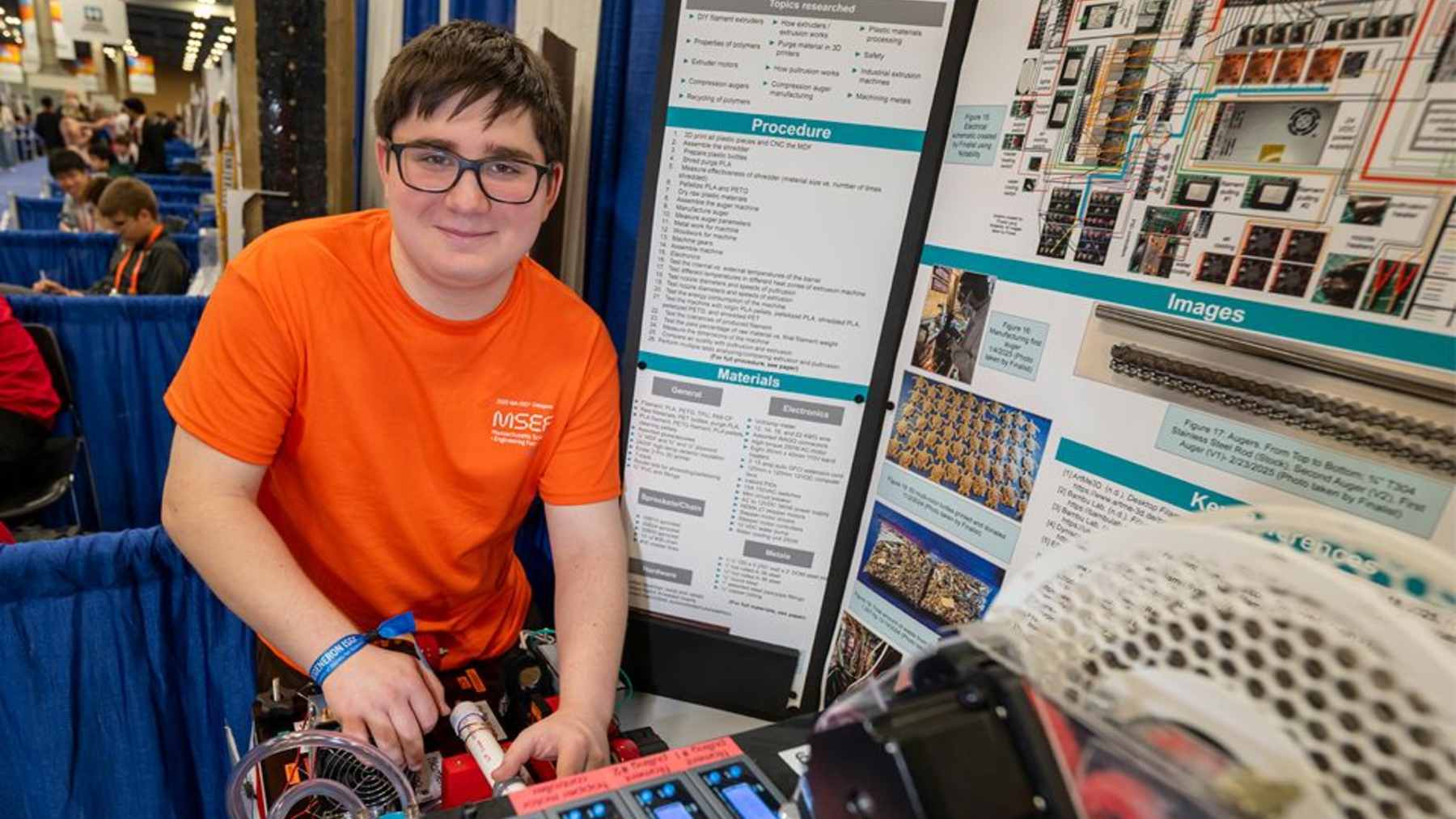
Benjamin Davis, a 16-year-old from Wrentham, Massachusetts, decided to do something about it. His desktop machine turns that waste, along with old plastic bottles, into brand-new printing filament, and it won him the $75,000 Regeneron Young Scientist Award at the 2025 Regeneron International Science and Engineering Fair.
A student project that stood out among 1,700
The fair, held in Columbus, Ohio, in May 2025, brought together nearly 1,700 young scientists from 48 U.S. states and more than 60 countries, regions and territories. Organizers handed out more than $9 million in awards and scholarships.
Benjamin, then a sophomore at Bishop Feehan High School in Attleboro, was one of only two students to receive a Regeneron Young Scientist Award. Only one prize at the fair was bigger, the $100,000 George D. Yancopoulos Innovator Award.

His project also took first place in its engineering category. Not bad for a teenager who built much of it in his own workshop.
The waste problem hiding in 3D printing
3D printers build objects layer by layer from a thin plastic thread called filament. It sounds tidy, but a lot can go wrong along the way.
Up to 67% of the filament used in a typical 3D printing project may end up as waste, according to the fair’s organizers. That includes failed prints, temporary supports and the plastic a printer pushes out when it cleans its nozzle or switches colors, which is known as purge.
Machines that turn this scrap back into filament already exist. The catch is that commercial ones can be expensive and complicated, and that’s exactly the gap Benjamin set out to close.
How the machine works
His project was titled “From Crude to Extrude,” and it merges two manufacturing techniques into a single filament production system. It is fed with plastic from PET bottles and with 3D printing purge material.
In simple terms, extrusion pushes melted plastic through a small opening to form a strand, a bit like squeezing toothpaste out of a tube. Pultrusion works by pulling material through a shaping die, which helps keep the strand steady and uniform.
By combining both, and drawing on electrical, mechanical and chemical engineering, Benjamin made the process about 45% more efficient. According to the organizers, his device is also faster than other home recyclers and produces a higher-quality filament.
Cheaper, simpler, and made for regular users
Price is a big part of the story. The design costs 90% less than commercial options, which could put filament recycling within reach of far more people.
It’s also meant to be easy to run. The idea is that someone without a technical background can recycle their own plastic scraps and keep printing, instead of tossing them in the bin.
Think of schools, libraries or small makerspaces where printers hum all day long. For them, a cheap desktop recycler could mean fewer trash bags and a smaller bill for new spools.
“One of the best weeks of my life”
Benjamin developed the project with guidance from Kelly Gomez, a science teacher at Bishop Feehan. According to the school, he is the first student in its history to earn a national honor at the fair.
“It was an incredible experience, probably one of the best weeks of my life, and I am so glad that I had the opportunity to participate in the fair,” he said.
In a later interview, he said the most memorable moment was hearing his name announced on stage. Even so, meeting students from all over the world who shared his passion for science meant just as much.
Doors opening after the win
The award did more than pad a college fund. Benjamin says it led to presentations at conferences of the American Association for the Advancement of Science and a spot as a fellow of the American Junior Academy of Sciences.
It also helped him pick a direction. He now plans to study advanced manufacturing and mechanical or materials engineering in college, which makes sense for someone who already builds his own production machines at 16.
What he is building next
Since the fair, Benjamin says he has been “improving my extrusion-pultrusion machine to make it even more efficient and commercially viable.” He is also working on equipment for high-temperature composite filaments.
Outside the lab, he co-founded Tech Forge, a school club that teaches students how to use tools and build things. One of its recent projects was a fully functional 10-foot conveyor belt inspired by the Polar Express for the school’s Santa Shop event.
His advice for other young scientists is refreshingly down to earth. “The most important thing in science and engineering projects is to stay passionate about your research while also maintaining balance in your life,” he said. And judging by his results, that balance is paying off.
The official announcement of the award has been published by Society for Science.
Photo: Society for Science