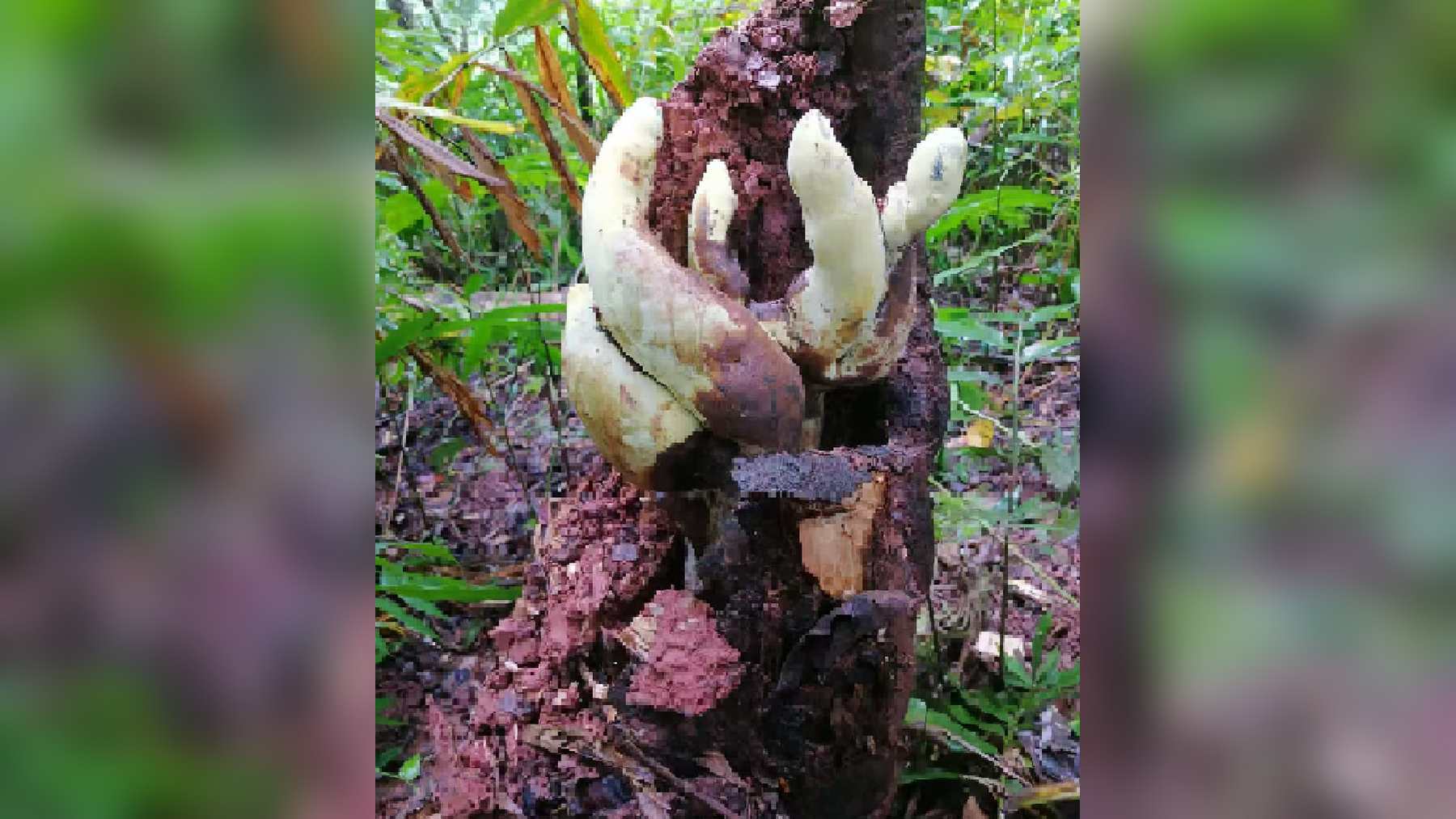
Jing Song collected it on August 5, 2024, near Damaidi, a village in Luquan County, part of the city of Kunming, in China’s Yunnan Province. Pale, fleshy fingers were pushing up out of the dirt around the roots of a Chinese cork oak, and they turned out to be a giant fungus that nobody had ever named.
Now it is Dianjunus rex, or “D-rex.” According to Frontiers, the species “produces vertical fruiting bodies up to 50 cm high and weighing up to 2.2 kg,” about 20 inches and 4.9 pounds, “the largest known within the phylum Ascomycota.”
“This remarkable species represents a new fungal family, Dianjunaceae, and provides a rare window into the evolution of extreme fungal body forms,” said Indunil C. Senanayake, an associate professor at the Germplasm Bank of Wild Species of the Kunming Institute of Botany and a corresponding author of the study. “The discovery illustrates how much fungus biodiversity remains to be discovered in East Asian forests.”
Whitish fruiting bodies on cork oak roots
Song shares first authorship with Zhuyue Yan, both at the Kunming Institute of Botany of the Chinese Academy of Sciences, and Fuqiang Yu of the same institute is the other corresponding author. Scientists from Chiang Mai University in Thailand and the Colegio de Postgraduados in Mexico are on the paper too.
“During fieldwork in temperate coniferous forests near Damaidi and Yipinglang and in tropical rainforest near Nanbang, scientists from the Kunming Institute of Botany found large whitish fruiting bodies (‘stromata’) clearly belonging to an unknown ascomycete fungus,” Frontiers reported. “These grew on woody roots of Chinese cork oak, emerging from the rhizosphere,” the soil right around the roots.
“Ascomycetes, with more than 64,000 species the largest group of fungi, don’t grow true mushrooms but instead release spores from tiny, sac-like structures inside or on the surface of such fruiting bodies,” the release explains.
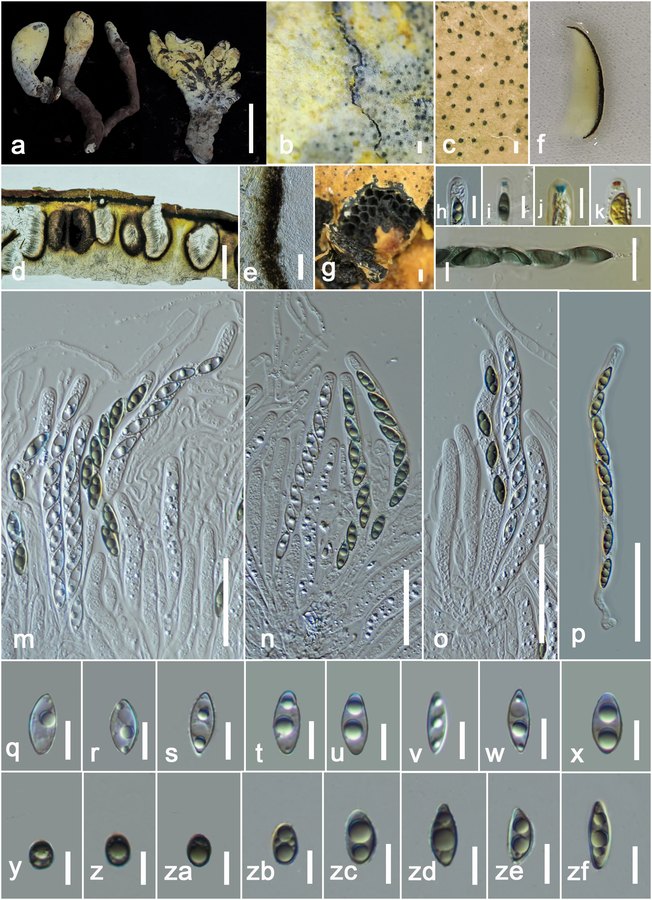
Young ones are whitish, with bulb-like tips. As they get older they go dark yellow and split into fingers, peppered with black dots where the spore chambers open. The team also noted that “the fresh stromata are very fleshy and dehydrate rapidly after being detached,” and that “there is no strong smell or taste from stromata.”
A king named for an ancient kingdom
“The scientists collected the fruiting bodies and deposited voucher specimens in the collections of the Kunming Institute of Botany. They grew spores on media to study the morphology of the fungus, and also sequenced its genome, including the ensemble of protein-coding genes,” Frontiers wrote.
The result was a new species, a new genus and a new family within the order Xylariales. “The authors named it Dianjunus rex, for its regal size and the ancient Dian kingdom,” and “jūn” is the Chinese word for mushroom or fungus. “The closest known relative to ‘D-rex’ is Graphostroma platystoma, which grows on dead hardwood across the northern hemisphere.”
The nearest lookalike was a mystery from 1903. A fungus called Squamotubera le-ratii was described that year from New Caledonia, in a few lines of Latin with no drawings, and the original specimen has since gone missing. It was smaller, about 2.8 inches (7 centimeters) high, and wrinkled and scaly on the outside, which D-rex is not.
A family that may date to the asteroid
To figure out how old the family is, the team used a molecular clock, which counts DNA differences between species and turns them into an estimate of when they split. It put the start of Dianjunaceae at about 65 million years ago.
“Strikingly, this is only one million years after the Cretaceous-Paleogene mass extinction event,” Frontiers noted, the extinction that followed the asteroid that struck Mexico’s Yucatán 66 million years ago.
“This timing raises an intriguing possibility. After the mass extinction, forests experienced dramatic changes, including the sudden availability of large amounts of dead plant material,” Senanayake said. “For wood-associated decomposing fungi, such environmental disruption may have created new ecological opportunities.”
Plenty of other groups got a fresh start in that wrecked world, and a fossil feather from Montana has offered clues to why some birds survived the asteroid.
Why a fungus would grow so big
“Why does ‘D-rex’ grow so uncommonly big? Until now, the record-holders among ascomycete fruiting bodies measured 20 to 30 cm tall,” Frontiers wrote, which is about 8 to 12 inches.
“A fruiting body which towers above surrounding vegetation and debris could have better dispersal of spores by wind in dense forests. However, such a large structure requires substantial energy investment, suggesting that this strategy likely evolved only where the ecological benefits outweighed the costs,” Senanayake said.
Its DNA hints at how it saves up for that. D-rex has fewer than half the carbohydrate enzyme genes of wood-rotting cousins like Xylaria, and almost none of the pectin lyases that fungi use to break the glue between plant cells. The team only ever saw the fruiting bodies on dying or dead trees, and their guess is that D-rex lives hidden inside healthy trees and starts feeding on the wood once the host dies.
What the team cannot say yet
The paper gives the age of the family as “approximately 65 (50–80) MYA,” a range that starts well before the extinction and ends long after it. The tree-dwelling stage is “a working hypothesis,” in the authors’ words, and the study offers no sample of the fungus from inside a healthy host.
On weight, the formal description gives “250–600 g weight” for the stromata, and the 2.2-kilogram figure comes from the largest two-lobed specimen. The same paper calls Engleromyces goetzei, a bamboo fungus from Kenya recorded at “around 3.2 kg,” or about 7 pounds, “the largest species reported within the order Xylariales to date.” D-rex belongs to that same order, so its record rests on height: it is the tallest ascomycete fruiting body on record, not the heaviest.
More fungi waiting in subtropical China
“The researchers predicted that more discoveries of fungi from subtropical China lie in store,” Frontiers wrote. Most of that life stays out of sight in underground fungal networks until something like D-rex comes up through the leaf litter.
“This region combines exceptional habitat heterogeneity, climatic stability, and complex biotic interactions that promote fungal diversification. Historically, however, fungal diversity in these ecosystems has been underestimated due to logistical difficulties in field sampling, the seasonal and cryptic nature of fungal fruiting, and a historical emphasis on economically important fungi,” Senanayake said.
The full study was published in Frontiers in Fungal Biology.
Song’s specimen from Damaidi now sits in the fungarium of the Kunming Institute of Botany as HKAS148941, the reference against which any future D-rex will be checked.
Image: Song et al. / Frontiers in Fungal Biology, CC BY 4.0