Fossil hunters usually go looking for bones, teeth or footprints. Few would think to crack open a lump of fossilized dinosaur poop hoping to find a feather, yet that’s exactly where one of the best-preserved bird feathers from the age of dinosaurs has turned up.
The 66-million-year-old feather, found inside a coprolite from Montana, belonged to an extinct diving bird that was eaten by a large meat-eating dinosaur. Scientists say its structure could help answer a long-standing puzzle in paleontology, namely why the ancestors of today’s birds survived the asteroid impact that wiped out the other dinosaurs, while many other bird groups did not.
A lucky find on a rocky slope
The fossil was discovered back in 2016 by David DeMar Jr., a research scientist at the University of Washington’s Burke Museum, in the Hell Creek Formation of eastern Montana. “I was crawling up a rocky outcrop collecting fish fossils when I came across a dark, reddish-brown nodule about half the size of a golf ball,” he recalled.
He took a closer look with a hand lens and got a surprise. “I picked it up and scanned its surface through my hand lens, and that’s when I couldn’t believe what I was seeing, a tiny fossil feather,” DeMar said, according to the University of Washington.
The results were published on September 10, 2026, in a study led by Jingmai O’Connor, associate curator of fossil reptiles at the Field Museum in Chicago.
What exactly is a coprolite?
A coprolite is simply fossilized dung. Over millions of years, minerals replace the original material, turning a very ordinary piece of waste into rock that can preserve bits of an animal’s last meal.
To see inside without breaking it, the team used CT scanning, which the Field Museum describes as “essentially, thousands of X-rays that are digitally stacked to reveal the contents of an object.” It’s the same basic idea as a hospital scan, just pointed at a rock.
“Every hour processing the data revealed another feather, another scale, another bone, in stunning 3D,” said Nate Carroll, a paleontologist at the Carter County Museum.
A meal inside a meal
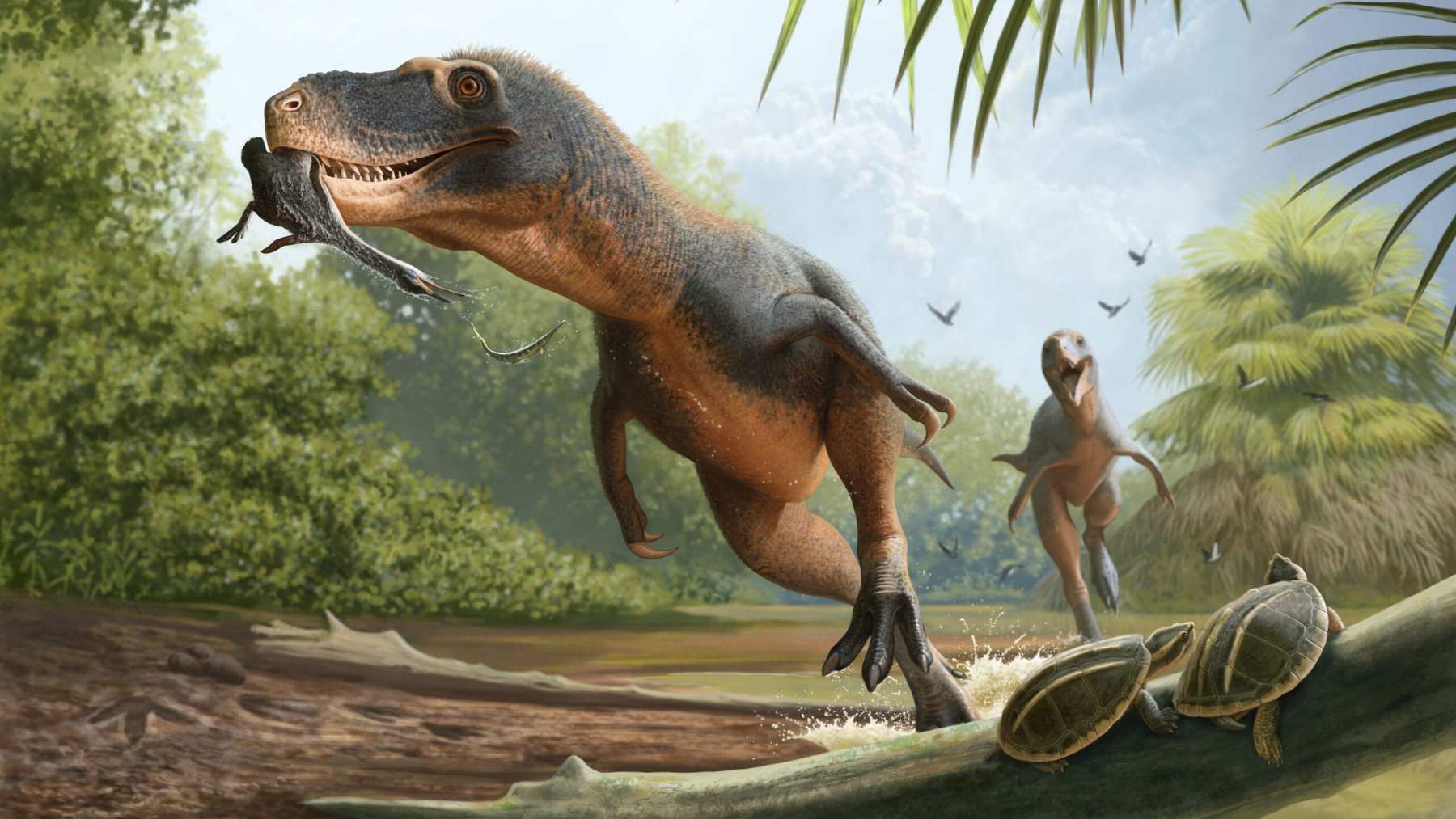
The scans showed several feathers, tiny scales from a gar fish and leg bones from a hesperornithiform bird. Hesperornithiforms were aquatic birds, ecologically similar to modern loons, that used their feet to dive for fish. Most of them couldn’t fly.
So the fish scales were probably the bird’s own dinner. The bird, in turn, became a snack for a theropod dinosaur, possibly a T. rex or a Nanotyrannus, which later left behind the evidence.
Gregory Wilson Mantilla, a biology professor at the University of Washington and curator at the Burke Museum, said the find offers “an incredible window into predator-prey interactions 66 million years ago.” Think of it as a crime scene frozen in stone.
Modern feathers, with a twist
What makes the fossil special is the feather design. Two of the feathers had a square shaft with a spongy, lightweight center, a feature otherwise known only from living birds and their immediate ancestors.
According to the researchers, no other feather from the Mesozoic era (the age of dinosaurs) shows this combination. The next comparable record comes from Early Eocene fossils in Denmark, roughly 10 million years younger. The main feather is tiny, too, at about 0.37 inches long.
But the bird’s plumage wasn’t fully modern. “Some of these diving birds’ feathers seem to have been modern-looking and waterproof, but they also had some smaller fuzzy, primitive body feathers,” O’Connor explained.
Why feathers might have decided who survived
That mix is the key to the team’s idea. When the asteroid hit, the planet went through what scientists call an impact winter, a period of darkness and cold that lasted long enough to push many species over the edge.
Hesperornithiforms lived in watery habitats similar to those of some surviving bird lineages, yet they vanished. O’Connor suggests their older-style body feathers may not have insulated as well as the fluffy down of modern birds, the kind that keeps a duck warm on a freezing lake.
“We think the types of feathers that these birds had, and/or the way they molted those feathers, may have been one of the underlying causes of the selectivity of the end-Cretaceous mass extinction,” she said. In other words, a good winter coat may have mattered more than we thought.
Not everyone is convinced
It’s worth keeping some caution here. The feather is a single, remarkable data point, and the survival idea remains a hypothesis rather than a proven explanation.
Some experts are skeptical. Paleontologist Julia Clarke put it bluntly, according to Smithsonian Magazine. “It’s a stretch to explain the survivorship of some [species] and the extinction of others from that evidence.”
A new place to look for clues
For O’Connor, the bigger lesson may be about where scientists search. “As far as I know, no one has ever thought to look for feathers or to study feathers in coprolites, so this project was really exciting,” she said.
That’s a big deal, because Hell Creek is already one of the richest fossil sites in North America, famous for Tyrannosaurus and Triceratops, as the UC Museum of Paleontology notes. Countless coprolites sit in museum drawers, and many have never been scanned.
The fossil itself is now on permanent display at the Burke Museum in Seattle. “It’s such a beautiful, well-preserved feather, from such an unexpected source, and it’s exciting that it could help us answer this huge question in paleontology,” O’Connor said. Not bad for a lump of ancient poop.
The main study has been published in Current Biology.
Illustration: Andrey Atuchin / University of Washington