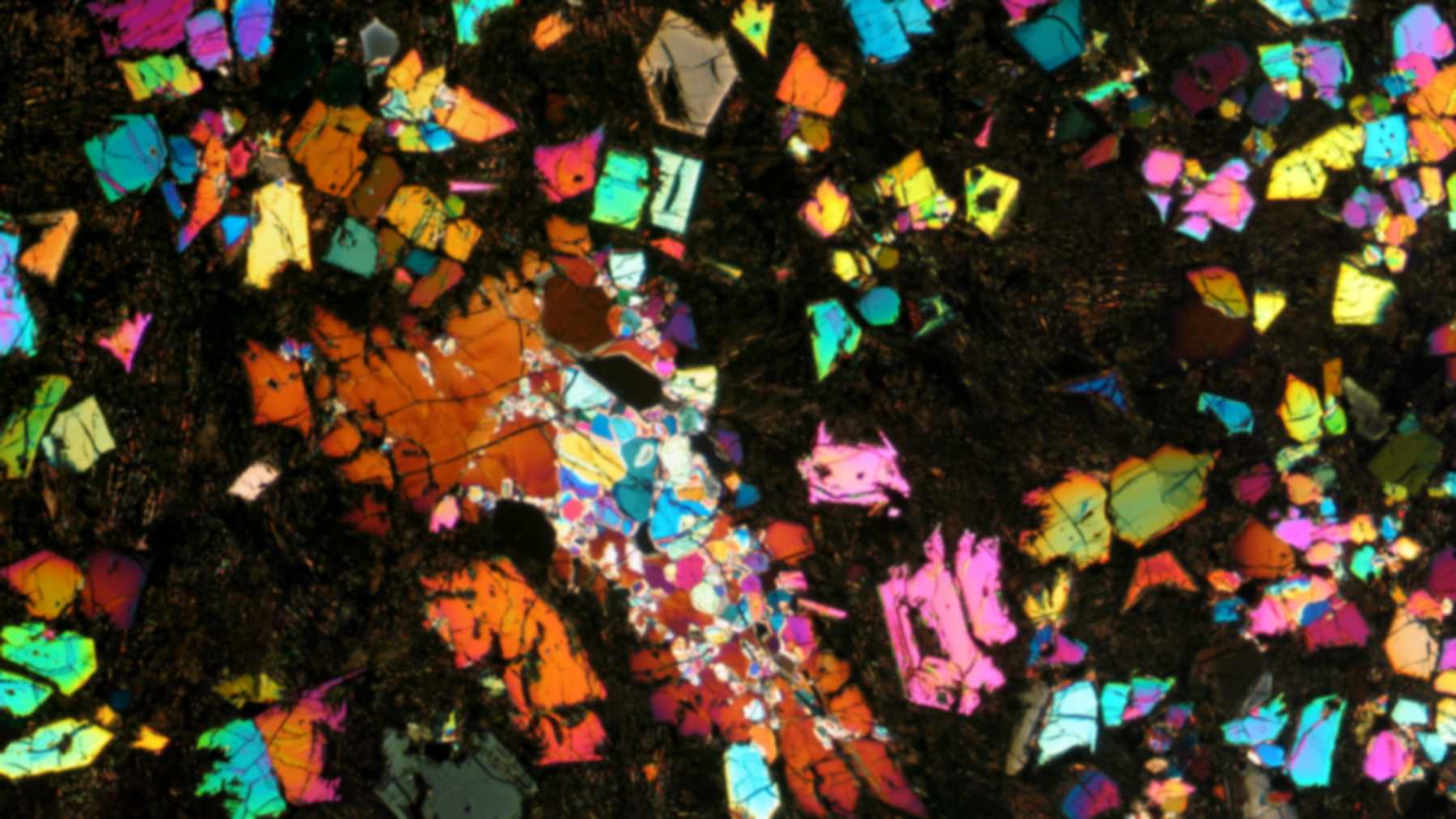
A 1-pound angrite meteorite from the Sahara Desert, Northwest Africa 12774, holds crystals that grew at about 17.56 kilobars, roughly 255,000 pounds per square inch, according to a study in the July 2026 issue of Earth and Planetary Science Letters. A team led by Aaron Bell of the University of Colorado Boulder says that pressure takes a world at least 621 miles (1,000 kilometers) in radius, or about 1,240 miles (2,000 kilometers) across.
The claim at the center of the study, announced by CU Boulder on June 1, 2026, is that angrites came off a protoplanet, a planetary embryo, and not a little asteroid.
A stone with no find site
According to the Meteoritical Bulletin, Rachid and Jaouad Chaoui bought it from a Mauritanian dealer in March 2019, and Marc Jost and Karl Wimmer acquired the main mass from them at the Ensisheim Show that June. The bulletin describes a single dark, dense stone of 454 grams lacking fusion crust, and lists its coordinates as “Unknown.”
Tony Irving of the University of Washington classified it in 2019 with P. Carpenter of Washington University in St. Louis, and lent Bell’s team a thin section. Bell, an assistant research professor in the Department of Earth Science, worked with Laura Waters, an associate professor of Earth and Environmental Sciences at New Mexico Tech in Socorro, and Mark Ghiorso.
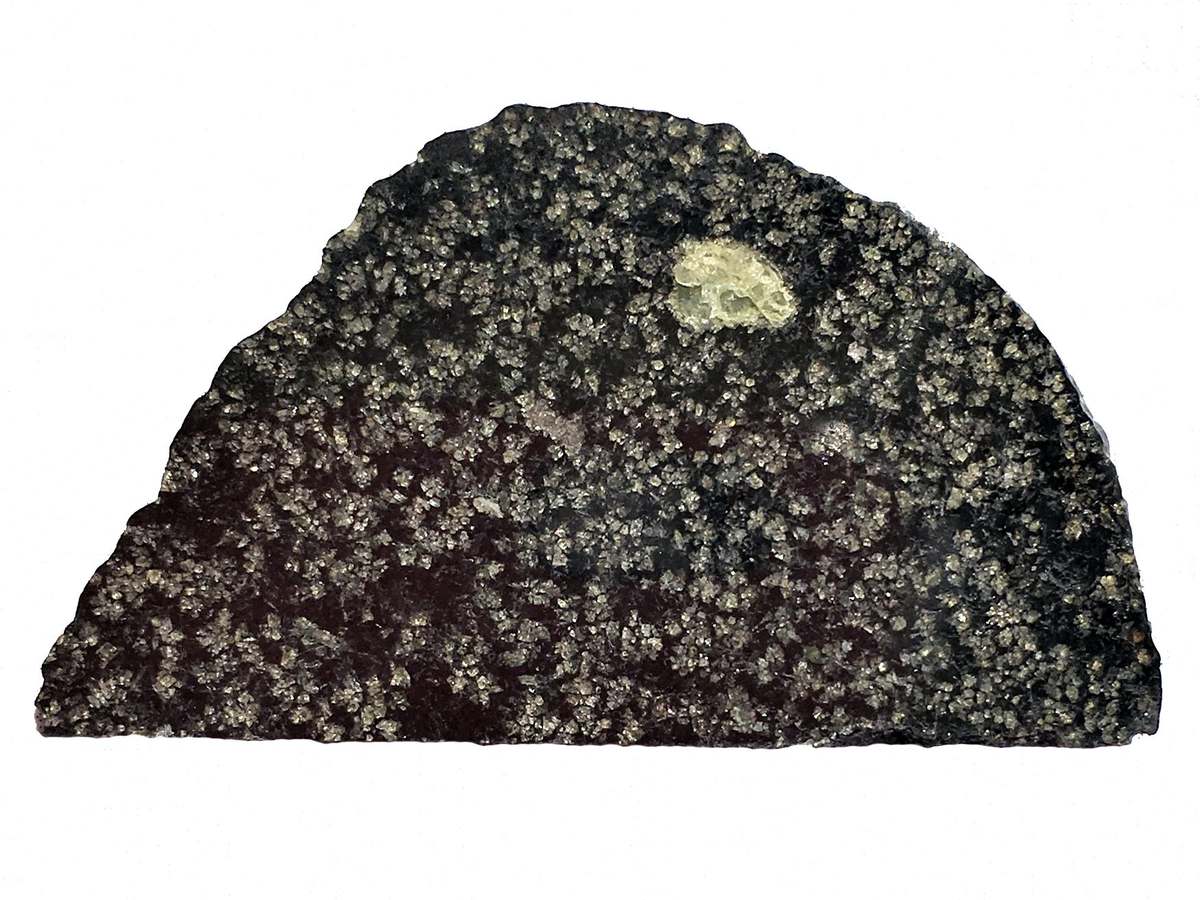
“It’s incredible to think there was once a world this large,” Bell said in the CU Boulder release. The world is known only because a few of its fragments happened to land on Earth, he added.
Sixty-eight rocks and a small-asteroid story
CU Boulder counts 68 angrites out of more than 80,000 meteorites found on Earth, and the bulletin lists 67 approved ones. The paper describes them as igneous achondrites with crystallization ages among the oldest known materials in the solar system, only 4 million years younger than the earliest solids formed from the solar nebula.
Angrites hold very little silica, a major ingredient of Earth, Mars and nearly every rocky planet. So scientists thought they came from an asteroid less than 124 miles (200 kilometers) in radius, CU Boulder says, a body the paper compares to 4 Vesta.
A pressure gauge built from scratch
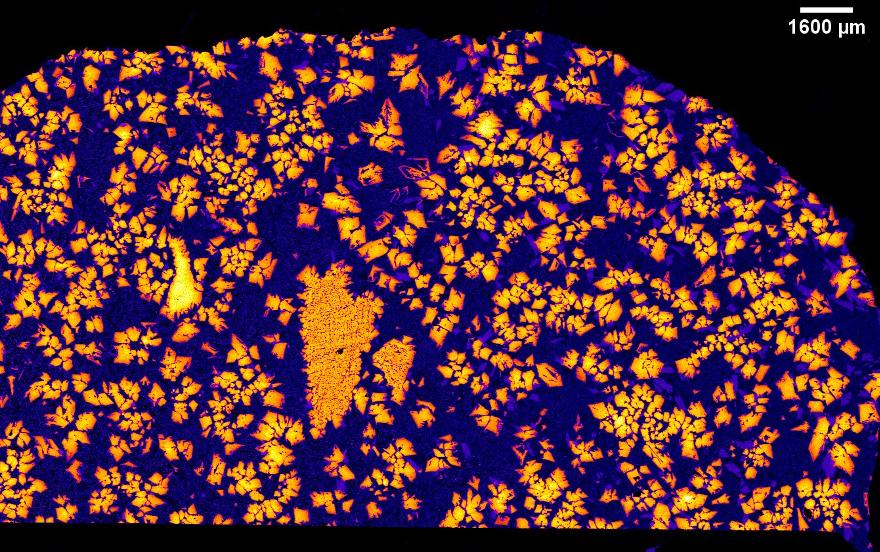
The bulletin lists 17.0 to 17.7 percent aluminum oxide, by weight, in the rock’s augite crystals. CU Boulder calls that much aluminum “a telltale sign that the rock formed under enormous pressure deep underground.”
Putting a number on it takes a geobarometer, a formula that reads pressure from crystal chemistry. The usual ones run on sodium, which angrite melts and their crystals lack, so the team built a new one. New Mexico Tech says it took a year of development and testing.
The new gauge gave a mean crystallization pressure of 17.56 kilobars, plus or minus 0.89. For scale, CU Boulder notes, the bottom of the Mariana Trench sits at around 1 kilobar.
“Essentially, we found evidence of a massive, long-lost planet formed early in the history of the solar system but destroyed through impact,” Waters said in the New Mexico Tech release.
At least 1,240 miles across, maybe moon-sized
Pressure grows with the weight of rock overhead, and the deepest the crystals could have formed is the top of the metal core. Assuming a core that makes up 20 percent of the mass, with a density of 8,000 kilograms per cubic meter and a mantle at 3,400, the authors calculate that the parent body needed a radius of at least 1,000 kilometers.
The crystals’ edges are still sharp, which suggests the rock rose quickly and was stored only briefly before erupting, so the crystals likely formed at modest depths. If they grew less than 200 kilometers down, the paper says, the minimum radius is pushed beyond 1,800 kilometers, about 1,118 miles, comparable to the moon. CU Boulder floats a world possibly approaching the size of Mars, but the study’s own estimate stops at the moon.
Four million years in
“For a planet of this size to exist when our solar system was so young suggests the process of planetary accretion occurs much faster than previously thought,” Waters said.
Her university’s release puts the usual model estimate for building planets at 50 million to 100 million years, while this work points to about 4 million. New Mexico Tech says a high-pressure rock this old also supports pebble accretion, the idea that planet-sized bodies grow from particles ranging from centimeters up to meters in diameter.
Telescopes have caught signs that baby planets may start forming within a few hundred thousand years around newborn stars. If the large-body hypothesis holds, the paper says, angrites are the first recognized samples of a sizeable, first-generation protoplanet from the inner solar system, like the embryos predicted by accretion models.
Bell’s group wasn’t first to the big-body idea. In 2022, François Tissot of Caltech and three colleagues ran crystallization experiments and concluded that the parent body was large, possibly moon-sized, and formed from materials condensed at about 1,880 to 2,060 degrees Fahrenheit (1,030 to 1,130 degrees Celsius). The new pressures, his team writes, are the first direct evidence that the body reached a radius of at least 1,000 kilometers.
“The materials that formed the angrite parent body are fundamentally different from the ingredients of Earth and Mars,” Bell said. Meteorites keep turning up in this line of work, like a tiny Martian meteorite with clues inside, alongside lab tests on how Earth’s water may have formed in molten rock.
One stone, many open questions
The authors note that the pressures cannot be translated directly into a radius, only into a minimum size, because the core-mantle boundary is the deepest point where the crystals could have formed. So the 621-mile figure leans on an assumed core share and assumed densities, and the moon-size figure leans on a depth no one can measure.
It is also mostly one rock. Only NWA 12774 and NWA 7812 carry this aluminum-rich augite, and the bulletin rules out that the two stones are paired because their mineral and whole-rock compositions differ.
How the protoplanet died is open too. CU Boulder says a catastrophic event may have shattered it, the kind of crash astronomers think they saw when two planets may have collided around another star, with its pieces later feeding other rocky planets, Earth included.
Many meteorites sitting in drawers haven’t been thoroughly studied, he said, so there were likely more of these protoplanets that scientists don’t know about.
The full study was published in Earth and Planetary Science Letters.
Photo: John Kashuba