Scientists working off Australia’s Cocos (Keeling) Islands have described a genus of deep-sea spaghetti worms new to science, named Terebellosuctoria for the suction cup on each worm’s underside. The Australian Museum and CSIRO, Australia’s national science agency, announced the find on Oct. 14, 2026. The orange worms were hauled from a seamount about 2,200 feet down by the CSIRO research vessel Investigator.
The formal description appeared on July 8, 2026, in Records of the Australian Museum, the museum’s peer-reviewed, open-access journal. Elena Kupriyanova, a senior research scientist at the Australian Museum, led the study. Pat Hutchings, a senior fellow at the museum and a marine worm specialist, named the genus with Guillemine Daffe and Nicolas Lavesque, both with France’s CNRS and the University of Bordeaux.
A tangle that was not an animal
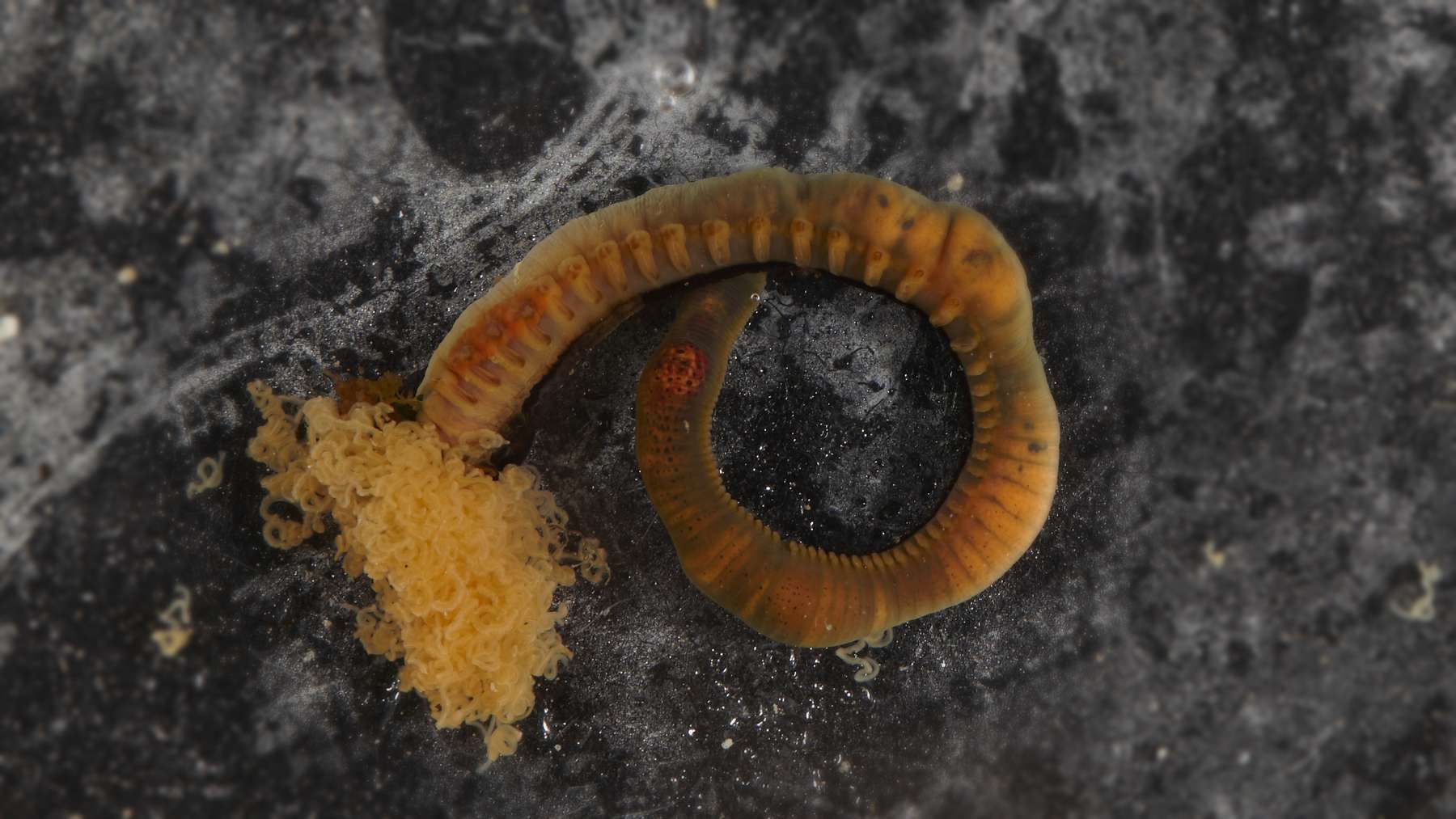
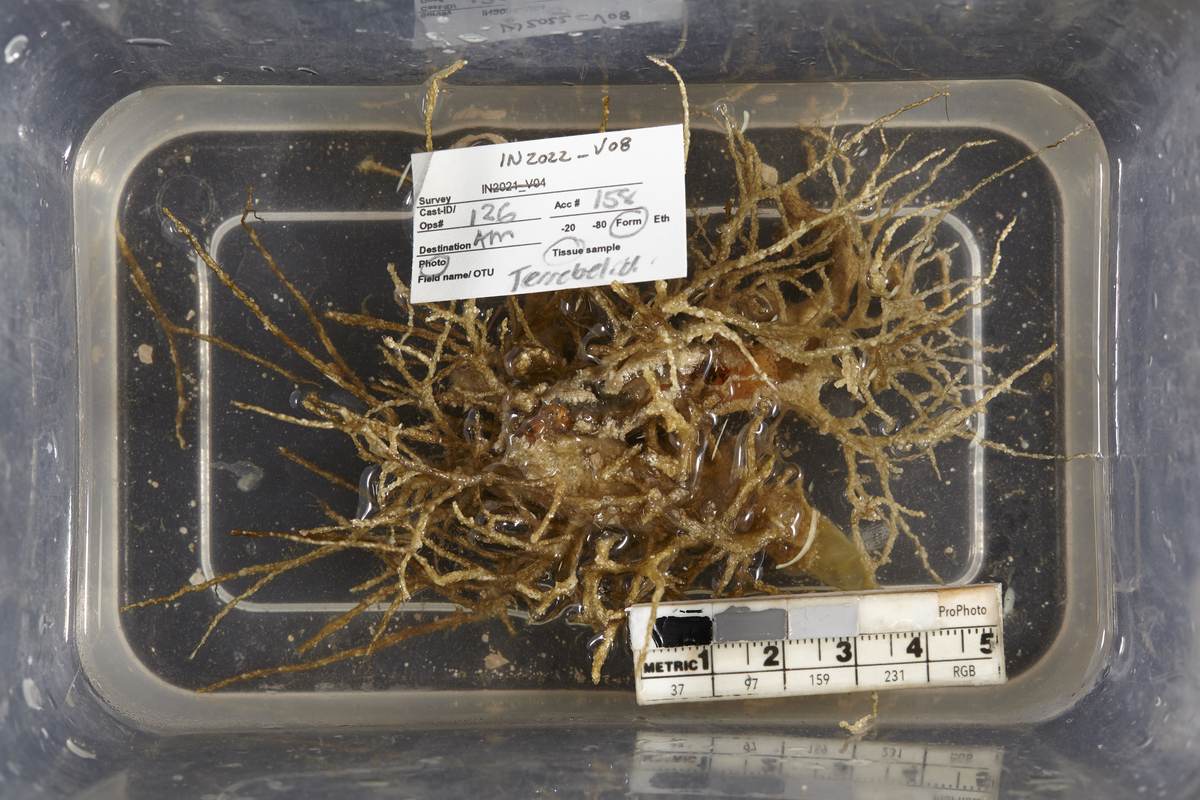
The beam trawl came back with a tangle of branching brown tentacles, and Kupriyanova spotted orange spheres caught in the branches. They looked “suspiciously a lot like polychaete eggs,” she said in a statement from the Australian Museum. Dissection showed that the branching mass was not an animal at all, according to the museum. The branches were elaborate extensions of the worms’ tubes, and bright orange worms up to 75 millimeters (about 3 inches) long came out of them.
Each tube is a large, clear sheath of chitin, the tough material in insect shells, coated with foraminifera, tiny single-celled organisms with shells. The tubes branch out and are cemented together, the paper says. The orange spheres were eggs about 0.004 inch (0.1 millimeter) across, found in the tubes of females carrying them.
Why they are called spaghetti worms
Terebellosuctoria belongs to the polychaetes, marine worms with segmented bodies and bristled side feet. The museum notes that polychaetes may look like centipedes, but their close relatives are earthworms. Spaghetti worms make up the family Terebellidae and build tubes in soft sediment. Their nickname comes from their many long tentacles, which pick fine food particles off the mud.
The type specimen of the first new species, the single animal that anchors a species name, came up on Oct. 6, 2022, from a seamount at 2,126 to 2,211 feet (648 to 674 meters). It is 15 millimeters (0.6 inch) long and was reddish orange in life.
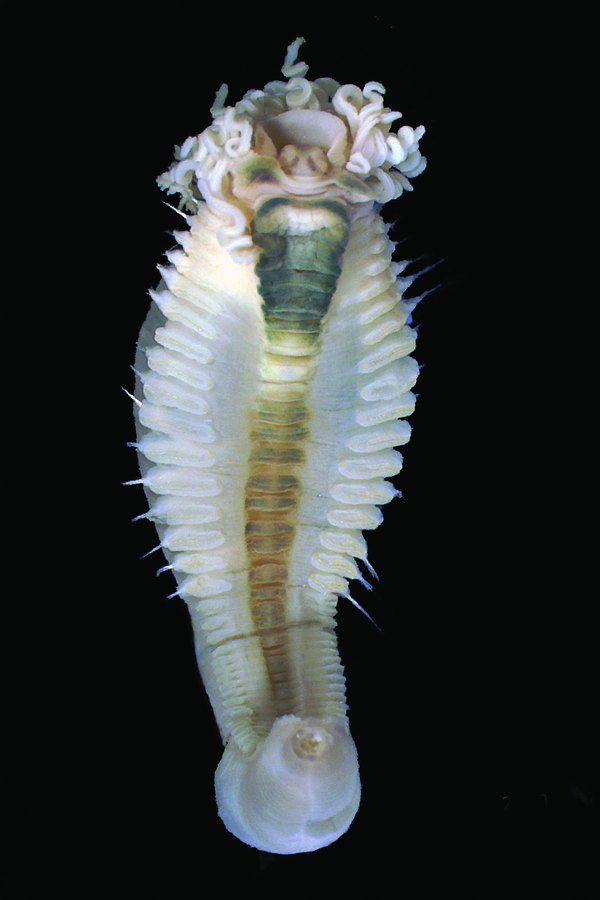
A suction cup on the belly
On these worms, the pads under segments 3 to 8 join into one raised, pigmented sucker with brown, folded edges. The authors write that the pads “resemble a suction cup, hence ‘Terebellosuctoria.'” The name joins Terebella, the family’s founding genus, with suctorius, a New Latin word meaning suited for sucking.
“The sucker-like structure is what makes this new genus so interesting and unique,” Kupriyanova said.
A genus is the rank just above species. New deep-sea species turn up fairly often, but a new genus is rare.
Two new species and a renamed one
The paper names two species in the new genus. Terebellosuctoria jimii has three pairs of gills and eyespots. Terebellosuctoria keelingensis has two pairs of gills and no eyespots, came from another seamount off the islands at 1,532 to 1,565 feet (467 to 477 meters), and builds simple tubes instead of branched ones.
The first name honors Naoto Jimi of Nagoya University in Japan, the first to describe this kind of ventral sucker in a terebellid. In 2025, Jimi and colleagues described a worm with a similar sucker off Minamidaito Island, Okinawa, and placed it in the genus Lanice for the time being. The new paper moves it into Terebellosuctoria, so the genus now holds three species from the Indian and Pacific oceans.
Jimi’s team had suggested that the sucker helps the Okinawa worm hold on to sponges. The two Cocos species were not associated with sponges or any other organisms, the authors write. The sucker may instead help sediment-dependent worms persist where sediment is scarce, such as on seamount slopes, the underwater mountains where these worms were found.
Seven new species from two voyages
Museums Victoria led the voyages to the seamounts of Christmas Island and the Cocos (Keeling) Islands in 2021 and 2022, according to a CSIRO release. Before 2020, the paper notes, there were no systematic studies of seafloor animals in the deep sea off Australia’s west coast.
The museum says the expeditions collected more than 850 marine worms. Scientists had already described 13 new species from the haul, and the new paper adds seven more: the two spaghetti worms, two onuphid worms and three scale worms. Before 2017, only 15 of Australia’s more than 2,000 known annelid species had been described from below 3,281 feet (1,000 meters).
Marine worms are among the most abundant and diverse animals on the seafloor, and many help recycle nutrients, Hutchings said. Like many marine invertebrates, they go unseen, and only “a tiny fraction has been officially named and described.”
“An expedition may collect hundreds or thousands of specimens, but discovering what they actually are can take years,” Kupriyanova said. For T. jimii, it took nearly four years from trawl to name.
Deep-sea specimens from off northwestern Australia also produced a giant-eyed octopus, Opisthoteuthis carnarvonensis. In Germany, a giant isopod from Puerto Rico sat in a University of Tübingen collection under the wrong name for decades, and NOAA scientists found nine new deep-sea sponges in Alaska trawl samples going back to 1997.
What is still unknown
Because sampling remains limited, the authors say it is too early to draw firm conclusions about the geographic range of the new species. Both new spaghetti worms are known only from seamounts off the Cocos (Keeling) Islands. One more worm from the voyages likely constitutes a new species but is not formally described, and two scale worms belong to a potential new genus that the team will address in future work.
In 2022, Australia set aside most of these waters as the Christmas Island Marine Park and the Cocos (Keeling) Islands Marine Park. The authors call studies like this one an essential first step to managing the global marine reserve system. The full study was published in Records of the Australian Museum.
Photo: CSIRO