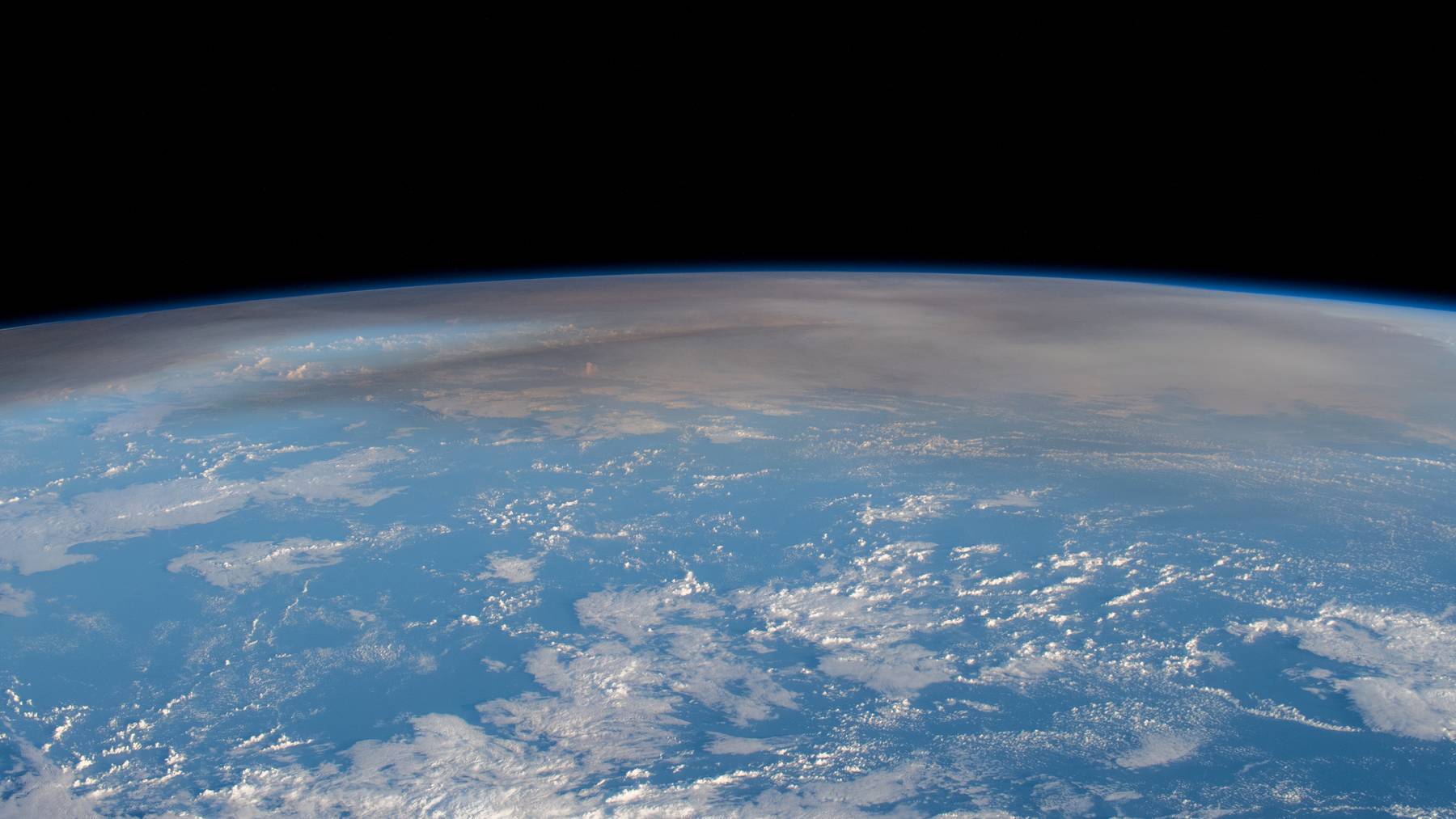
Satellite readings show that the Hunga Tonga eruption’s plume broke down about 900 metric tons (990 short tons) of methane a day. The reaction ran high in the stratosphere over the South Pacific in January 2022. A team led by Maarten van Herpen of Acacia Impact Innovation in the Netherlands reported it in Nature Communications on May 7, 2026.
The same math implies the volcano first pushed at least 330,000 metric tons of methane into the stratosphere. The University of Copenhagen, whose chemists took part, compares that to a year of methane from more than two million cows. At 900 tons a day, the cleanup covered a small share of that gas.
Record readings at 19 miles
Hunga Tonga-Hunga Ha’apai sat about 492 feet (150 meters) below sea level. It exploded at 5 p.m. local time on January 15, 2022. The study says it threw material as high as 34 miles (55 kilometers).
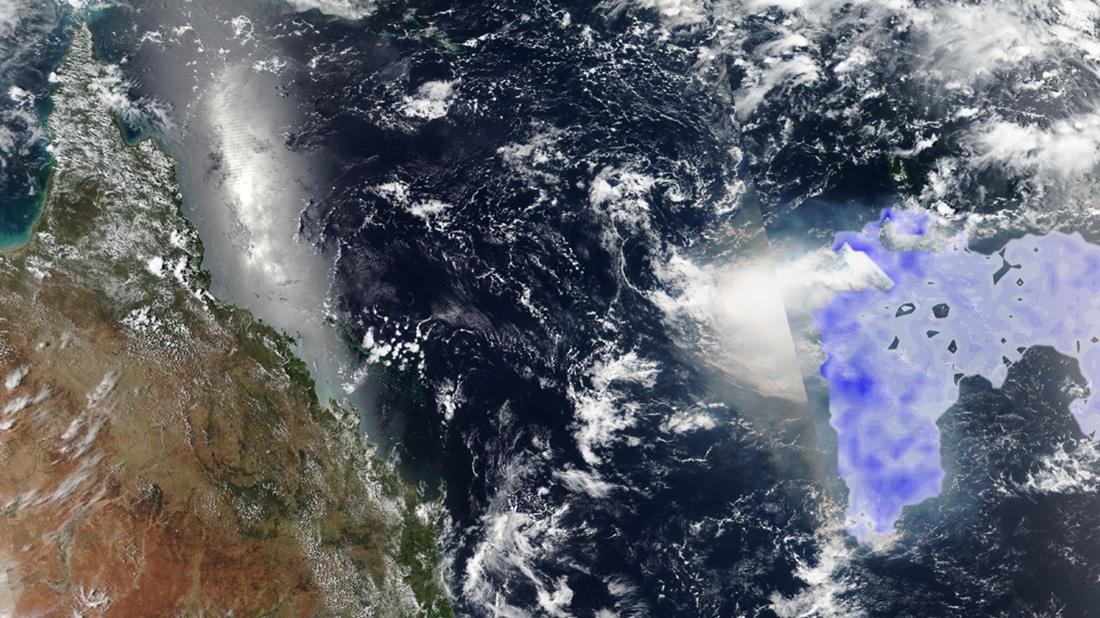
Twenty hours later, the TROPOMI instrument on ESA’s Sentinel-5P satellite passed over the plume near New Caledonia. It found formaldehyde at up to 12 parts per billion about 19 miles (30 kilometers) up. That is the highest level ever recorded in the stratosphere.
Formaldehyde’s 2.5-hour lifetime
Formaldehyde is a step on the path from methane to carbon dioxide. “When we analysed the satellite images, we were surprised to see a cloud with a record-high concentration of formaldehyde. We were able to track the cloud for 10 days, all the way to South America,” van Herpen said in the university’s announcement.
At midday inside the plume, sunlight destroys formaldehyde in about 2.5 hours. Any formaldehyde blown out by the volcano itself should have been 95 percent gone by the first satellite pass. By the second pass, 99.95 percent should have disappeared.
Instead, the total seen on January 17 roughly matched January 16. Traces were still visible on January 25. The authors read that as in-plume production, with the cloud itself making formaldehyde.
Each methane molecule that breaks down yields about one formaldehyde molecule. Dividing the amount by its lifetime gave about 75 metric tons of methane destroyed per hour at midday on January 16. Adjusted for sunlight over a full day, that came to 900 tons, give or take 220.
Chlorine from seawater and ash
Methane in the air is usually destroyed by hydroxyl radicals, short-lived molecules of one oxygen and one hydrogen atom. If hydroxyl did all the work, the plume needed at least 2.3 million metric tons of methane. ACE-FTS, an instrument on Canada’s SCISAT satellite, found no such excess in its 2022 monthly profiles.
Chlorine atoms fit the data better. The paper puts the needed supply at 2,000 to 5,000 metric tons of new chlorine per day, and no known mechanism provides it.
Their candidate is iron in fine ash mixed with sea salt. Along with ash and salt, the eruption lofted about 146 million metric tons of water, close to 10 percent of all stratospheric water. When sunlight hits iron and chloride together, chlorine atoms break free and attack methane.
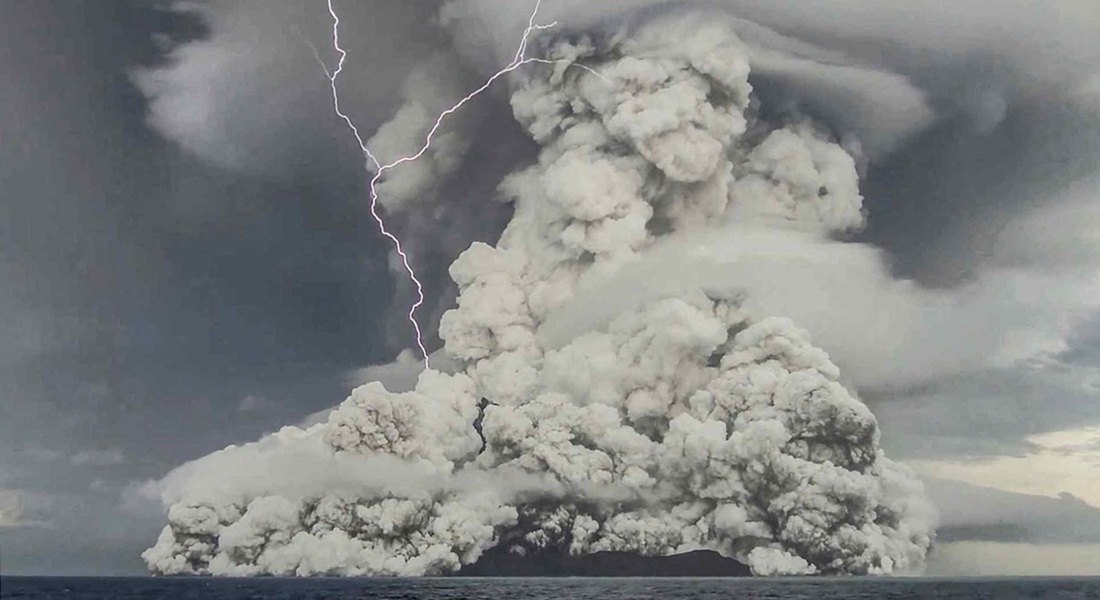
Matthew Johnson, a chemistry professor at the University of Copenhagen, helped find this reaction in 2023. It happens where Saharan dust meets sea spray over the Atlantic. Now it “appears to occur in a volcanic plume high up in the stratosphere, where the physical conditions are entirely different,” he said.
Methane in, methane out
In the chlorine scenario, the plume held at least 14 parts per million of methane on January 16. Background methane at that altitude is around 1 ppm, the paper says. That gap gives the minimum of 330,000 metric tons injected.
Breaking methane down does not erase its carbon, since the chain ends in carbon dioxide and water. Still, methane is about 80 times as potent as carbon dioxide over 20 years and lasts only about a decade, the university notes.
Johnson wants the global methane budget revised. “Because dust has not previously been taken into account, it is important that we correct the data on which these estimates are based,” he said. Trends such as Siberia’s summer methane, which roughly doubled from 2010 to 2023, rest on that budget.
Proof for methane removal
Several groups are studying ways to speed up methane’s natural breakdown, such as lofting iron particles into the air. Others test strategies built on temporary carbon capture. A National Academies report named verification as a key gap, the study says.
Satellites that read methane directly struggle over water, which reflects little infrared light. TROPOMI reads formaldehyde in ultraviolet light, so it works over the ocean. “But here we address that problem by showing that methane breakdown can in fact be observed using satellites,” said senior author Jos de Laat of the Dutch weather institute KNMI.
Johnson calls copying the volcano an obvious idea for industry, “but only if it can be proven to be safe and effective.” Open-air trials already draw pushback, as Mexico’s response to a startup’s sulfur balloons showed.
Iron chemistry awaits lab tests
The authors call the iron and salt reaction plausible, not proven, and say laboratory work and plume models must confirm it. The 330,000-ton figure is also an inference. ACE-FTS first crossed the plume on February 6, 2022, and its methane data that day were invalid.
This eruption, which sent a pressure wave around the planet, was unusual in other ways too. It carried huge amounts of seawater and fairly little sulfur dioxide, so other volcanoes may behave differently. On day one, sulfur dioxide inflated formaldehyde readings in part of the plume by about 40 percent.
The full study was published in Nature Communications. Co-authors work at the Royal Belgian Institute for Space Aeronomy, Spain’s CSIC and Utrecht University, according to the University of Copenhagen announcement.
Photo: NASA / Kayla Barron