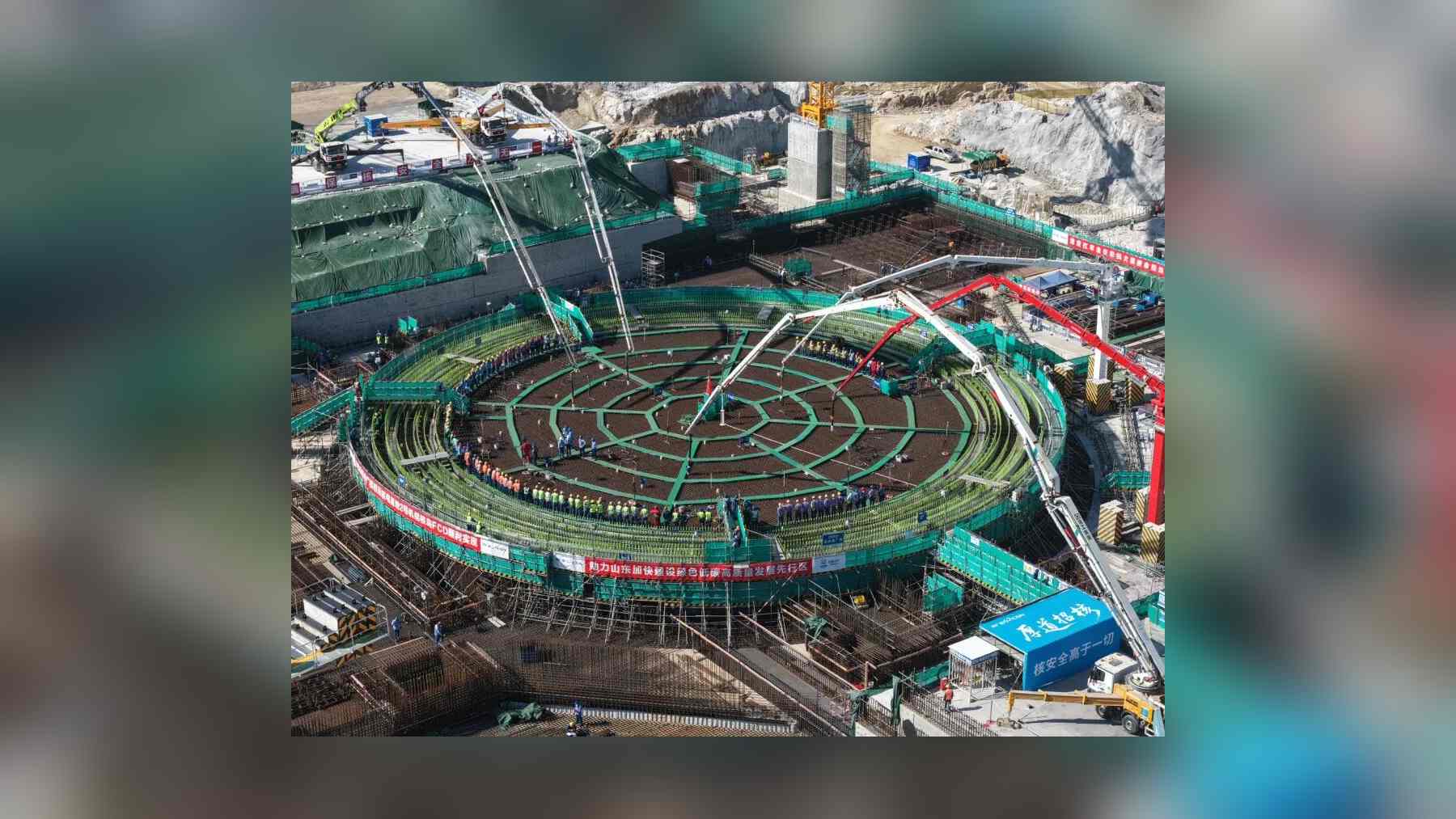
China General Nuclear (CGN) began pouring concrete for Unit 2 at its Zhaoyuan nuclear plant on September 5, 2026. The pour in Shandong province started at 9:18 a.m. and called for about 8,800 cubic meters (roughly 311,000 cubic feet) of concrete. It was expected to run nonstop for about 60 hours, according to a CGN statement published by China’s National Nuclear Safety Administration.
That first pour on the nuclear island, known in the industry as FCD, marks the formal start of main construction. CGN says it moves the first phase of the project into full-scale construction. The coastal site is planned for six Hualong One units, a Chinese-designed pressurized water reactor.
A 177-foot raft of concrete
The concrete went into the raft foundation under Unit 2’s reactor building, according to CGN. It is a solid cylinder with a radius of 27 meters (about 89 feet) and a height of 3.7 meters (about 12 feet). That makes a slab roughly 177 feet across.
According to the Zhaoyuan city government, crews fed the concrete through seven pouring points at once. That let them cast the foundation in one continuous operation. The city compared the volume to about 3.5 standard swimming pools.
Other reactor projects also start with a heavy base, such as the 1,050-ton slab Canada laid east of Toronto. At Zhaoyuan, CGN credits a digital system linked to China’s Beidou satellite network with cutting human error during pours. The company says 17 advanced building techniques have been used since phase one began.
Unit 1 is already rising
Unit 2 sits beside Unit 1, whose main construction started on November 18, 2025. Both reactors won national approval on August 19, 2024. Zhaoyuan is CGN’s tenth nuclear power base in China, the company said.
On the neighboring unit, workers have lifted four steel liner modules into the reactor building, the project’s chief commander told the city. The liner now reaches 29.72 meters (about 97.5 feet). Crews are also building the turbine foundation and circulating water pump pit, and installing rebar cages on the cooling tower.
Six 666-foot cooling towers
Each of the six units is planned with a natural-draft cooling tower 203 meters (about 666 feet) tall. Each tower has a water spray area of 16,800 square meters (about 4.2 acres). CGN says Unit 1 is the first Hualong One in China designed with one.
China’s reactors are concentrated along its eastern coastline, according to the Energy Information Administration (EIA), the federal energy statistics agency of the United States. At Zhaoyuan, CGN says the towers will change where the turbine side of the plant sends its heat. Its direct cooling source shifts from the sea to the atmosphere.
In a wet cooling tower, warm water from the condenser gives up its heat to rising air, mainly through evaporation. The cooled water is collected and pumped back for reuse. Because some of it leaves as vapor, the plant still needs make-up water.
The International Atomic Energy Agency (IAEA) spells out the tradeoff in its Climate Change and Nuclear Power 2018 report. “Thermal plants with once-through cooling withdraw significantly more water than plants employing cooling towers, but consume (evaporate) less,” the agency writes.
50 billion kilowatt-hours a year
Once all six units run, CGN expects the site to generate about 50 billion kilowatt-hours a year. The estimate uses the average operating hours of Chinese nuclear plants in 2025. CGN says that would cover the yearly production and household power needs of more than 5 million people.
The company puts the yearly savings at about 15.02 million metric tons of standard coal, a unit of energy content. It also projects 46.2 million metric tons less carbon dioxide each year. CGN likens that to planting more than 110,000 hectares (about 272,000 acres) of forest.
Yu Xiangdong is party secretary and executive director of Shandong Zhaoyuan Nuclear Power Co. He said more than 300 companies from Shandong have signed on to work with the plant. He also said Zhaoyuan is plugging into the Jiaodong Peninsula’s clean heating grid and will test nuclear heat and steam for factories.
China’s 36 reactors under construction
Two Zhaoyuan reactors now count toward a national tally that the EIA tracks using IAEA data. Its June 5, 2026, analysis counted 36 reactors being built at 19 sites, more than 49 percent of the world’s total.
By May 2026, 60 Chinese reactors were running, with 58.7 gigawatts spread over 18 sites, by the agency’s count. “Reactors are built in batches of 6 to 10 reactors to take advantage of economies of scale,” the EIA wrote. China is also building a domestic supply chain for the main plant parts.
The EIA cited a status report that put China’s average build time from 2012 to 2021 at six years. The global average was about nine. Western vendors have their own plans, with Westinghouse seeking up to 91 nuclear units abroad.
First power still lacks a date
CGN’s statement lists liners, pump pits and rebar cages, yet gives no year for first electricity from either Zhaoyuan unit. The city’s notice skips it too, and Unit 2 broke ground nearly ten months after Unit 1.
Whether 46.2 million metric tons of carbon dioxide really stay out of the air each year hinges on which Shandong coal or gas plants run less, and CGN names none. On its nuclear and environment page, the EIA says reactors emit no carbon dioxide while operating. Still, “Nuclear power plants are constructed with large amounts of metal and concrete, which require large amounts of energy to manufacture.”
The IAEA puts mean life cycle emissions from nuclear power at 5 to 20 grams of CO2 per kilowatt-hour. The EIA lists radioactive waste as a major environmental concern. Spent fuel can wait in storage for decades, as it has at Oregon’s closed Trojan nuclear plant.
The CGN statement on Unit 2 was published by China’s National Nuclear Safety Administration on September 11, 2026.
Photo: China General Nuclear