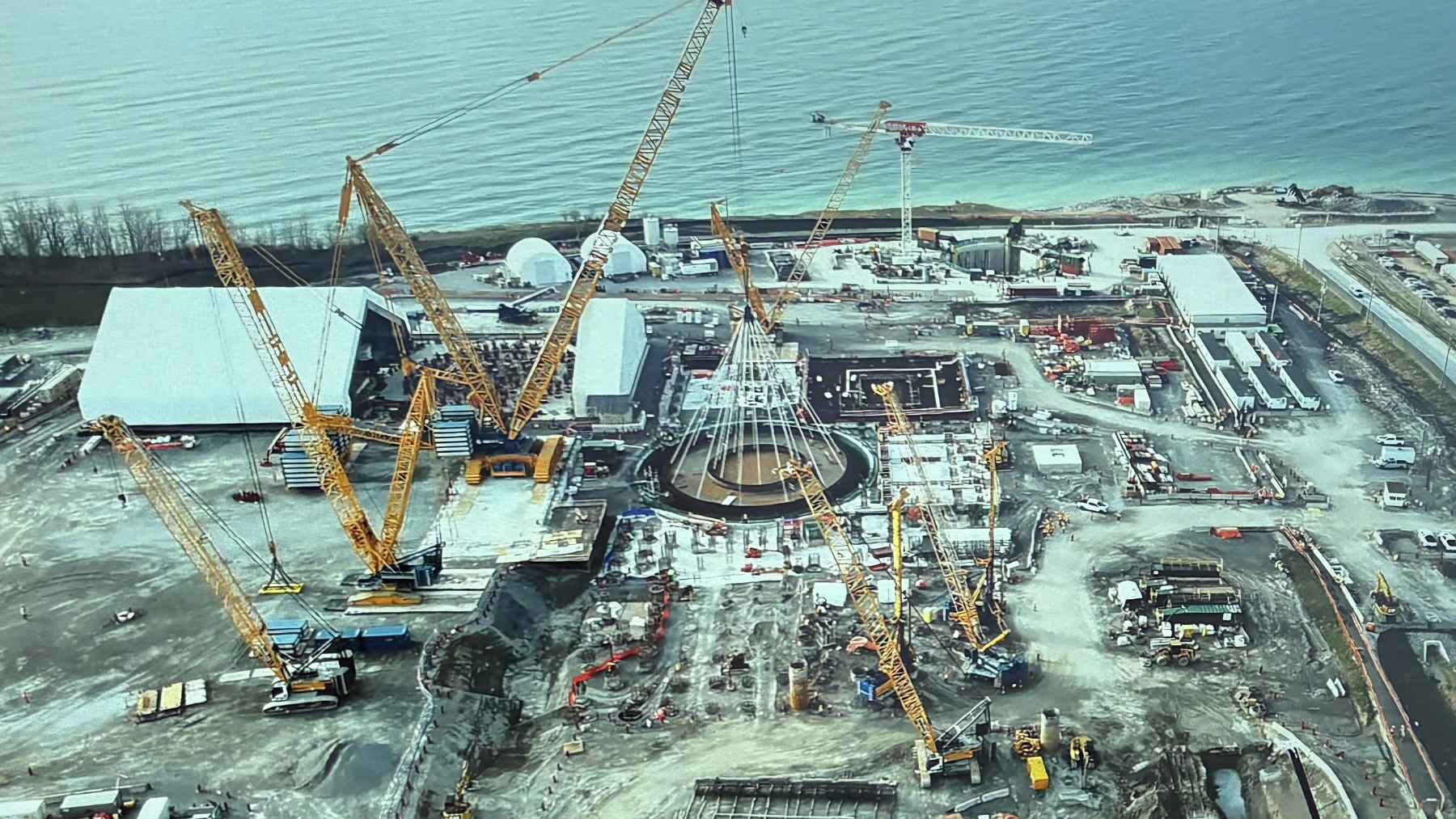
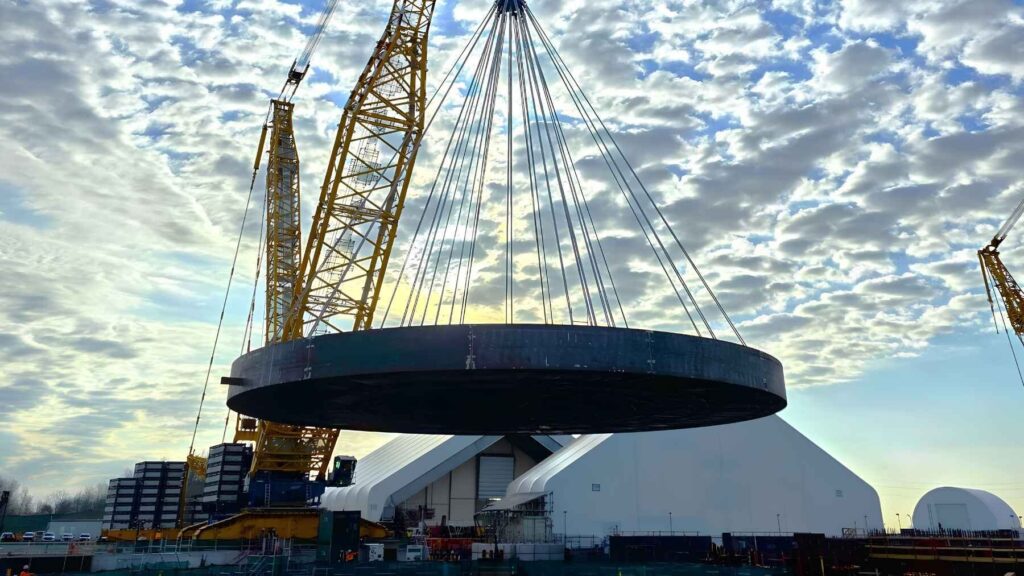
A 2.1-million-lb. foundation has been lowered into a 115-ft.-deep shaft at Darlington, east of Toronto, turning one of the nuclear industry’s biggest promises into an actual construction project. The machine above it, a GE Vernova Hitachi Nuclear Energy BWRX-300, is designed to produce 300 megawatts of electricity, enough for about 300,000 homes, though it is not expected to supply the grid until 2030.
For years, small modular reactors sounded like the future that never quite arrived. Now Canada is testing whether that future can be built on schedule, on budget, and copied elsewhere. Not just a huge lift, but a very expensive test of repeatable nuclear power.
A giant slab makes it real
The piece lowered into place is called a basemat, which is the foundation for the reactor building. Ontario Power Generation, the provincial utility, says the lift took place on April 22, 2026, and that the round foundation is about 121 ft. across. It was fabricated and welded as one large module before being placed underground.
Why does a slab of steel and concrete count as news? In nuclear construction, the first reactor-building foundation is the point where plans start becoming a nuclear unit. The Canadian Nuclear Safety Commission says Darlington now has one unit under construction, after the utility received its construction license in April 2025.
Boris Vulanovic, senior vice president of SMR execution at the utility, framed the moment as a sign of forward motion. “Reaching these milestones speaks to the momentum we’re building from the way we work together,” he said.
What makes this reactor small
A small modular reactor, or SMR, is smaller than the large units most people picture when they think of nuclear power plants. The BWRX-300 is a boiling water reactor, which means heat from splitting atoms boils water, steam spins a turbine, and the turbine makes electricity.
The “modular” part means many components are meant to be made or assembled in repeatable sections, almost like a construction recipe. The developer says the power block can fit within two soccer fields, and later repeat units could take about 24 to 36 months from first nuclear concrete to fuel loading.
The fuel story is simple but important. Canada’s current CANDU reactors use natural uranium, while many small reactor designs need enriched uranium. The utility has selected Urenco USA to supply enrichment services for up to four BWRX-300 reactors, so the fuel path exists, but it is still a different supply chain.
The first comes with a few asterisks
The word “first” needs a little unpacking. Darlington is being described as the first grid-scale SMR in the Western world and the first in the G7, not the first SMR anywhere. Russia and China already have small modular reactors operating, and Argentina has a pilot project under construction.
That distinction matters because the Canadian project is not trying to win a science-fiction contest. It is a more conventional bet, shrinking a familiar water-cooled reactor concept into a package that utilities hope can be repeated. That is less glamorous, and it may also be the point.
The price tag is the real test
The Darlington plan is not cheap. The full four-reactor program is budgeted at about $15.1 billion in U.S. dollars, while the first unit and shared infrastructure come to about $5.6 billion. Those numbers include roads, tunnels, cooling-water lines, engineering, interest, inflation, and other costs that can make or break a nuclear project.
For that money, the four reactors are expected to provide 1,200 megawatts, enough for about 1.2 million homes. Canada’s Major Projects Office says the project is expected to create 18,000 annual jobs during construction, sustain 2,500 annual jobs during operation, and direct more than 80% of spending to Canadian companies.
Still, the electric bill is where many people will feel the debate. The projected power cost has been reported at about 15 Canadian cents per kilowatt-hour, or roughly 11 U.S. cents depending on exchange rates. The big question is whether the first unit teaches enough lessons to make the next ones cheaper.
Why the world is watching
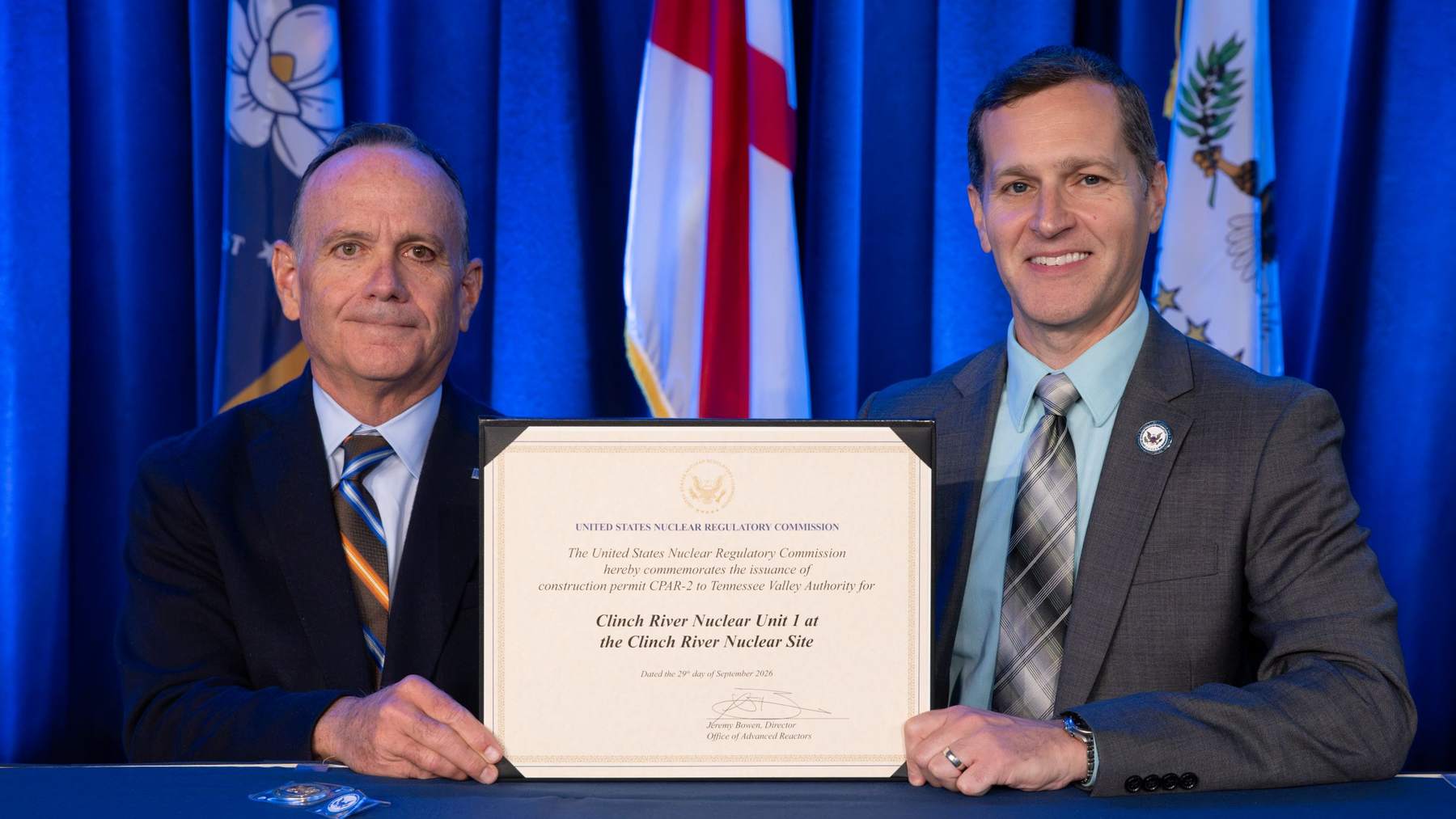
Darlington is not only an Ontario energy project. In the United States, the Tennessee Valley Authority has filed a construction permit application for a BWRX-300 at its Clinch River site near Oak Ridge, and the U.S. Department of Energy later selected the utility for up to $400 million in support.
Other countries are circling the same idea, including Poland, where Orlen Synthos Green Energy plans a fleet of BWRX-300 reactors. Sweden, Estonia, Hungary, and Saskatchewan have also examined or advanced their own versions of the small-reactor path, though each place faces its own politics, grid needs, and licensing rules.
This is why a hole in the ground in Ontario has become a global signal. If Canada builds the first reactor well, investors may see a repeatable pattern instead of a one-off experiment. If costs climb or schedules slip, utilities elsewhere will notice that, too.
A foundation is not electricity
For now, the Darlington SMR is still a construction project, not a power source. The reactor has to be assembled, inspected, fueled, licensed to operate, connected to the grid, and run safely before anyone can say the model has worked.
The regulator says the utility applied in March 2026 for a 20-year operating license for one BWRX-300, with a public hearing still to come. The developer says the first unit is scheduled to be operational in 2030, which means the most important proof is still several years away.
So, what changed this spring? The West stopped talking only in slides and started building in concrete. A foundation is not the finish line, but it is no longer just a pitch.
The official project information has been published by Ontario Power Generation.