A fishing trip aimed at catching swordfish has added an unexpected animal to the Red Sea’s scientific record. On May 30, 2025, Jordanian fisherman and retired dentist Marwan Shriem caught a pelagic stingray in the Gulf of Aqaba, an encounter researchers documented in a study published on August 11, 2026.
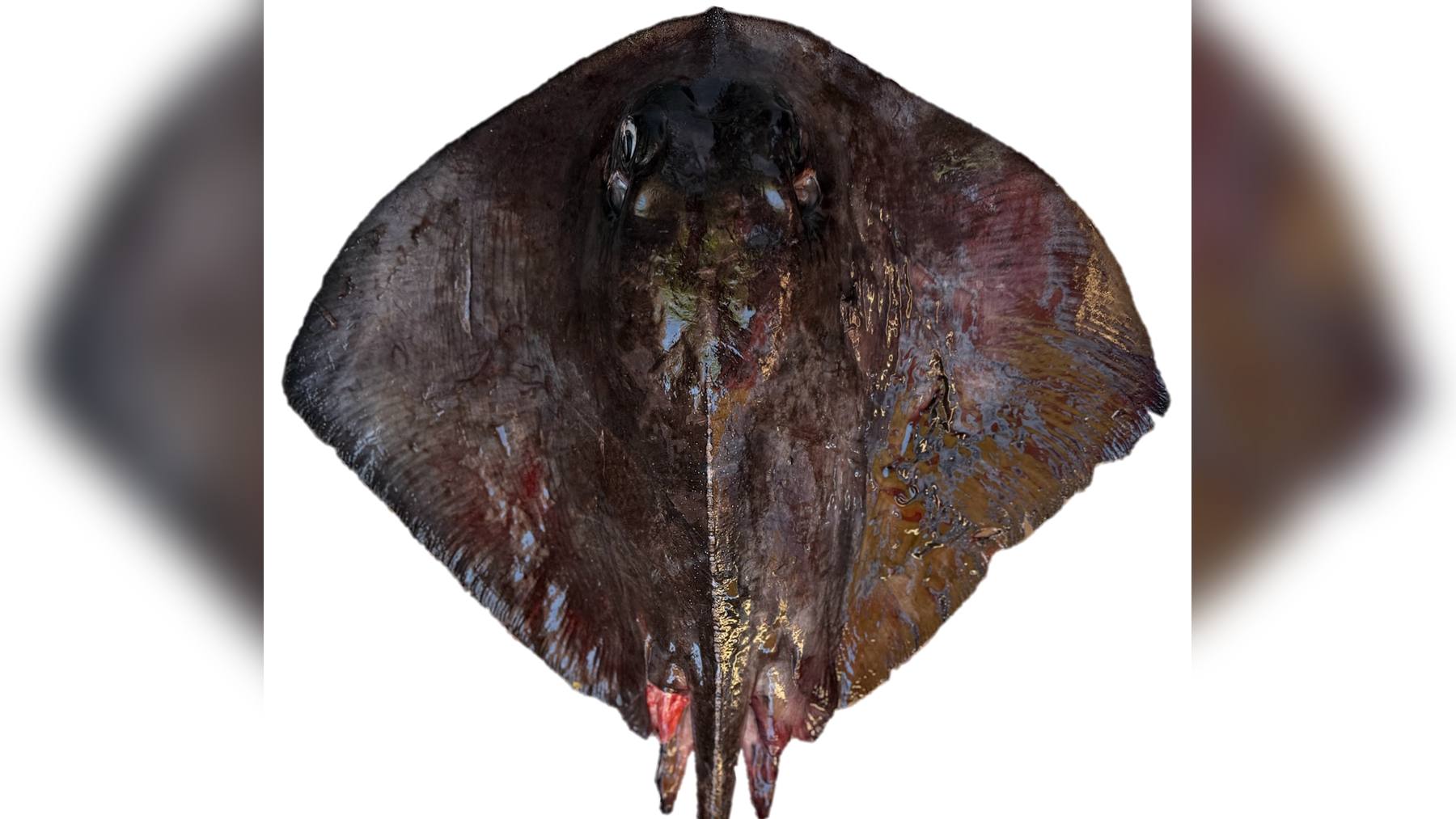
The dark fish, described as a “devil fish” in news coverage, belongs to the species Pteroplatytrygon violacea. Its capture establishes the first confirmed Red Sea record, but leaves a bigger question open. Was this an occasional visitor, or had these rays been swimming there unnoticed for years?
How a fishing video became scientific evidence
According to Al Jazeera’s reporting, Shriem had more than 25 years of fishing experience when he hooked the unfamiliar animal near the surface. Other experienced fishermen he consulted did not recognize it either, prompting interest in a catch with little commercial value.
An Instagram video brought the animal to the attention of Ashlie J. McIvor, a researcher at Red Sea Global. The encounter eventually became a scientific paper, with Shriem listed among its five authors. A routine fishing post had become a useful biodiversity record.
Researchers identified a mature male and visually estimated its disc width at about 18 inches (45 centimeters), using the fisherman’s body for scale. That was an estimate, not a tape measurement. No specimen or tissue samples were retained, so identification depended on photographs and video.
A stingray built for the open sea
What made this fish stand out? Its flattened body was wider than it was long, with angular fin tips, a short rounded snout, and dark coloring above and below. That dark underside was particularly useful because many other stingrays have pale bellies.
The name “pelagic” refers to life in open water, where this species spends its time instead of resting on the seabed like many familiar rays. It already occurs across the Atlantic, Pacific, and Indian Oceans, as well as the Mediterranean. The discovery adds a location to its known range, rather than introducing a species unknown to science.
The Florida Museum describes it as a frequent accidental catch in fisheries targeting other animals, including tuna and swordfish. Its open-water habits also mean encounters with people are uncommon, although its venomous tail spine requires caution during handling. The dramatic nickname tells readers less than the animal’s actual biology.
Two possible routes into the Red Sea
Researchers considered two ways the stingray could have entered the Red Sea. It may have traveled north from the Indian Ocean through the Bab-el-Mandeb Strait, or south from the Mediterranean through the Suez Canal.
The team considers the Indian Ocean route more plausible because the species is already documented in the Arabian Sea and western Indian Ocean. But a plausible route is not a tracked journey. “Both routes remain speculative in the absence of genetic or tracking data,” the authors write.
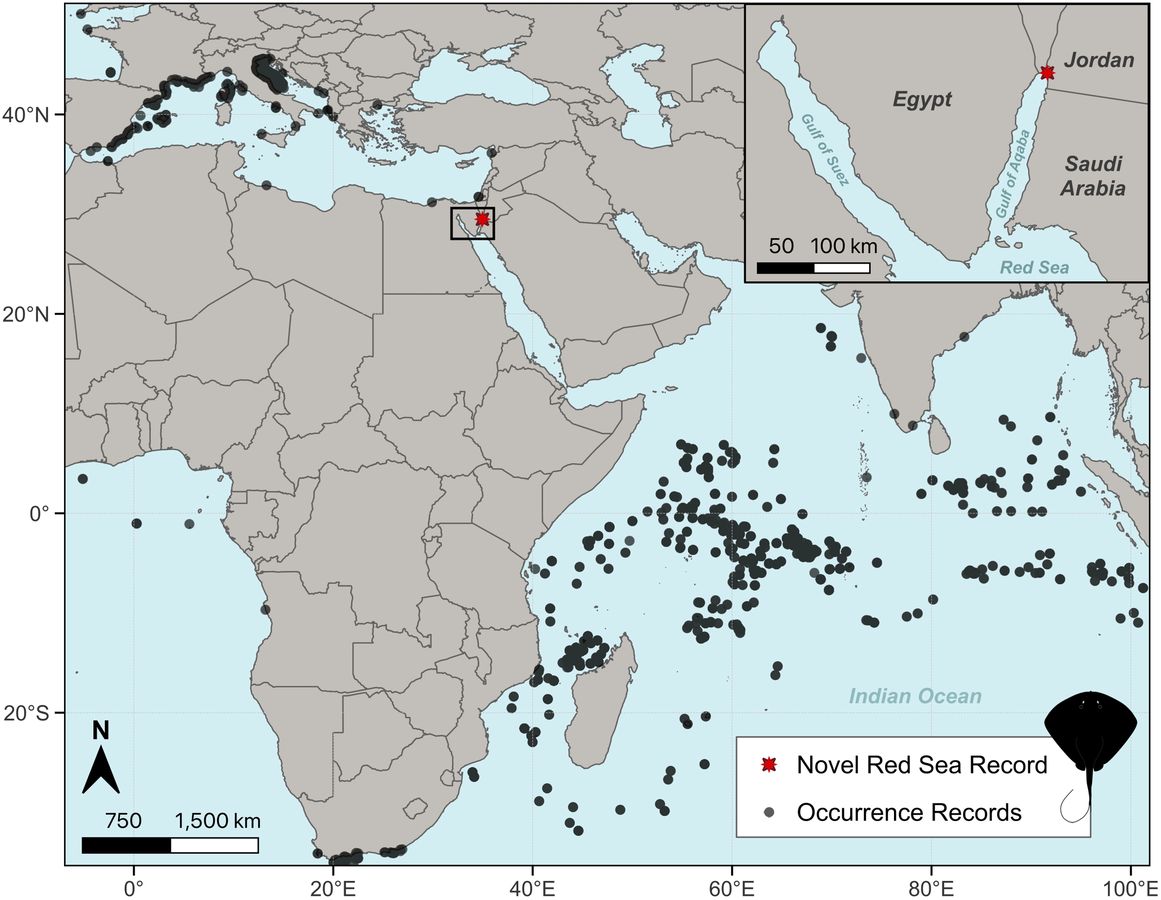
That uncertainty matters when interpreting an unusual wildlife sighting. One animal cannot establish when a species first arrived, how many others are present, or whether it is reproducing locally. Nor does this record, by itself, demonstrate an invasion or a movement caused by climate change.
Warm enough, but unusually salty
Water temperature offers one reason the Gulf of Aqaba could suit this ray. The study cites surface temperatures of roughly 70°F to 81°F (21°C to 27°C), overlapping the approximately 55°F to 81°F (13°C to 27°C) recorded in earlier tracking studies of the species.
Salt is the bigger question mark. Surface salinity in the gulf reaches about 40.3 to 40.8 practical salinity units, while sightings in the eastern Mediterranean occur in waters around 38 to 39. Those Mediterranean records suggest some flexibility, but this single catch does not measure how well the fish tolerates Aqaba’s conditions over time.
Along the gulf’s eastern side, winds also drive upwelling, bringing deeper water toward the surface and supporting phytoplankton growth. These microscopic organisms help sustain marine food webs, potentially making the area attractive habitat. Suitable conditions, though, are only part of the evidence needed to establish a resident population.
Why an overlooked catch matters
The environmental significance reaches beyond one unusual-looking fish. Pelagic stingrays are often caught unintentionally and discarded, meaning an animal can pass through fishing gear without ever reaching a market or a researcher’s notebook.
That creates a blind spot. The authors suspect earlier Red Sea catches may have gone unidentified or unreported, and call for targeted surveys and better observation of fisheries. Recording accidental catches could help reveal both where these rays occur and how often fishing affects them.
For now, the encounter shows how much there is still to document in a familiar fishing ground. The study was published on Frontiers in Fish Science.
Image: McIvor et al. / Frontiers in Fish Science, CC BY 4.0