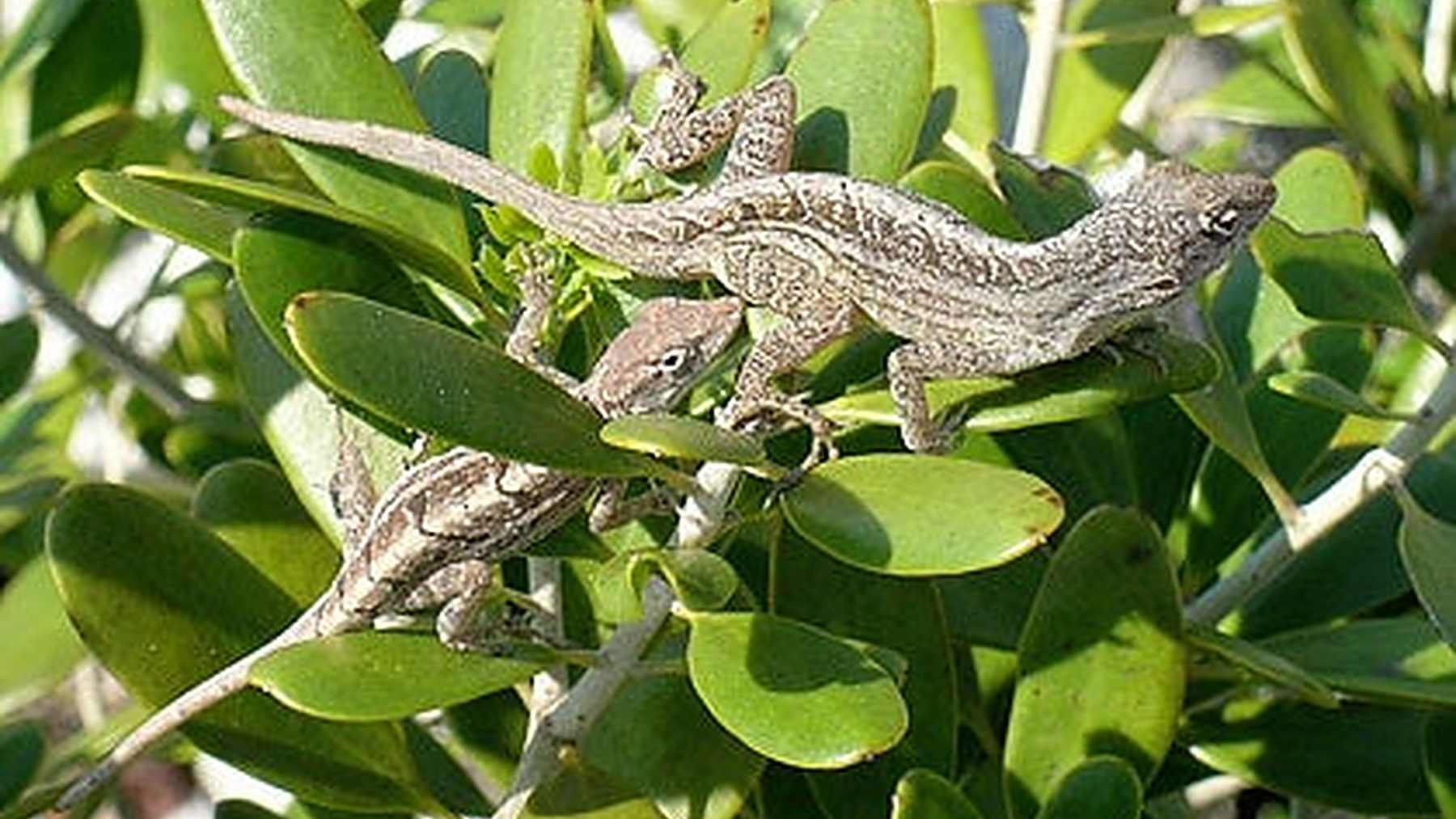
In May 2005, scientists released one male and one female brown anole on each of seven small Bahamian islands. Four years later, all seven populations had shifted toward shorter hindlimbs, yet differences associated with their founding groups had survived.
The experiment, led by biologist Jason Kolbe and published in Science in 2012, captured something researchers rarely witness from the beginning. Natural selection pushed the lizards toward bodies better suited to their surroundings, but chance still helped determine the outcome. Who arrived first mattered.
A hurricane cleared the way
The opportunity followed Hurricane Frances, whose storm surge submerged small islands near Great Abaco in September 2004. Researchers searched seven of them repeatedly afterward and found no brown anoles, creating an unusual opening for a field experiment.
These were islands without the study species, rather than empty landscapes. Plants, insects, and other organisms formed the setting in which the introduced lizards would live, hunt, and reproduce. Their vegetated areas ranged from roughly 380 to 1,880 square feet.
The team collected brown anoles, scientifically known as Anolis sagrei, from nearby Iron Cay and randomly selected the pairs. They followed the new populations through 2009, comparing them with the source population and lizards on 12 nearby reference islands. Those comparisons helped distinguish changes in the experimental colonies from shifts also occurring elsewhere.
What two founders can change
Why would choosing just two animals make such a difference? A small group carries only a sample of the genetic variation found in its original population, and that sample may be unusual simply by chance.
Scientists call this the “founder effect.” Imagine drawing a handful of marbles from a mixed bag and getting mostly one color, even though the bag contains many others. The handful does not faithfully represent everything left behind.
A new colony can therefore begin with a different genetic makeup without those differences offering any survival advantage. Usually, scientists encounter such populations long after their arrival, making it difficult to reconstruct the starting point. Here, the researchers had recorded that beginning themselves.
Why shorter legs helped
Iron Cay offered a forested habitat with broader surfaces for running and perching. The smaller islands had low, scrubby vegetation and narrower branches, presenting the newcomers with a different set of everyday challenges.
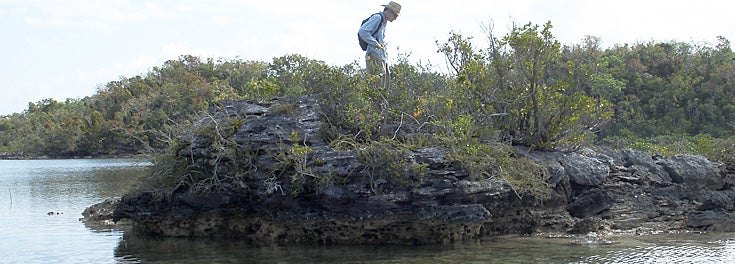
For an anole, a branch is a route to food, a place to defend territory, and a possible escape path. Longer hindlimbs help with speed on broad surfaces, while shorter ones improve movement on narrow supports.
Think of the difference between striding across a sidewalk and balancing along a narrow rail. That comparison helps explain why the researchers predicted shorter hindlimbs on the new islands. The advantage depends on where an animal has to move.
Changes appeared within years
All seven introduced populations survived the study period, growing an average of 13-fold during their first two years. Their rapid increase gave researchers expanding populations to measure as the experiment unfolded.
By 2006, the colonies already differed in hindlimb length, and those differences did not correspond to the widths of their perches. That mismatch supported the founder-effect explanation, rather than the idea that each island’s vegetation had already produced its own distinct limb length.
Between 2006 and 2009, hindlimb length adjusted for body size decreased by 6.5% in males and 4% in females. These were changes in population measurements across generations, not individual adult lizards shrinking their legs. The decline was about five times greater than in the reference populations.
The founders’ imprint remained
But did adapting to similar surroundings make the seven populations alike? Only to a point, because the colonies that initially had relatively longer hindlimbs generally remained at the longer end of the range.
“Natural selection drives them all down, while the founder effect keeps the order the same,” said study co-author Thomas Schoener of the University of California, Davis. More precisely, the paper reported only small changes in the populations’ relative ranking over time.
The distinction is the heart of the experiment. Natural selection explained the shared movement toward shorter hindlimbs, while founding differences helped explain why the populations still differed from one another. Their common direction did not erase their different starting points.
What the findings do not mean
The islands were not sealed containers, and two released lizards did not necessarily mean just two genetic contributors. Some early offspring came from sperm females had stored before release, and later sampling detected evidence of immigrants. Those complications did not erase the overall founder signal.
The study also did not establish that the differences would last forever. Its four-year window showed persistence during adaptation, leaving open how continued selection, incoming lizards, or environmental changes might alter the pattern later.
For readers trying to understand biodiversity, the useful takeaway is that present-day habitat cannot always explain every difference between populations. The history of a population’s arrival can remain visible even while it adapts. The study was published in Science.
Photo: UC Davis