Bacteria grown at Tarbiat Modares University in Tehran, Iran, made the sulfuric acid that dissolved 53.6 percent of the copper in powdered discarded circuit boards. It took seven days, according to a study published September 13 in Scientific Reports, and the microbes never touched the scrap.
A second, chemical stage then pulled 80 percent of that dissolved copper into a solvent over five rounds. That figure covers copper already in the liquid, not all the copper the boards held at the start.
Telecom boards, 27 percent copper
Atusa Samaei and Seyyed Mohammad Mousavi of the university’s Chemical Engineering Department did the work with Zahra Shokri and Reza Soleimani. Mousavi is the corresponding author. The Iran National Science Foundation funded the project.
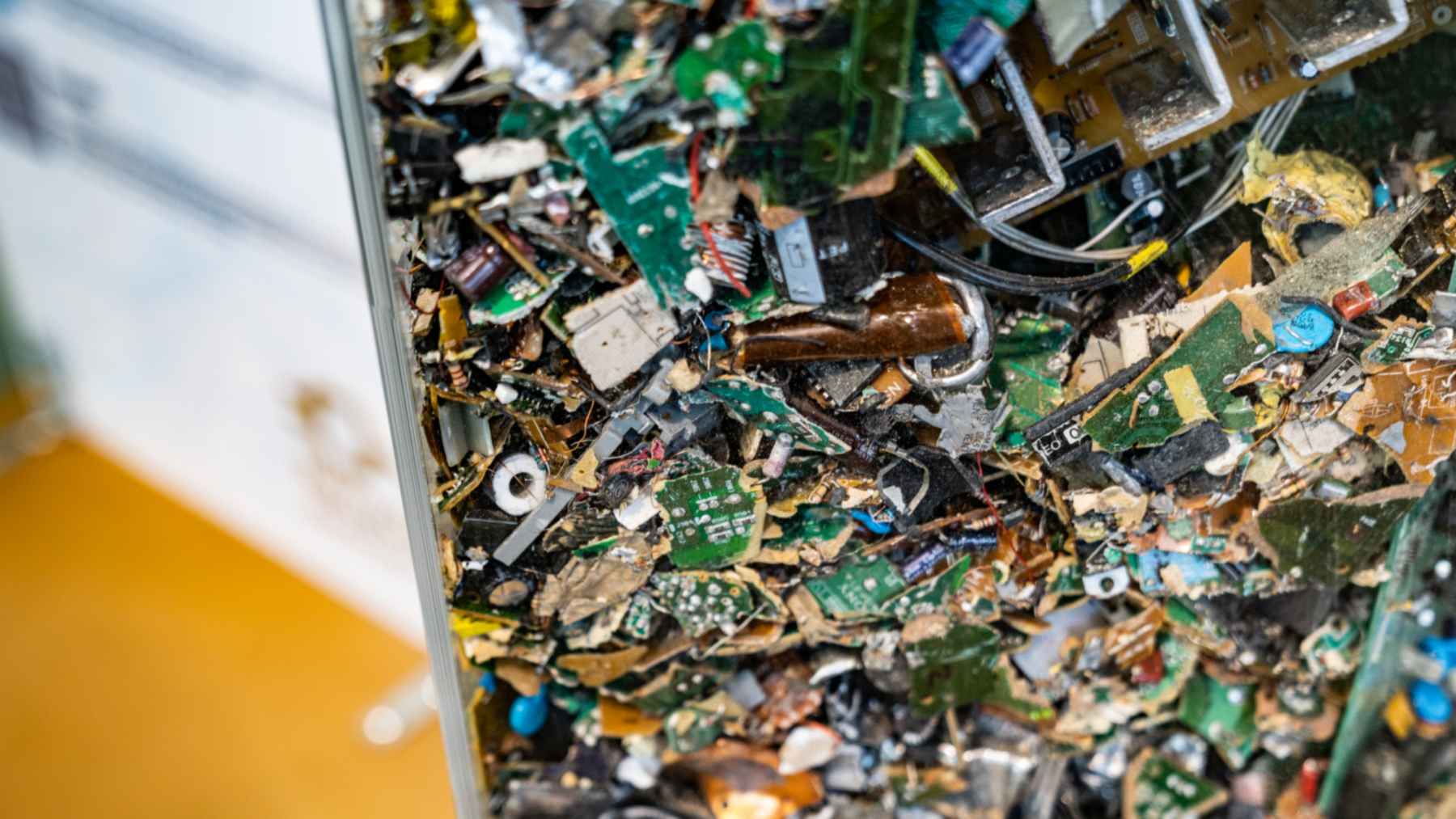
The team took waste telecommunications circuit boards from industrial electronic assemblies. With pliers, they removed resistors, capacitors, connectors and chips, then milled the bare boards three times. Only particles finer than 75 micrometers, about 0.003 inch, went into the tests.
Copper made up about 27 percent of the powder by weight. Tin, aluminum, nickel and iron each accounted for 1.7 to 2.9 percent.
According to the Global E-waste Monitor 2024 from the ITU and UNITAR, the world produced 62 million metric tons of electronic waste in 2022. That is about 68 million U.S. tons, and only 22.3 percent was documented as properly collected and recycled. Valuable metals sit in that scrap, and a metric ton of old mobile phones can hold more gold than a ton of gold ore.
Acid harvested on day 17
The acid came from Acidithiobacillus thiooxidans, a bacterium that feeds on sulfur. As it grows, it releases sulfuric acid. The strain came from the Iranian Research Organization for Science and Technology.
In shaken flasks, cell numbers peaked around day 17. By then the culture had a pH of about 0.8, far more acidic than lemon juice.
At that point the team removed the cells and kept only the acidic liquid, a method called spent-medium bioleaching. The authors write that cell-free liquid “eliminates microbial toxicity,” since nothing alive has to face the metal powder. Other groups have tried living microbes that extract metals from meteorite rock in orbit.
Copper peaked on day seven
The researchers added powder at 50 grams per liter, about 6.7 ounces per gallon, and kept the mix shaking at 86°F. Within 24 hours the pH rose from 0.8 to around 4. The metals were using up the acid.
After seven days the liquid held 7,241 milligrams of copper per liter. The authors calculate that as 53.6 percent of the copper in the powder. Nickel came out at a similar share, while aluminum, iron and tin dissolved in much smaller shares.
Leaving the powder in for 10 or 14 days lowered the copper reading. The authors suggest some copper came back out of solution or stuck to the solid particles.
Plain sulfuric acid matched it
The team also ran a control: off-the-shelf sulfuric acid at 0.11 molar, the same strength the bacteria had made, with the same powder, heat and seven days of shaking. It pulled 7,374 milligrams of copper per liter, a shade above the 7,241 from the bacterial batch.
Nickel came out almost level too, 560 milligrams per liter against 547. The paper’s reading is that “proton-mediated dissolution is the dominant driver,” so the microbes mattered mainly as acid makers.
Iron told a different story, with 30.4 milligrams per liter in the bacterial batch and 114.8 in plain acid, and aluminum dropped as well. The authors label that gap “a preliminary observation” and note that they did not run a live-cell test or a blank.
Five passes to reach 80 percent
Moving copper out of the liquid relied on solvent extraction. An oily phase of kerosene and an extractant called D2EHPA picks up copper ions from the watery leachate. On its own, D2EHPA captured about 14.5 percent of the dissolved copper.
The team then added an ionic liquid, a salt that melts below 212°F (100°C). Copper in the solvent rose from 1,050 to 2,715 milligrams per liter. With the pH set at 4.3 and sodium acetate added, one pass captured 35.3 percent.
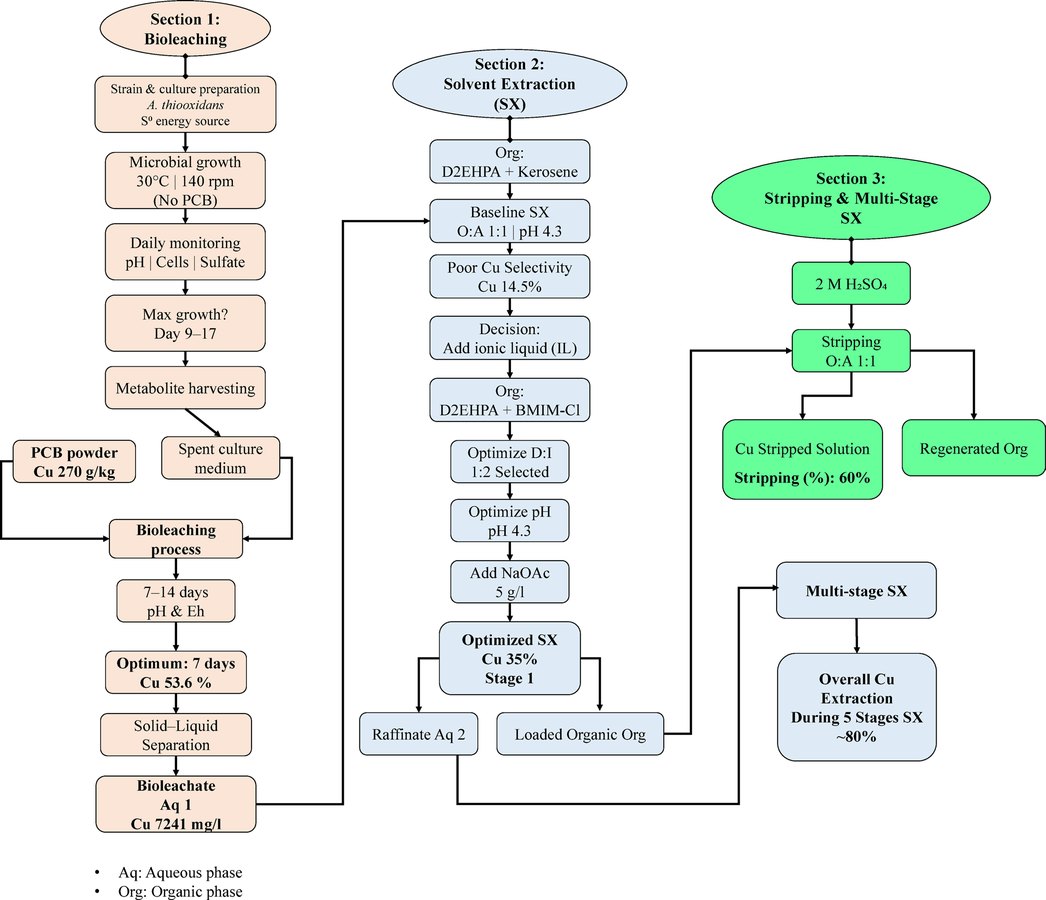
Five passes through fresh solvent at room temperature lifted cumulative extraction to 80 percent. Copper in the watery phase fell from about 3,901 to 723 milligrams per liter. A final acid wash, called stripping, returned 60 percent of the copper in the solvent to a water solution.
Those three numbers, 53.6, 80 and 60 percent, come from separate steps. The paper never multiplies them into one board-to-solution total, and readers should not assume 80 percent of a board’s copper ends up reusable.
No cost or carbon figures yet
All the tests ran in laboratory glassware, with culture flasks of 100 milliliters, about 3.4 fluid ounces. The authors present the result as a “potential bench-scale framework.” Before industrial use, they say, stripping must improve, and the ionic liquid needs tests of reuse and long-term stability.
No life-cycle, energy or cost analysis came with the paper. The authors argue the route needs less energy and fewer reagents than standard acid leaching, but list those analyses as future work. The solvent stage also still depends on kerosene.
The full study, released as an accelerated preview that may still be edited, was published in Scientific Reports.
For comparison, the paper’s own table cites chemical routes that pass 95 percent for extraction and stripping, but with harsher reagents. Similar questions of cost and scale hang over China’s growing pile of retired electric car batteries.
Photo: Tony Webster / Wikimedia Commons, CC BY 2.0