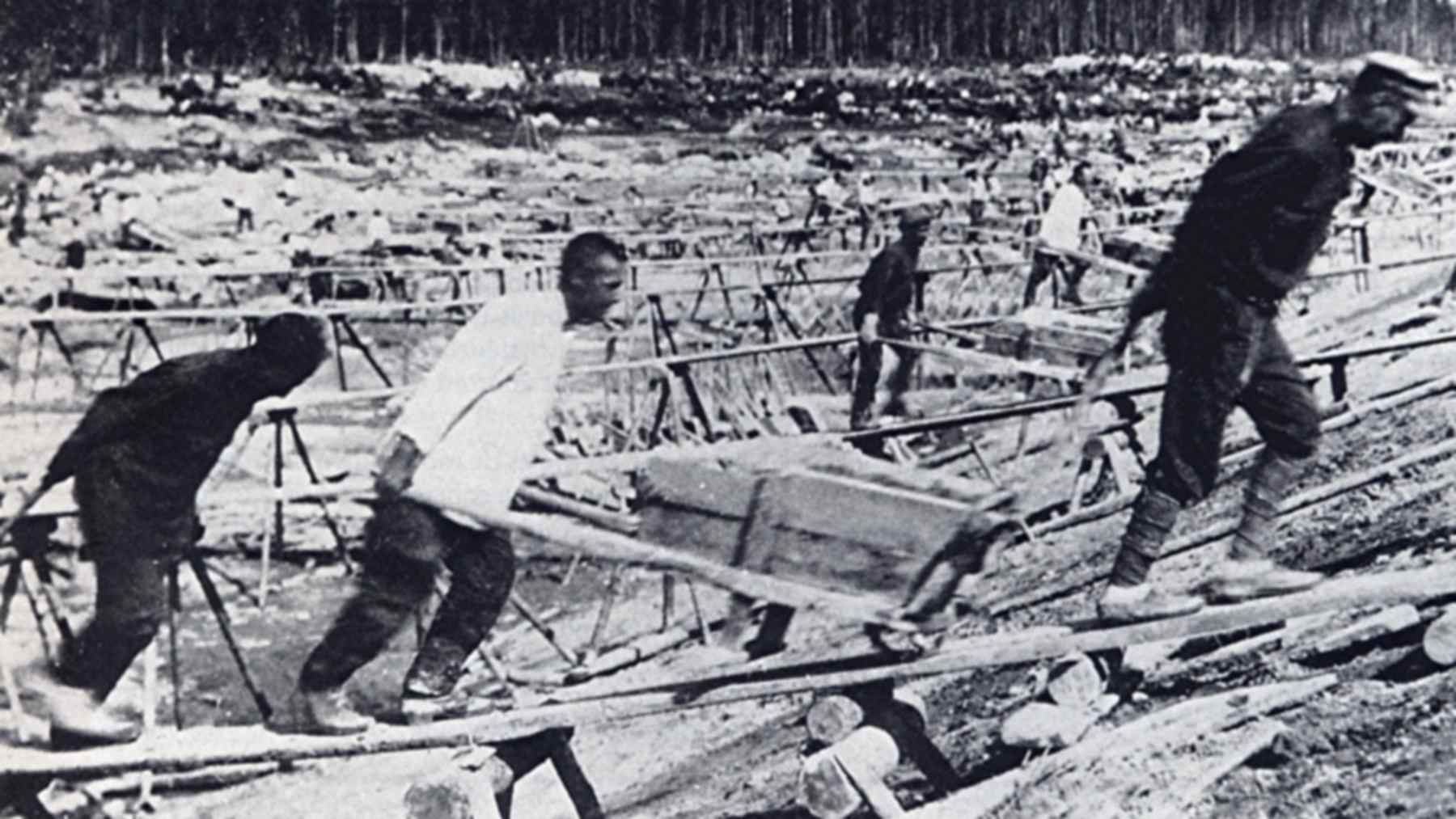
More than 100,000 Soviet prisoners dug the White Sea-Baltic Canal between 1931 and 1933. Working with picks, shovels and homemade wheelbarrows, they opened a 141-mile (227-kilometer) waterway across northwestern Russia in about 20 months. The channel ended up far shallower than first planned, and thousands of the builders died.
Known in Russian as Belomorkanal, it was the Gulag’s first massive construction project, according to an online exhibit by George Mason University. The exhibit says the canal “turned out to be too narrow and too shallow to carry most sea vessels.”
Eighteen feet became twelve
In the spring of 1930, the Soviet Council of Labor and Defense proposed a canal 18 feet (5.5 meters) deep. With that depth, warships could move from the Baltic to the northern seas. They would no longer need to sail around Scandinavia.
Historian Mikhail Morukov, working from Gulag archives, quotes a note from Joseph Stalin to Vyacheslav Molotov about the cost. Stalin wrote that “20 million plus 70 million is too much,” and Molotov replied, “I doubt the expediency of the canal.”
According to Morukov’s chapter, the final decision cut the depth to 10 to 12 feet (about 3 to 3.7 meters). The budget was capped at 60 to 70 million rubles. No foreign currency was set aside for imported machinery, and prisoners would do the work.
For shipping, those lost feet were decisive. A vessel’s draft is how far its hull sits below the waterline, and big ships often adjust their draft to fit a route. A shallow channel simply shuts out larger seagoing vessels.
Wooden gates and 19 locks
The approved design was ready on July 1, 1931. It called for 128 hydraulic structures, 19 locks and 49 dams along a 227-kilometer route. Its estimated cost was 88 million rubles, against 353 million in the civilian planners’ earlier estimate.
Much of the route was never dug as a trench. The canal links the White Sea with Lake Onega by joining lakes, rivers and cut channels. Its locks lift and lower boats by changing the water level inside a closed chamber.
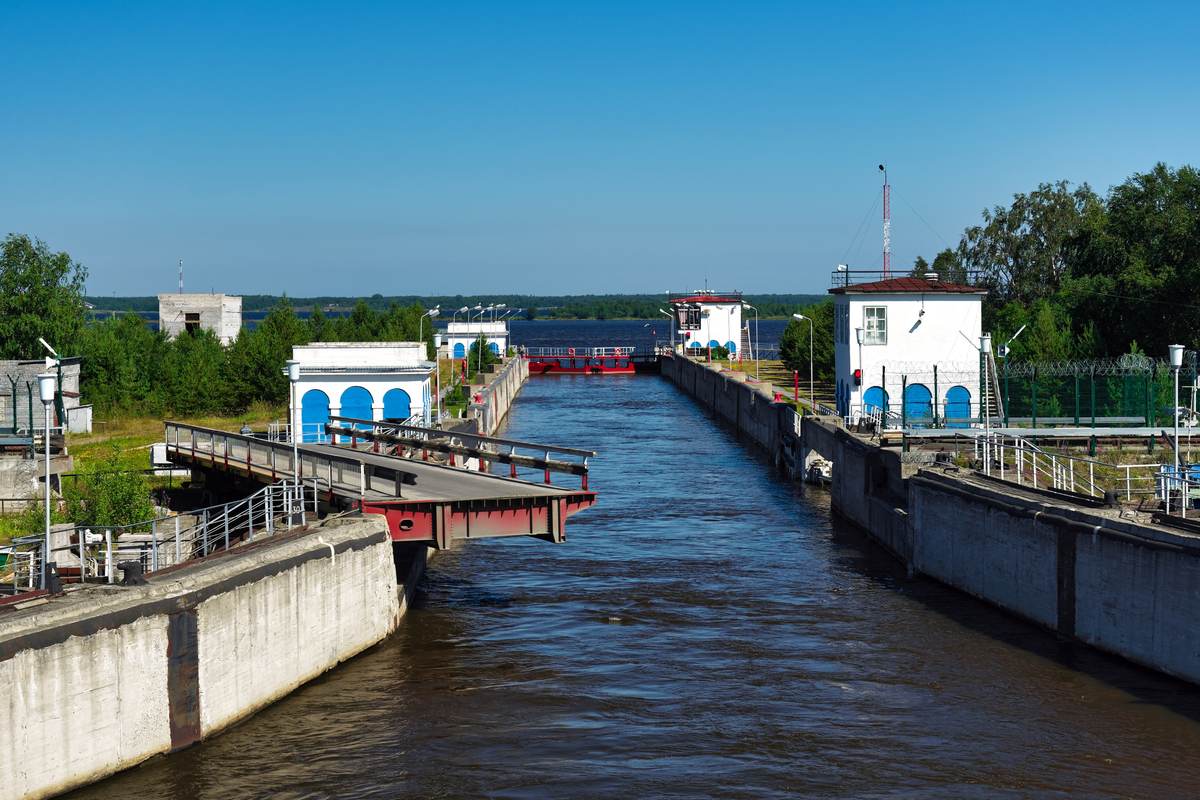
Steel and concrete were scarce, so engineers used local timber and stone. Morukov writes that a professor named Maslov, himself a prisoner, designed a wooden lock gate. Inmates built wooden barrow trucks that workers nicknamed “Fords.”
Rations cut while workloads rose
By mid-1931 the camp held more than 100,000 prisoners, up from 72,000. The figures come from a report by Genrikh Yagoda, the security chief in charge of the project. Prisoners worked up to 16 hours a day, and 1,438 died that year.
As the 1932 deadline slipped and work dragged on, food supplies got worse. The monthly flour ration fell from 23.5 kilograms (51.8 pounds) per prisoner in 1932 to 17.16 kilograms (37.8 pounds) in 1933. Vegetable oil dropped from 1 kilogram to 0.3 kilograms.
Camp managers also turned bread rations into a tool of discipline. Top workers could earn bonus rations of up to 1,200 grams (about 2.6 pounds) of bread, while refusing work meant less food. The George Mason exhibit notes that prisoners who kept missing quotas would “slowly starve to death.”
25,025 deaths in one archival count
How many people died on the canal is still disputed. Published estimates range from about 50,000 to 250,000. Historian Nick Baron, then at the University of Manchester, reviewed them in a 2001 paper in Cahiers du monde russe.
Using archival mortality rates and camp population figures, Baron calculated 25,025 deaths over 21 months of construction. He stressed that this covers only immediate deaths, so later deaths from injuries would push the real toll higher. He also estimated that roughly 175,000 prisoners worked on the project in total, as sick, injured and dead workers were constantly replaced.
Warships through, freight lagging
On May 28, 1933, the canal opened while still unfinished, with the steamship Chekist leading the first convoy. Baltic Fleet ships reached Soroka Bay on July 21, 1933. They became the core of the Soviet Northern Fleet.
Morukov counts 17 naval transfers through the canal before World War II, including destroyers and submarines. Freight never caught up, and in 1940 the waterway moved 1 million metric tons, or 44 percent of what it was designed to handle.
Ships and barges still use it as a small freight corridor. The canal administration’s report on the 2025 season lists 206,000 metric tons (about 227,000 short tons) of cargo through November 24. Locks were worked 8,556 times, and 54 passenger boats carried 3,267 people.

No full list of the dead
Baron’s 25,025 comes from mortality rates and headcounts, not from a register of named victims. A prisoner released sick, or one who died of an injury months later, mostly does not show up in those records.
In 1930 the planners listed only two economic gains, more timber exports and better supply routes to Siberia, and Morukov calls the canal’s prewar economic weight insignificant. Molotov had complained in 1930 that the economic part of the plan was “not clear.” Depth, cost and traffic remain the key questions for new waterways such as Turkey’s planned Canal Istanbul.
Morukov’s archival study appeared in The Economics of Forced Labor: The Soviet Gulag, published by the Hoover Institution Press in 2003.
Photo: Unknown author / Wikimedia Commons (public domain)