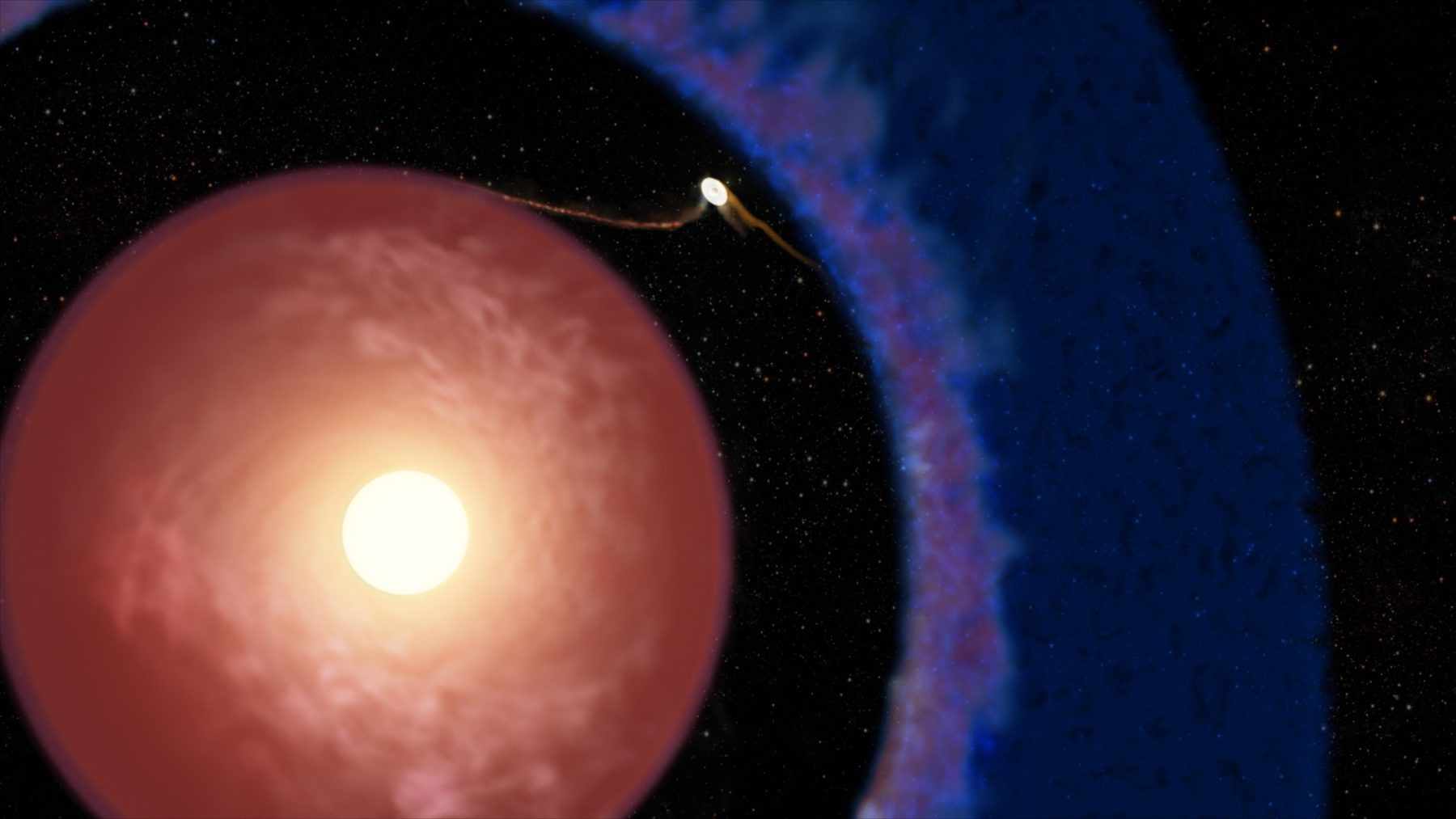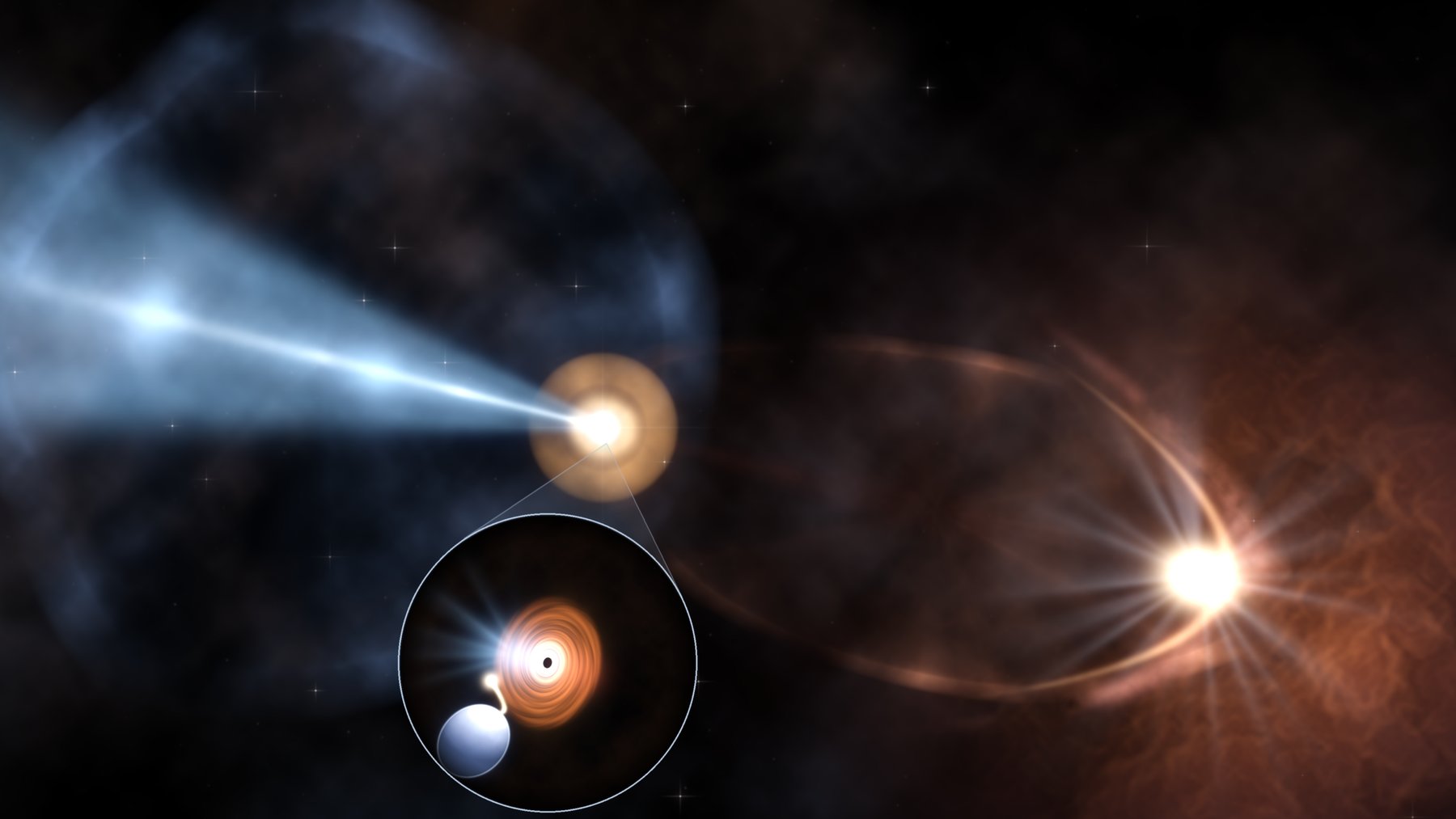
Astronomers have identified what they call the Milky Way’s first microblazar, a black hole about 12,000 light-years away that fires a jet almost straight at Earth. The system, IRAS 18293−0941, was announced on September 22, 2026. The team was led by Josep Martí of the University of Jaén in Spain.
According to the South African Radio Astronomy Observatory, the black hole circles a hot, massive star every 11.38 days. Its second jet points away from us and cannot be seen. Yet it seems to be slamming into a gas cloud where some of the galaxy’s most energetic particles may be made.
Blazars shrunk to stellar size
Blazars are among the brightest objects in the sky. They sit in the cores of distant galaxies, where supermassive black holes launch jets that happen to point our way. That alignment makes them look far brighter than they really are.
Since the 1990s, theorists have argued that a small version should exist in our own galaxy. In it, a black hole with the mass of a star pulls gas off a companion. Part of that gas settles into a disk, and the rest shoots out along two opposite jets.
For co-author Benito Marcote, a senior support scientist at ASTRON and the Joint Institute for VLBI ERIC in the Netherlands, the big gain is distance. “Those blazars are too far away to image in detail,” he said in the University of Amsterdam release. A copy inside the Milky Way can be studied up close, the way astronomers already follow stars near the galaxy’s center.
Earlier candidates failed closer checks, the SARAO release notes. In IRAS 18293−0941, the jets move at about three-quarters of the speed of light. That is roughly 140,000 miles per second (225,000 kilometers per second).
Catalogued in 1983, then forgotten
The Dutch-American IRAS satellite first recorded the object in 1983, according to the University of Amsterdam. Thick dust hides it from ordinary telescopes. For decades, few astronomers paid it any attention.
“Everything about IRAS 18293−0941 was hiding in plain sight,” Martí said in the SARAO announcement. Interest came back when radio observations showed a bright, compact core sending out radio waves from only one side.
An 11.38-day flicker in starlight
Telescopes at three Spanish observatories, Montsec, Calar Alto and the University of Jaén, monitored the star for years. The paper reports brightness changes of only about 0.01 magnitude. The pattern repeated every 11.38 days.
Such shallow dips told the team that we see the orbit almost face-on. The study puts its tilt at around 20 degrees, which lines the jet up close to our line of sight.
Under Einstein’s relativity, matter racing toward us looks brighter and matter rushing away looks fainter. Astronomers call this Doppler boosting. It explains why the approaching jet stands out in radio images while its twin all but vanishes.
Gaia and the EVN agree
A one-sided jet could still belong to a faraway galaxy lying behind the star by chance. To rule that out, the team used the European VLBI Network. It links radio dishes from South Africa and Latvia to China and Spain, so they act like one antenna thousands of kilometers wide.
The network’s position for the jet matched the star’s position from the European Space Agency’s Gaia satellite. “This was the moment the result became solid,” Marcote said in the SARAO release.
Where the hidden jet hits gas
Deep images from South Africa’s MeerKAT radio telescope show a bubble about 100 light-years across. The receding jet carved it out. At the far edge sits a small, bright knot of radio emission that the team calls a hotspot.
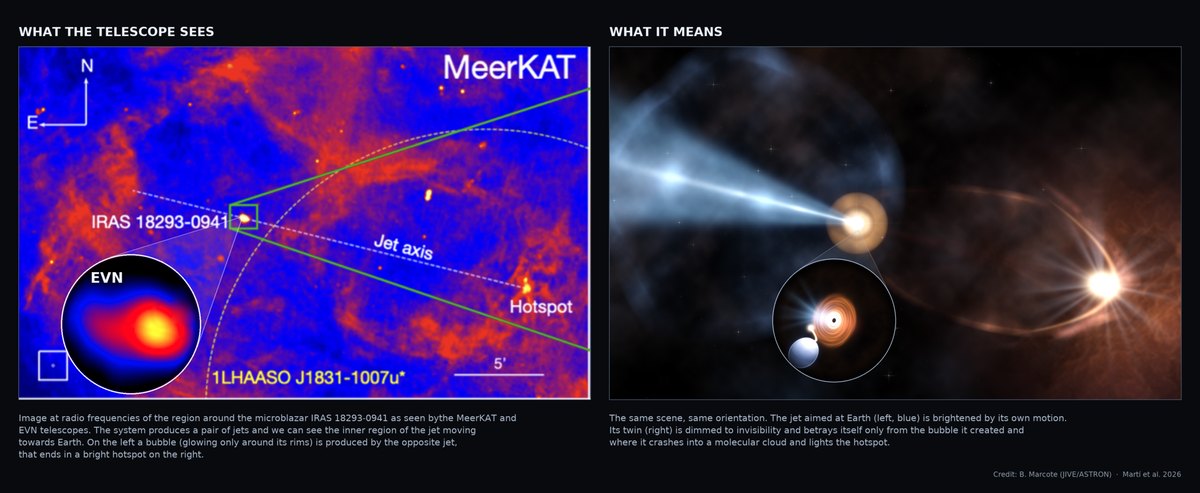
There, the jet appears to crash into a cloud of hydrogen and dust. The impact warms the dust and makes the gas glow. China’s LHAASO, Mexico’s HAWC, Namibia’s H.E.S.S. and NASA’s Fermi satellite have all detected gamma rays from that same patch of sky.
Some of those photons carry more than 100 trillion electronvolts. That is over ten times what the Large Hadron Collider gives a single proton. Where such extreme particles get their energy remains an open question.
In the team’s model, the jet carries about half a million times the power the sun radiates. Protons sped up at the hotspot smash into the dense gas, making particles that give off gamma rays.
“The jet does the accelerating. The cloud does the shining,” said co-author Pedro Luque-Escamilla of the University of Jaén. He called it elegant that the accelerator and its target sit tens of parsecs from each other.
Fast flickering never showed up
SARAO’s release calls it the first convincing microblazar. In the paper, Martí’s group sticks to the word candidate, a serious one in their phrasing. Fast flickering from the inner disk or jet, a classic blazar trait, never turned up in the data, and the authors blame a thick dusty envelope that could be blurring it.
Some of the headline figures come from the model. The black hole’s 10 solar masses and the system’s age of 50,000 years are both assumed in the paper’s table of parameters. Its distance of about 3.6 kiloparsecs, or roughly 12,000 light-years, comes from a 2021 study, and older work placed the source at 8 to 9 kiloparsecs.
Tying the gamma rays to this one jet still needs more evidence. The group wants repeated high-resolution radio images to follow the black hole jet, a closer study of the cloud and new searches for similar systems. “No single telescope could have told the whole story,” said co-author Jakob van den Eijnden of the University of Amsterdam.
The full study was published in Astronomy & Astrophysics.
Image: B. Marcote (JIVE/ASTRON)