Pacific salmon spend years at sea and then return to the river where they hatched to spawn. Some of those trips are very long. Chinook bound for the Yukon headwaters in Canada travel more than 2,000 river miles (3,200 km) in about 60 days, says the Alaska Department of Fish and Game.
They do not feed along the way. Research over seven decades points to two senses working in stages. A magnetic sense handles the ocean crossing, and smell takes over for the last stretch upriver.
The smell of home
Young salmon learn the odors of their home stream before they go to sea, NOAA Fisheries explains on its olfaction and homing research page. “Maturing adults use retained odor memories to guide their homing migration,” the agency writes.
Fish that miss contact with their home water at the right age are more likely to stray to other rivers. NOAA notes that strays, hatchery or wild, can harm local populations through genetic and ecological effects.
The idea came from a walk. In 1946, a hike in the Wasatch Range brought back childhood smells to biologist Arthur Hasler. He began to suspect that salmon find their way by scent, Brigham Young University’s College of Life Sciences recounts.
28 fish took the wrong branch
Hasler tested the idea in 1953 at Issaquah Creek, near Seattle. His team caught 322 salmon in two traps and plugged the nostrils of half of them with cotton. The fish were released 1 mile (1.6 km) below the fork.
All but 8 of the 73 control fish returned to the branch where they were caught. Among the fish without a sense of smell, 28 of 70 went up the wrong branch, Hasler reported.
Later work with Al Scholz in the Great Lakes began in 1968 and took about 15 years. Young salmon were exposed to a synthetic scent. About 18 months later, the adults came back to the water that carried it.
A magnetic map at sea
Smell works in a river, but it cannot guide a fish across the open ocean. Salmon can travel up to 4,000 miles (6,400 km) out to sea, according to the National Science Foundation. The round trip can reach 8,000 miles (12,900 km).
A 2013 study in Current Biology used 56 years of fishery records for sockeye returning to the Fraser. Vancouver Island blocks the river mouth. The fish arrive either around the north end of the island or through the Strait of Juan de Fuca.
The route the fish chose was closely linked to the strength of Earth’s magnetic field, Oregon State University reported. Salmon tended to take the path that best matched the magnetic signature they left behind as juveniles. Field drift explained about 16 percent of the variation, sea temperature 22 percent and the two together another 28 percent.
“Salmon have to get it right because they only have one chance to make it back to their home river,” said Nathan Putman, the lead author, then a postdoctoral researcher at Oregon State.
The result was a correlation drawn from catch records, not an experiment. The authors suggested the magnetic signal could bring fish within about 31 to 62 miles (50 to 100 km) of their river. From there, smell and other cues would take over.
Fish that never saw sea
A year later, the same group ran an experiment at the Oregon Hatchery Research Center. Juvenile Chinook about 2 inches (5 cm) long went into 5-gallon buckets. For about eight minutes, they were exposed to magnetic fields matching places in the ocean.
The young fish turned as if heading for their ocean feeding grounds. They had never left the hatchery, so the response was inherited, not learned, according to the 2014 study summary. The test field was too weak to move a compass needle, Putman noted.
“The fish can detect and respond to the Earth’s magnetic field. There can be no doubt of that,” said David Noakes, senior scientist at the hatchery center and a co-author.
One trip, then the end
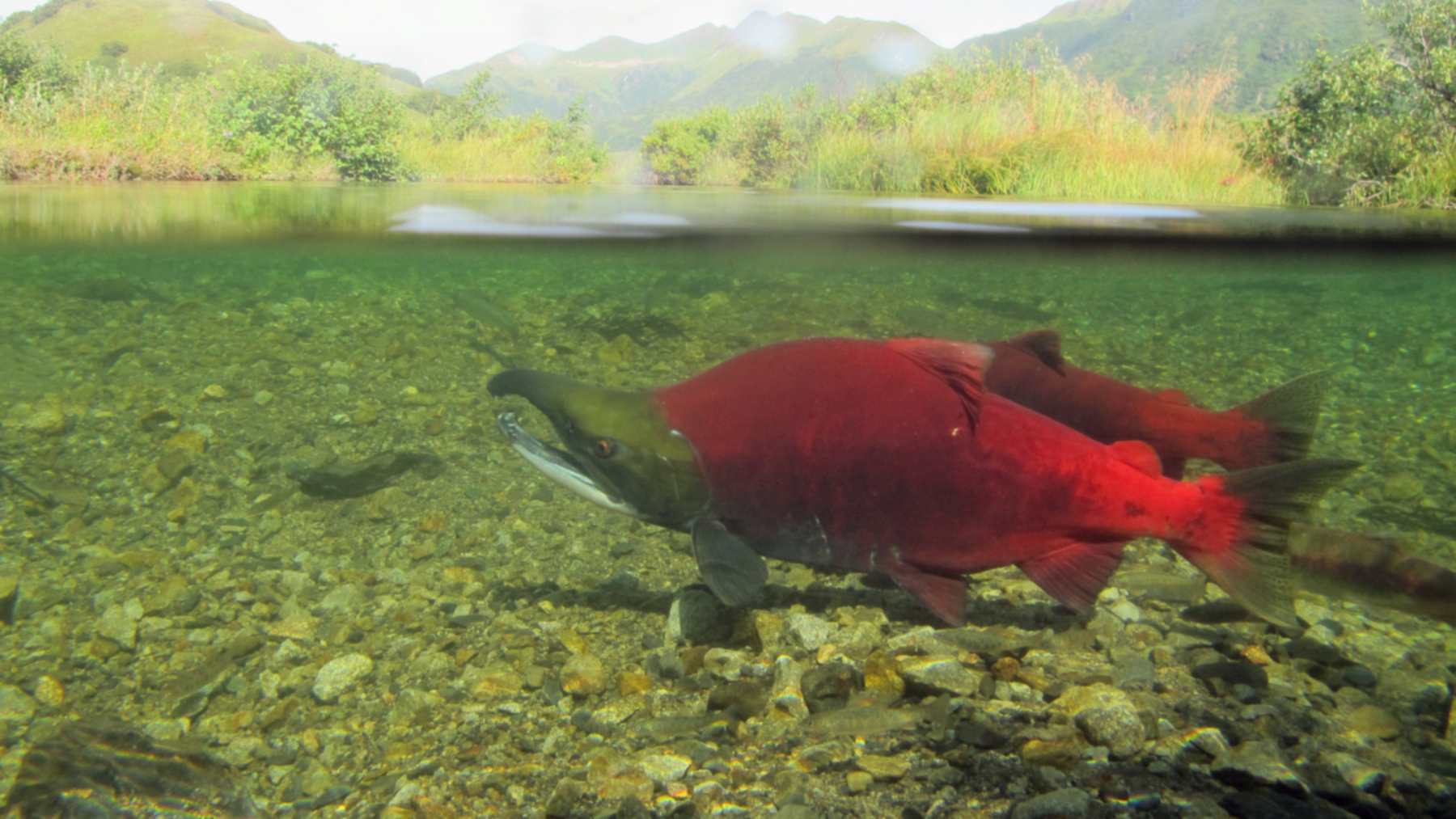
For most Pacific salmon, the journey home is the last one. Sockeye spend one to three years in lakes and usually two to three at sea, NOAA Fisheries says. Back in fresh water they turn red with green heads, and all of them die within weeks of spawning.
Chinook are the largest Pacific salmon, the Alaska Department of Fish and Game says. NOAA gives a typical size of about 3 feet (0.9 m) and 40 pounds (18 kg), and up to 120 pounds (54 kg). The Alaska record, according to the state, is a 126-pound (57 kg) fish taken near Petersburg in 1949.
Their rivers have changed. Oregon has seen record steelhead returns on the Deschutes River, while at Bonneville Dam sea lions learned to wait below the fish ladder. In Alaska, salmon that make it upstream feed bears, eagles and the forest, as a test with human voices near salmon streams showed.
What is still unknown
Magnetism at sea and smell near home is the authors’ working model, and parts of it remain untested in the open ocean. “They likely have a whole suite of navigational aids that help them get where they are going,” Putman said.
Return rates vary by river, species and year, and no single figure applies to all salmon. NOAA’s Northwest Fisheries Science Center is now studying how ocean acidification affects the senses salmon use to find home.
The data come from NOAA Fisheries, the Alaska Department of Fish and Game, Oregon State University and Brigham Young University, consulted on November 3, 2026.
Photo: Katrina Mueller / USFWS / Wikimedia Commons (public domain)