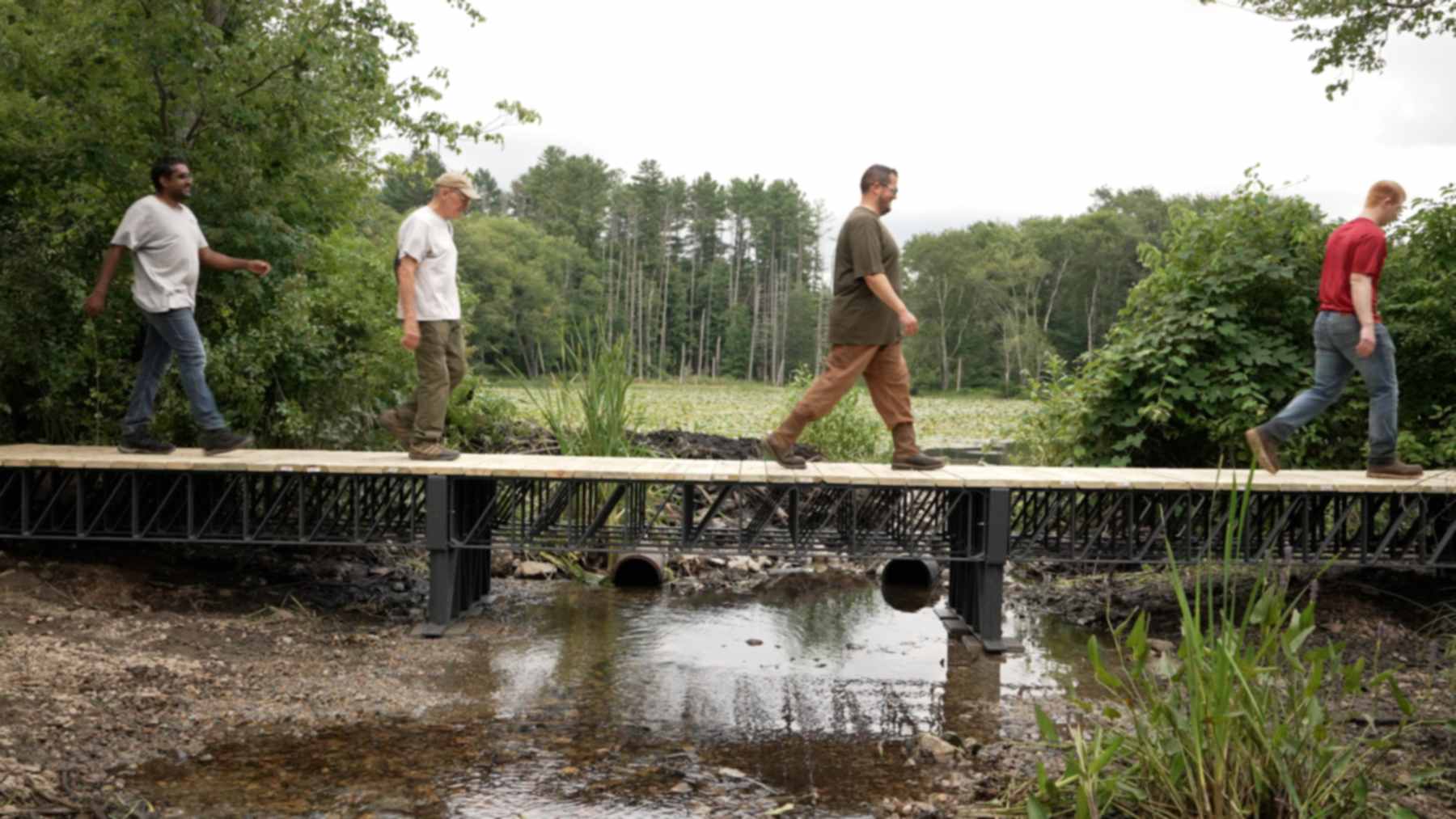
Recycled plastic now holds up a 40-foot (12-meter) trail bridge in a wetland in Oxford, Massachusetts. Atlas Building Composites installed it with the U.S. Army Corps of Engineers in July 2026, and the company’s installation record lists a 6-hour job and a design for horse and rider traffic. MIT News itself says only that the bridge went up in less than a day.
Atlas grew out of research at MIT, and MIT News profiled the company on September 14. Its founders want similar printed parts to frame houses. That is a far harder market than a footbridge or a dock.
A crossing for horse riders
Atlas lists the Oxford Trail Bridge as in service. According to MIT News, the structure uses American-made recycled composite trusses. The company’s parts also support barns, sheds, decks and docks.
A truss is an open frame that carries weight with less material than a solid beam. MIT compares the floor version to a ladder with diagonal rungs.
The plan behind the bridge is far larger, says Atlas chair, co-founder and MIT research scientist A.J. Perez. “Our mission is to convert waste plastic pollution into durable composites to build 1 billion homes,” he told MIT News.
Shredded bottles meet American fiberglass
Production begins when single-use plastic from water bottles and other objects goes through a shredder. Inside the Atlas system, that material melts and fuses with fiberglass. A large 3D printer then builds the finished part.
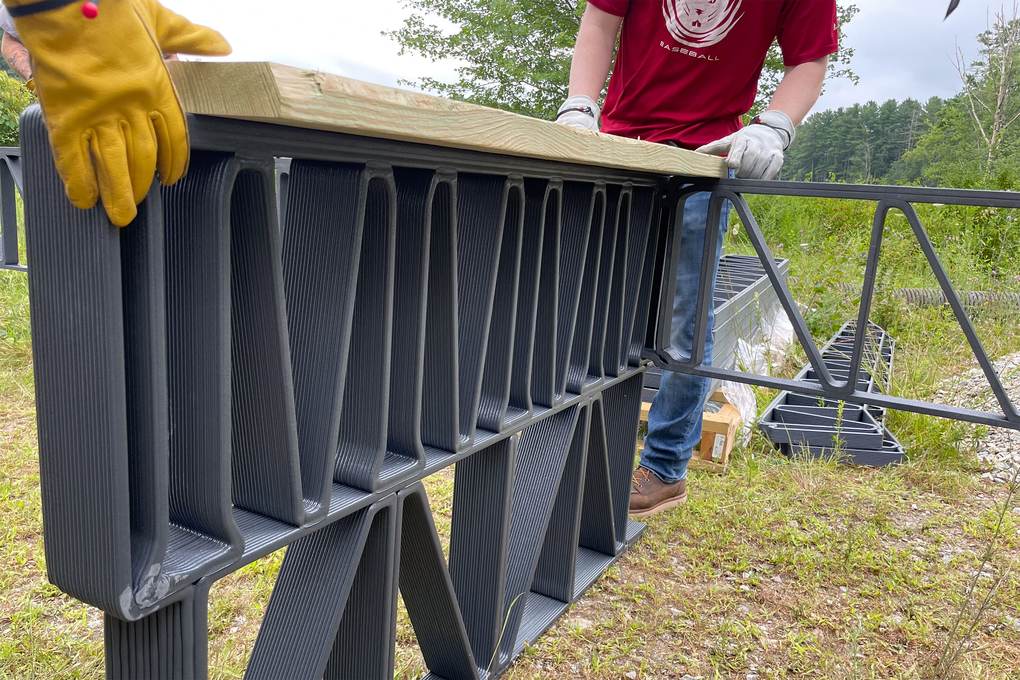
Perez started the underlying research in 2019 with MIT manufacturing professor David Hardt, in a group called MIT HAUS. He later teamed up with Matt Pouliot, a former Maine senator. Pouliot is now the company’s CEO.
Skipping the wash line
Conventional recycling washes plastic and then dries it. Atlas says on its website that washing takes about 3.5 liters of fresh water for every kilogram of PET, the polymer in drink bottles. Its own process drops both steps, so it can accept dirty, low-cost waste, the company says.
Perez also points to permits, because a new recycling plant normally brings in the local water agency. “A lot of that work disappears with the waterless recycling process,” he said.
Water is only one line in the environmental account, however. Neither the MIT report nor the Atlas pages give a full life cycle figure. Such a number would have to cover factory energy, fiberglass production, transport and disposal.
Sandbags until the chords snapped
The strongest public numbers come from a laboratory floor, not from the bridge. Perez, Hardt and three colleagues described the work in a paper for the Solid Freeform Fabrication Symposium. They printed 8-foot (2.4-meter) trusses from recycled PET with 30 percent glass fiber.
Each truss weighed 13 pounds (5.9 kilograms). The printer needed 13 minutes and 30 seconds per piece, including the initial purge. Four of them went under a sheet of plywood to form a floor measuring 4 by 8 feet (1.2 by 2.4 meters).
Under a typical 300-pound (136-kilogram) load, the floor stayed well within federal housing deflection guidance, the limit on how far it may bend. The team kept adding weight in later tests. Two truss chords finally buckled and fractured at 4,480 pounds (2,032 kilograms).
Those figures describe that floor alone, and the sources reviewed here include no equivalent load result for the Oxford bridge.
A framing cell per town
The founders do not want one giant plant shipping parts around the world. They picture small factories near the places that need housing, much as recycled plastic blocks became the walls of a Costa Rican home. According to MIT News, one Atlas cell can now make the framing for about one small home per day.
Perez said output at MIT reached 60 to 80 pounds (27 to 36 kilograms) of parts per hour. Systems specified for Atlas factories run at 150 to 200 pounds (68 to 91 kilograms). MIT notes that other 3D-printed housing efforts have mostly produced walls.
Perez also sees potential to make each part for less than injection molding. The report offers no price comparison that a buyer could check. Talks with international franchise partners are underway, with no countries or dates named.
Service life sits at the center of Pouliot’s environmental case for the material. “If you get a material into the building world and it does its job, it’s going to be used for a very long time and not need to be recycled again for a very long time,” he said.
Creep data and dirtier feedstock
After each loading cycle in the MIT tests, the floor did not return fully to zero deflection. The authors mainly blamed settling of the trusses and possible shear in the plywood. Creep, the slow deformation of a material under sustained load, could also contribute, they wrote, and long-term tests were underway.
The plastic itself is the second open question for anyone picturing bottles inside a wall. MIT reported in February that the test trusses used factory-discarded material from an aerospace supplier. Perez called it the “crème de la crème of recycled feedstocks,” and work on used soda bottles was still in progress.
Atlas now says its process handles dirty plastic, yet neither source publishes load results for parts made that way. End of life is unresolved too. Glass fiber composites in wind turbine blades have proved hard to recycle, and Pouliot himself notes that repeated recycling degrades material.
The latest official profile of the company appeared on MIT News on September 14, 2026. The floor tests appeared in the symposium’s proceedings.
Photo: Courtesy of Atlas