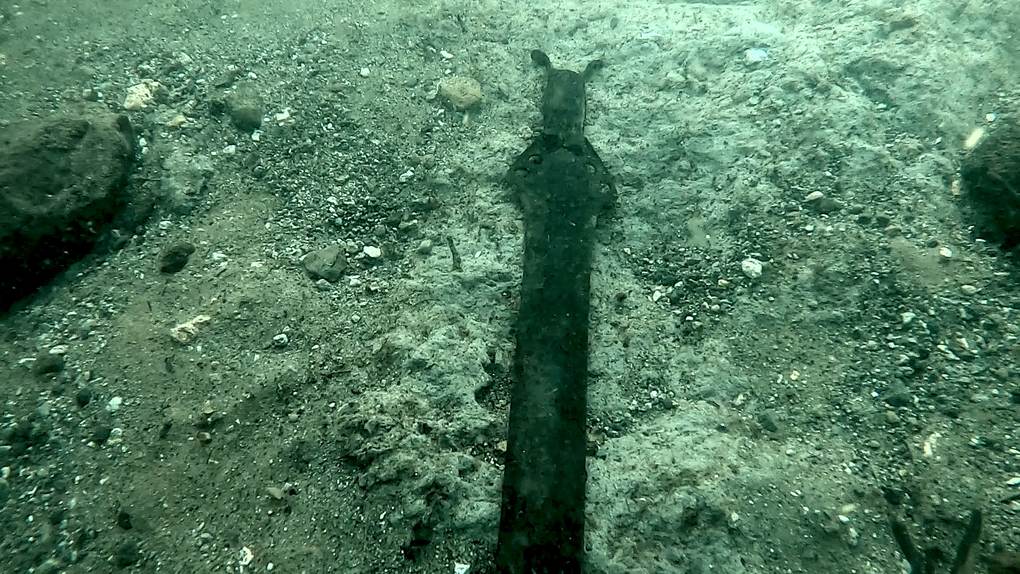
Divers in central Italy have recovered a Bronze Age sword from Lake Mezzano, a volcanic crater lake near Viterbo, and its edge is still sharp after about 3,300 years. The regional heritage office announced the find on October 6, 2026. It dates the bronze weapon to the 13th century B.C.
According to the office, which belongs to Italy’s Ministry of Culture, the sword surfaced late in this year’s dig. It came from a part of the southern shore that had seen little investigation, and a bronze razor lay close by.
Third blade since the 1970s
Two other swords have come out of this site since the 1970s, the office says. The new one matches the weapons made in central Italy at the end of the Bronze Age. The office says it testifies to the level of metalworking skill the communities of the time had reached.
Divers also brought up many intact pots this season. The bronzes included axes, arrowheads, daggers, spearheads and pins.
Margherita Eichberg heads the office, and its underwater archaeology service directed the work. The Carabinieri’s diving unit in Rome helped with survey, documentation and safety. Conservators from the firm CSR Restauro Beni Culturali treated each object as soon as it was recovered.
More than 600 submerged posts
Lake Mezzano fills an old volcanic crater close to the western edge of Lake Bolsena. Divers there have studied Gran Carro, another drowned settlement in Italy. At Mezzano, a village built on wooden piles was in use from early in the second millennium B.C.
Geologist Lamberto Ferri Ricchi discovered the site in the winter of 1971. Excavations followed in 1973 and again from 1983 to 1996, and then the work stopped for years. It resumed in 2025 under Barbara Barbaro, an underwater archaeologist with the office.
That first season mapped more than 600 wooden posts across about a third of the known settlement. They now stand in about 8 to 33 feet (2.5 to 10 meters) of water. To the team, that spread suggests the village followed the changing lake level for around 600 years.
Sediment clouds the water with every movement, so visibility is poor. At the level of the remains, the office recorded 57°F (14°C) in September 2025.
A razor beside the weapon
For the office, the razor’s position is a detail of particular interest. Similar pairings from other Bronze Age sites have been linked to people of high status, probably warrior elites. The two objects may therefore hint at who carried this sword.
Communities in central Italy were part of wide networks of contact between the 13th and 12th centuries B.C. Those links reached across the peninsula and the Mediterranean. Bronze weapons in that world signaled prestige, identity and power as well as serving in combat, the office notes.
Status objects from this period survive in very different settings. One example is a 3,400-year-old folding chair from a Danish burial mound.
Offering or accidental fall
Swords, axes and spearheads turn up in lakes across Europe. Archaeologists often read them as deliberate deposits tied to water rituals. The new announcement raises that possibility for Mezzano but does not claim it as settled.
Last year’s work pointed to another route into the water. The team thinks material fell and rolled from a probable wooden platform, which sometimes burned. Some bronzes showed signs of fire, and many burned structures remain among the timbers.
Metal finds from different sectors lie at remarkably similar depths, the office reports. It plans to use that pattern to test the models it is developing. Hundreds of potsherds likewise lay around a 5,000-year-old artificial island in Scotland.
Preservation here has been striking from the start. More than 25 bronzes recovered in 2025 lay against the surface of the clay deposit, an environment that kept oxidation at bay. A sickle kept its shine, and fragments of bronze ingots could point to workshops nearby.
A sword still without measurements
Much about the weapon has yet to be published. The announcement gives no length, weight or metal analysis, and no exact recovery date. Because the date is given only by century, the sword could be closer to 3,200 years old.
Nothing in the notice says whether the blade fell or was placed in the lake, or reports any test of its cutting edge. The team also warned in 2025 that some objects above the clay may have washed in from the banks.
Research will continue in the coming years, in collaboration with the town of Valentano. An exhibition of the Mezzano bronzes is promised soon.
The full announcement was published by the Superintendency of Archaeology, Fine Arts and Landscape for Viterbo and Southern Etruria on October 6, 2026.
Photo: Soprintendenza ABAP Viterbo e Etruria Meridionale