Russia and China are dangerously dominating the global PV industry, with new materials for which they are willing to blow up entire mountains. They did so in order to ‘gift’ the world with a new type of photovoltaics: those generated by perovskite solar panels. However, the lead they have taken is about to be lost thanks to a new invention from America. A group of engineers has just reached a historic milestone with a material that has never been studied before and that could multiply the energy we produce by 1000 times.
Goodbye to Russian solar panels: America beats one of the biggest photovoltaic industries
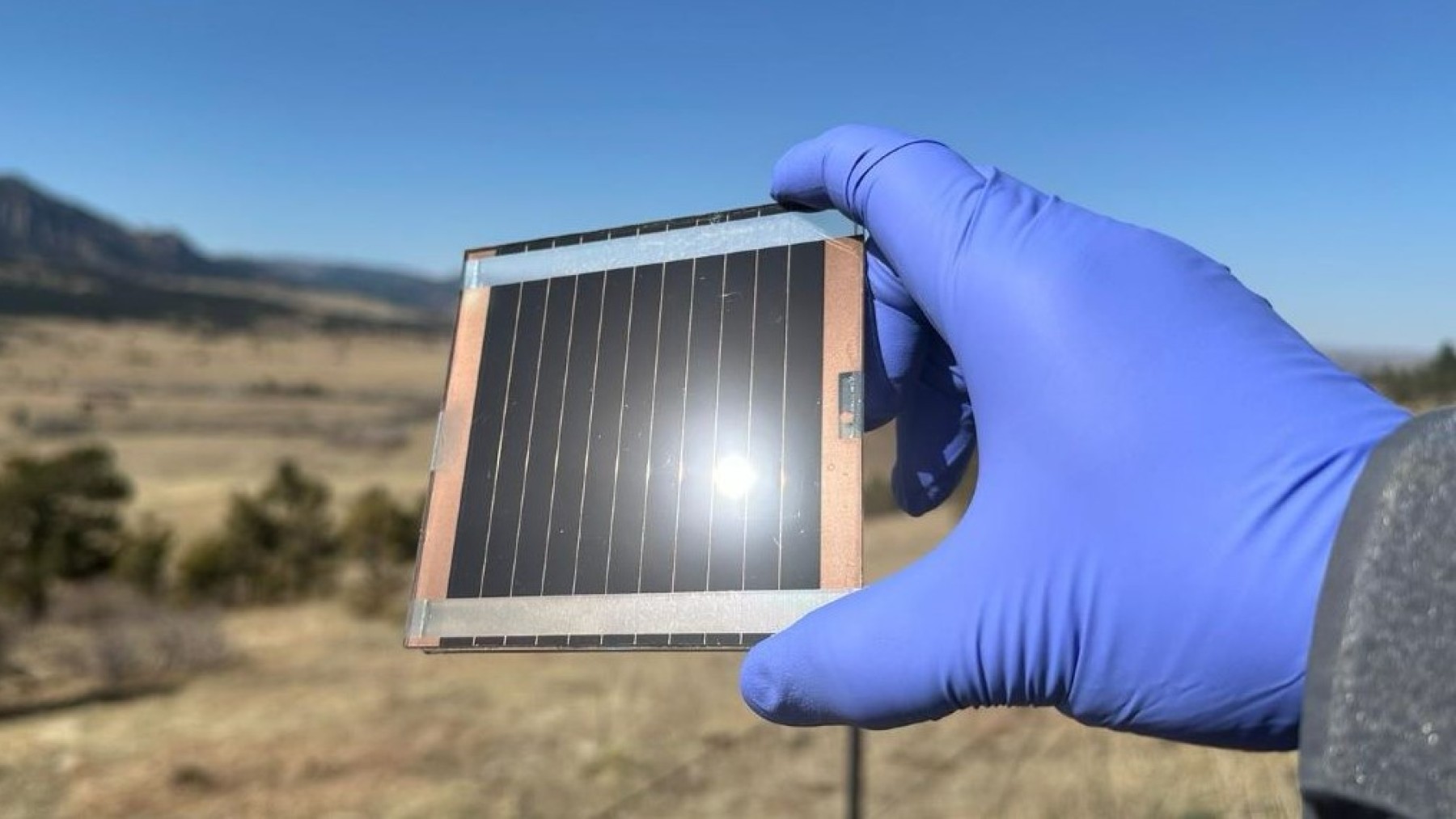
With novel perovskite designs and heterojunction contacts, the U.S.-based startup, PeroNova, has also actively worked on metal halide perovskite and silicon tandem solar cells. This new technology has the potential to improve the efficiency and stability of solar energy through the use of a single layer of the perovskite material on silicon solar cells.
PeroNova’s latest achievement is the development of a solar perovskite module with impressive efficiency figures:
- Lab-scale four-terminal (4T) perovskite-silicon tandem solar cells: ~30 efficiency.
- 900 cm² mini perovskite modules:900 cm² mini perovskite modules.
- 4T tandem configuration: ~About 28% efficiency.
- Outdoor applications: 22% efficiency.
- Space applications: 18% efficiency.
These efficiency figures do not belie that traditional silicon solar cells have efficiency levels ranging from 15 to 22 per cent.
80 % conversion efficiency and 2500 cycles: Some data about the new solar panels
Among the main characteristics affecting the technical advantage of PeroNova’s approach is the stabilization of the technology. The company has developed a novel interfacial treatment technology that significantly improves the durability of perovskite films:
Thermal cycling resistivity tests implied more than 80% power conversion efficiency retention after 2500 cycles. This enhanced stability responds to one of the most significant issues known to perovskite solar cells, allowing conceivable widespread use soon.
PeroNova’s perovskite-silicon tandem solar cells are being developed for various applications:
- Building-integrated photovoltaics (BIPV).
- Space applications.
- Portable electronics.
- Rooftop markets.
In view of this, these solar cells are appropriate for various applications indoors, outdoors, and even in space.
PeroNova has new plans to lead the photovoltaic market: Beyond its new material for solar cells
Launched in the year 2023, PeroNova, has very quickly come a long way in the creation of its perovskite-silicon tandem solar cells. The company’s approach involves:
- Realization of lab-scale 4T perovskite-silicon tandem solar cells.
- From a small-scale 4 cm² perovskite cell, the researchers achieved a 900 cm² mini perovskite module.
- Stability enhancement with reference to the new interfacial treatment technology.
- Partnering with the key US real estate developers towards the scale-up of BIPV and agrivoltaics adoption.
- Collaboration with companies dealing with space technology for space-related use.
New efficiency record has been achieved: PeroNova’s metal-halide silicon-tandem solar cells, in detail
However, it is crucial to minimize the discoveries of PeroNova at the same time analyzing the general information concerning perovskite-silicon tandem solar cells. A recent development by researchers from various institutions, including Nanchang University and Suzhou Maxwell Technologies, has pushed the efficiency boundaries even further:
- Fully textured perovskite/silicon tandem solar cell: These are the recommendations that I direct to the EC, alongside the concerns and suggestions for improvement that I address proactively to the Commission: 31. 5% certified steady-state efficiency
- Furthermore, since this is a high-efficiency cell, the stability test showed that much more than 95% of the initial efficiency was maintained during 800 hours of continuous operation.
As you can see, the new PeroNova solar panels are a step forward that highlights how perovskite is far from being the material of the future. This is what the Russians thought, until now, we have shown them that there are more viable, economical and, most interestingly, efficient options. In fact, there is already talk of the “miracle material”, a title recently taken away from monocrystalline silicon, which this tandem has managed to integrate in a completely innovative way (hence the secret of its effectiveness).