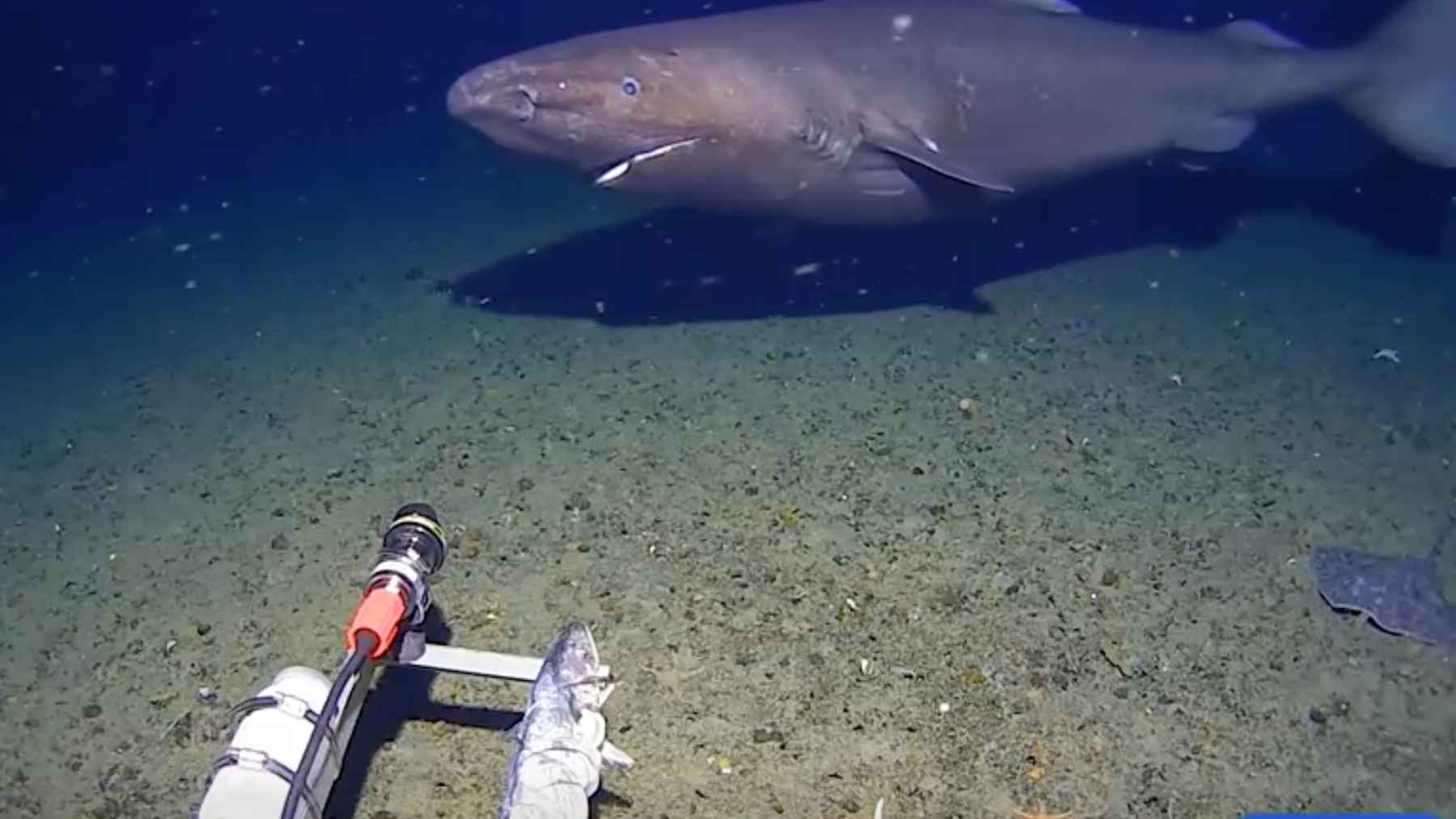
A slow-moving shark, about 10 to 13 feet long, has been filmed in the Southern Ocean near Antarctica, where many scientists assumed sharks were essentially absent. The video was captured roughly 1,600 feet down in near-freezing water, a depth and temperature that can make modern research gear struggle.
You can watch a traffic camera on your phone, but below the waves there are still huge blind spots. Researchers say this footage may be the first recorded shark video from this part of the ocean, and it is already pushing scientists to rethink what might be living in the deep around the Antarctic Peninsula.
What the camera captured
The video shows a sleeper shark from the Somniosidae family gliding past a deep-sea camera set near the South Shetland Islands. It appears briefly, then fades into darkness, while a skate that looks like a stingray sits still on the seafloor.
The shark was filmed in January 2025 at a depth of about 1,608 feet, where the water was around 34 degrees Fahrenheit. Researchers estimated it was roughly 10 to 13 feet long, and they noted it seemed to favor a depth near 1,640 feet.
The equipment was operated by the Minderoo-UWA Deep-Sea Research Centre, a program based at the University of Western Australia that specializes in sending cameras and sensors into places people rarely see.
Its founding director, Alan Jamieson, summed up the surprise bluntly when he said, “We went down there not expecting to see sharks because there’s a general rule of thumb that you don’t get sharks in Antarctica.”
Why sharks were not expected there
Sharks are found across the world, but they are not built the same way for cold water. Most are cold-blooded, meaning their body temperature tracks the surrounding sea, which can slow muscles and digestion when the water gets very cold.
That matters near Antarctica, where the ocean can stay below the usual freezing point of fresh water because salt lowers the freezing point. For a shark, the difference between water that is merely cold and water that is near freezing can be the difference between cruising and barely moving.
There is also a human factor. Antarctica is remote and expensive to reach, and deep-water camera work is usually limited to short windows during the Southern Hemisphere summer, so the record is shaped by when people can actually look.
What a sleeper shark is
Sleeper sharks are built for cold and deep living. They tend to move slowly, have relatively small fins for their body size, and often feed as scavengers, taking advantage of carcasses that sink to the seafloor.
Not all sleeper sharks look very different from each other on video, so the exact species in the Antarctic footage has not been confirmed.
Oceanographer Jessica Kolbusz called the moment rare, saying, “It was surprising since this is the first footage obtained of a somniosidae or any elasmobranch in situ in the Southern Ocean.” Elasmobranch is the umbrella term for sharks, rays, and skates.
The family is best known for the Greenland shark, an Arctic species whose lifespan surprised scientists. A 2016 paper in Science used radiocarbon dating, a way to estimate age using radioactive carbon, to show some individuals can live for centuries, with the oldest approaching 400 years.
A layered ocean, a narrow comfort zone
The shark did not appear to be roaming randomly through the water column, the open water above the seafloor. Researchers said it was holding to a depth band that ran along a seabed sloping into deeper water.
Why that depth? The team said it matched the warmest layer in a stack of water layers sitting on top of one another, like a layered dessert in a glass.
This layering happens when colder, denser water stays below while fresher meltwater sits closer to the surface and does not mix easily. In everyday terms, it can create a thin comfort zone where an animal can conserve energy while staying a little warmer than the water above or below.
The climate question, and what scientists can and cannot say
When a surprising animal shows up in a surprising place, it is tempting to jump straight to climate change. Scientists caution that it is hard to tell whether this shark is a new arrival, a rare visitor, or part of a population that has been there unnoticed.
Still, the background trend is clear. The Intergovernmental Panel on Climate Change reports that the heat content of the global ocean has increased since at least 1970, meaning the ocean is storing more of the excess heat trapped by greenhouse gases.
For now, researchers are focused on basics. More deep-water footage, more environmental data, and genetic testing from water samples could help show whether sleeper sharks are occasional passersby or quiet residents of the Antarctic deep.
Why the deep ocean still surprises us
It is easy to forget how little of the deep ocean humans have actually seen. NOAA notes that explorers have directly observed less than one-thousandth of one percent of the deep ocean seafloor, even though mapping and remote sensing have improved a lot.
That gap helps explain why a large shark can go unrecorded in a world full of cameras. It is easier to pull up a street clip than to keep a camera running a third of a mile down in ice-cold water.
There are also signs that more cameras mean more finds. A January 2025 university news release described sleeper shark footage captured in the Tonga Trench at about 4,600 feet deep, a reminder that these animals can live in places most people will never visit.
The main report has been published by The Associated Press.