Have you ever stared up at a steady night sky and assumed nothing up there changes on a human schedule? Astronomers just got a reminder that the cosmos can move fast, after spotting major shifts in WOH G64 in the Large Magellanic Cloud.
New research suggests this behemoth may have jumped from a classic red supergiant look into a hotter, more yellow phase that could mark a rare yellow hypergiant stage, possibly because it is part of a two-star system. If that holds up, it becomes a rare real-time window into how the biggest stars shed material on the way to their final act.
A giant star in the galaxy next door
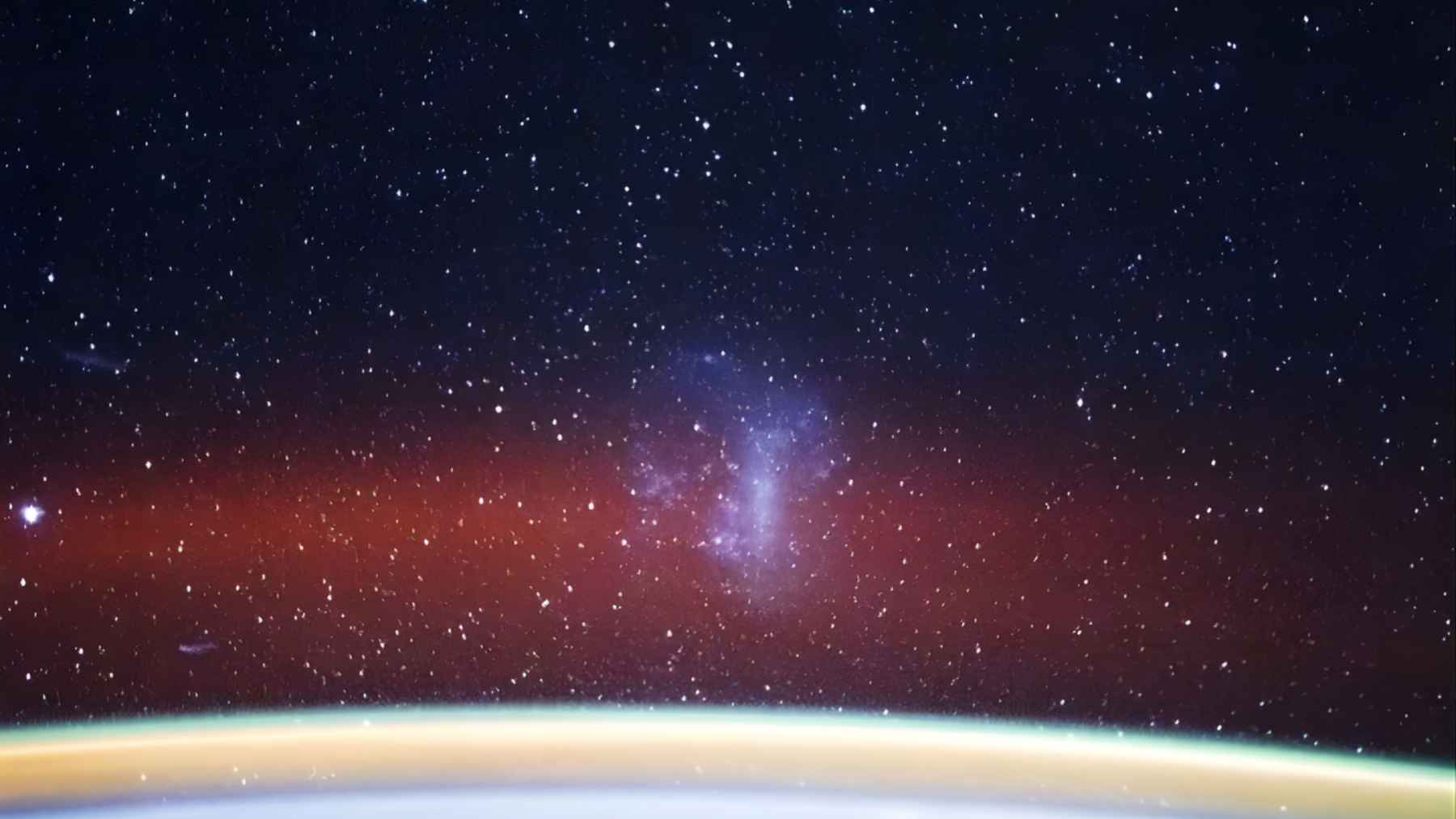
WOH G64 sits in the Large Magellanic Cloud, a neighboring dwarf galaxy roughly 160,000 light-years away (about 944 quadrillion miles). For decades it has been famous for its scale, with estimates putting its radius around 1,540 times that of the Sun.
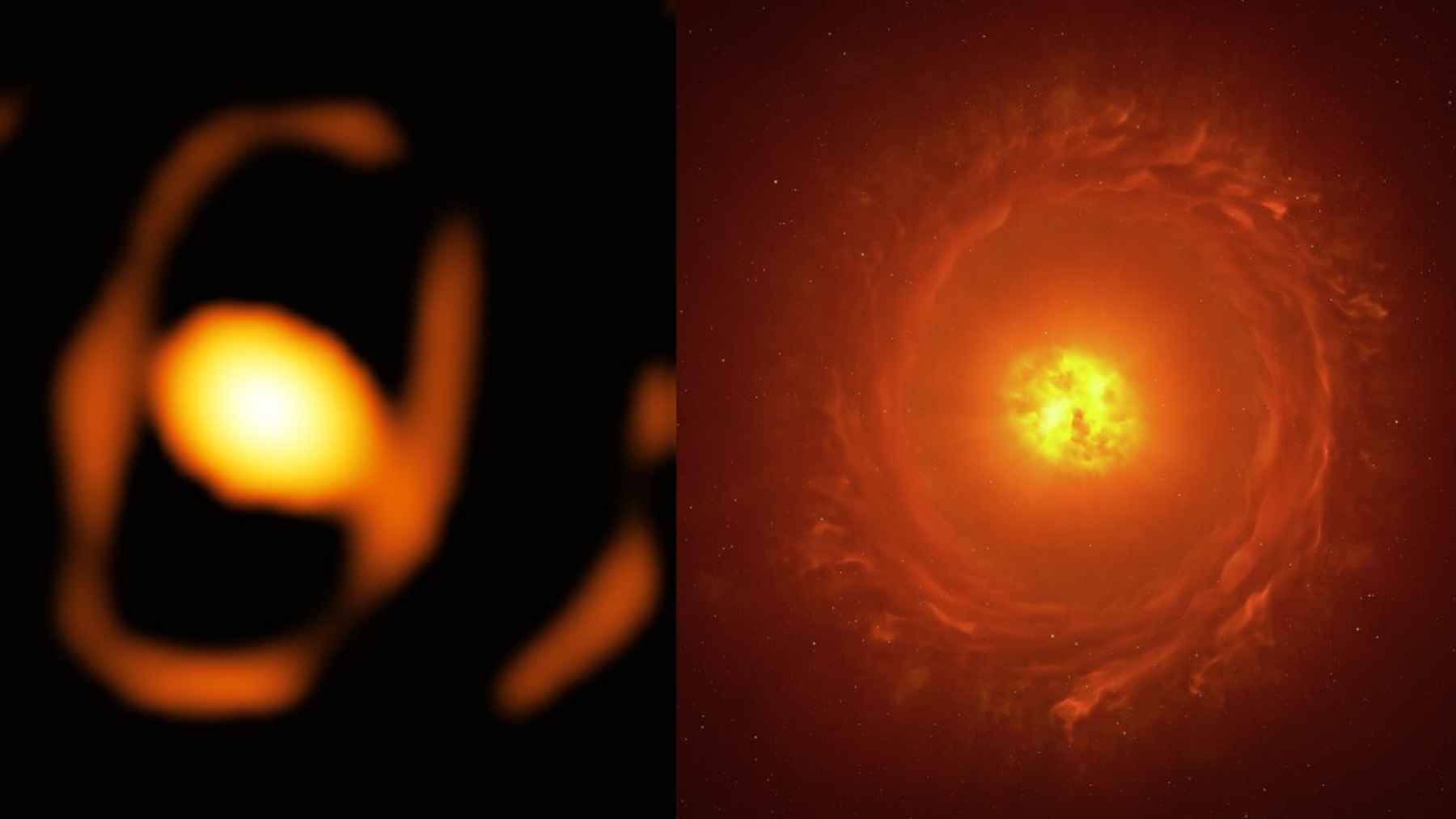
Stars this massive burn through fuel quickly and lose material as they age. In 2024, the European Southern Observatory’s Very Large Telescope Interferometer showed WOH G64 surrounded by a thick cocoon of gas and dust.
The year everything changed
Long-term monitoring is what made this story possible. Surveys tracked WOH G64 for decades and even picked up a repeating brightness cycle, with pulsations on an unusually long period of 886 days.
Around 2011, the star dimmed, and when it rebounded in 2013 and 2014, it looked different in spectra and color. That is the part that made astronomers sit up straight.
Researchers report the surface temperature rose by about 1,000 kelvins, which is roughly a 1,800-degree Fahrenheit jump, and the hue moved from deep red toward yellow. One member of the team said, “When we first saw the data, we thought we were observing a different star.”
Two scenarios and both are weird
The Nature Astronomy team lays out two explanations, and neither is routine. In the first, WOH G64 is a binary system, and an interaction between the stars triggered the ejection of part of the outer atmosphere.
In practical terms, that means the star we thought we were seeing may have been a kind of disguise. As outer layers were stripped away, hotter inner regions could have been exposed, making the system appear to heat up and change color quickly.
The alternative is almost the reverse story. WOH G64 may have been a warmer star all along, but a long eruption coated it in material that made it look red for decades, and only later did that obscuring veil thin out.
The debate is still part of the news
Not everyone is ready to call it settled. Some researchers argue the evidence for a companion is still limited, and follow-up spectra from other teams suggest red supergiant signatures may have returned at times.
That tension is exactly why WOH G64 is so valuable. If this is a genuine transition, it is one of the most dramatic changes ever seen in a red supergiant, but if it is a dusty shell game, that is also a clue about how giant stars hide their true state.
Either way, the star did not stop moving. Observers report it began fading again in 2025, dropping by roughly two magnitudes in less than a year.
Is a supernova next?
Here is the question everyone asks right after hearing “one of the biggest stars we know.” Massive stars like this are expected to end in a core-collapse supernova, or in some cases collapse into a black hole with little visible fireworks, but predicting timing is notoriously hard.
A useful reality check comes from the last famous nearby explosion in the same galaxy. Supernova 1987A erupted in the Large Magellanic Cloud and briefly became visible to the unaided eye from much of the Southern Hemisphere, peaking around magnitude 2.9.
The environment angle is the night itself
To watch a star change, you need a sky that is actually dark enough to measure it. Citizen science data analyzed in the journal Science suggests global night sky brightness increased at an average rate of about 9.6% per year from 2011 to 2022.
Light pollution is not just an astronomy complaint, either. TheU.S. National Park Service notes that poorly aimed outdoor lighting wastes energy, drives avoidable carbon dioxide emissions, and disrupts wildlife that depends on natural dark cycles.
It is also a rare environmental issue where the fix can feel immediate. Shielded fixtures, the minimum light needed, and switching off unnecessary lighting can cut glare and lower the electric bill.
What happens next
Scientists will keep watching WOH G64 the old-fashioned way, with patience and lots of data. Continuous surveys, along with targeted spectroscopy and interferometry, can test whether the “yellow” state persists and whether a companion’s signal strengthens.
This matters beyond one celebrity star. Astronomers have struggled with the “red supergiant problem,” where the most luminous red supergiants are rarely seen as confirmed supernova progenitors, raising the possibility that some stars change appearance before they die.
For everyone else, it is a reminder that the night sky is part of our shared natural heritage, not just a backdrop. When a distant star puts on a once-in-a-lifetime show, you want the lights around your home to let you see it.
The study was published in Nature Astronomy.