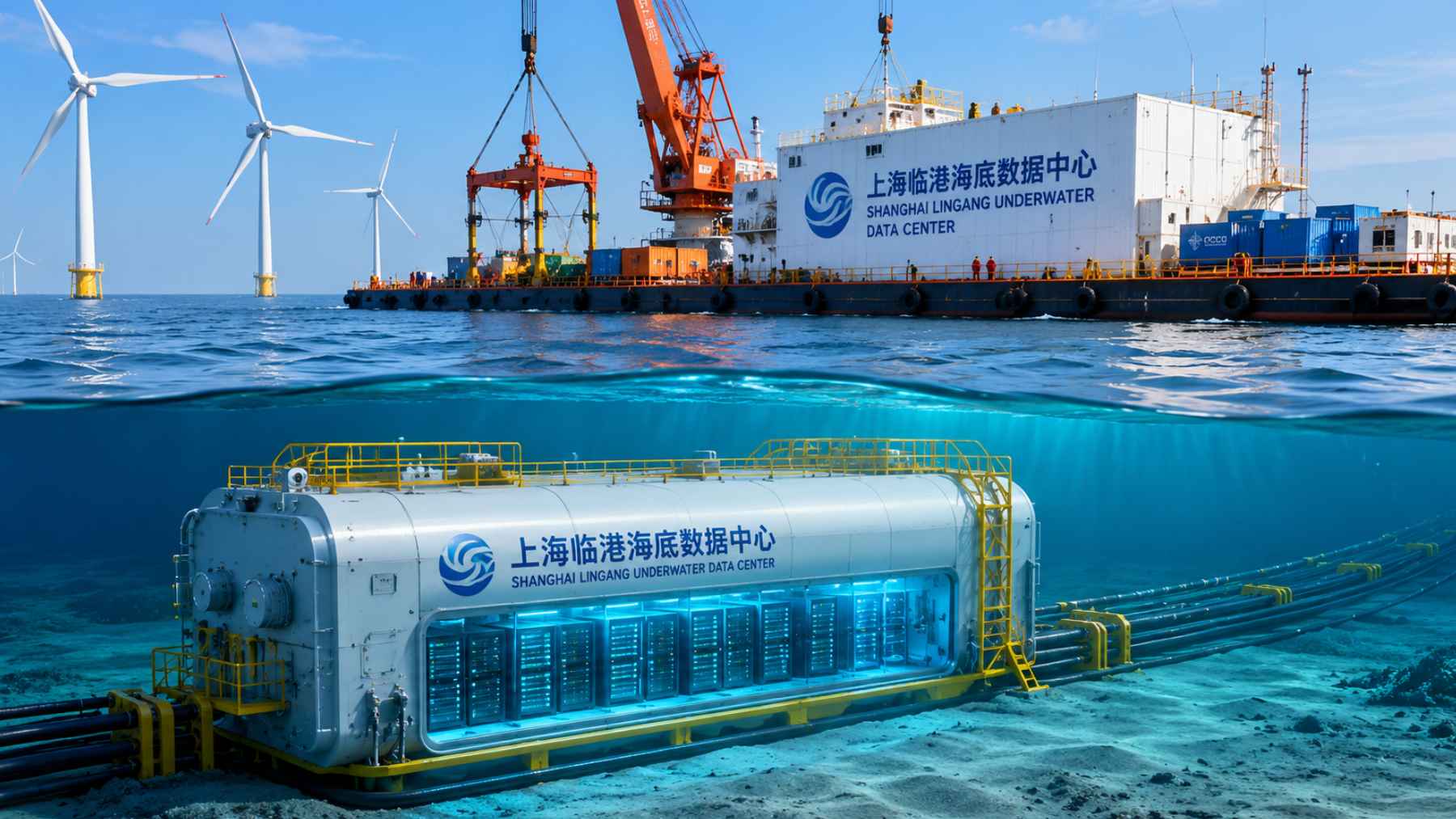
China has begun operating a wind-powered, underwater data center off the coast of Shanghai, turning a strange-sounding engineering idea into real AI infrastructure. The Shanghai Lin-gang undersea data center sits about 6.2 miles offshore and roughly 33 ft. below the sea surface, where seawater cooling and offshore wind are meant to ease the pressure that AI is putting on power grids, land, and freshwater supplies.
The stakes are bigger than one facility. The International Energy Agency says global data center electricity consumption is set to more than double to around 945 terawatt-hours by 2030, with AI as the most important driver of that growth. That means the electric bill for the digital economy is no longer an abstract concern.
A server room beneath the waves
The project officially entered operation in May in the waters off Shanghai’s eastern coast. Built by a subsidiary of China Communications Construction, it has a planned capacity of 24 megawatts, while its first demonstration phase is running at 2.3 megawatts.
Inside, the underwater facility holds 192 server racks arranged across four levels. Those racks support AI-focused workloads, including big data annotation and the development of domestic large language models.
Read More: {{post_title link:post}}
This is not just a science fair experiment in a metal tube. The project received an investment of about $226 million, according to China’s State Council, and local officials describe it as a way to build computing infrastructure while using less land and fewer cooling resources.
Why the ocean matters
Traditional data centers can spend a large share of their electricity just keeping servers from overheating. Tsinghua University Professor Li Zhen said conventional facilities typically use about one-third of their electricity on cooling systems, while an undersea site of the same scale could bring that share down to “about one-tenth.”
That is where the surrounding ocean comes in. The Lin-gang project uses seawater as a natural cooling source through a circulating copper-pipe heat exchange system, with average nearby sea temperatures reported at about 59°F.
Anyone who has sat next to a loud laptop fan on a hot day can understand the basic idea. Heat is the enemy, and cooling it takes money, equipment, and energy.
Wind power joins the cable
The system is connected directly to nearby offshore wind farms through subsea photoelectric composite cables. CGTN reported that more than 95% of the facility’s electricity comes from renewable energy through this setup.
Read More: {{post_title link:post}}
The Lin-gang project is located between phases one and two of the area’s offshore wind farm, placing the submerged modules close to the turbines that help power them. This means less dependence on the usual grid-routing model and a tighter link between renewable generation and computing demand.
That pairing matters because AI infrastructure is growing fast. If new data centers simply pull more fossil-fuel electricity from already strained grids, the environmental gains of smarter software could be swallowed up by the hardware needed to run it.
Land and water are part of the story
According to the project developers, the underwater design reduces electricity consumption by 22.8%, eliminates freshwater use for cooling, and cuts land use by more than 90%. Its power usage effectiveness, known as PUE, is reported to stay around 1.15, which developers describe as an industry-leading level.
The fully scaled facility could save 61 million kilowatt-hours of electricity each year, according to CGTN. That is 61 gigawatt-hours annually, not a one-time savings figure, and it helps explain why coastal cities are watching these ideas more closely.
Still, putting computers under the sea is not automatically a perfect green solution. Questions remain about maintenance, saltwater corrosion, subsea cabling, long-term costs, and how continuous heat release may affect local marine environments if this model grows.
From experiment to infrastructure
China is not the first to test the idea of underwater computing. Microsoft’s Project Natick deployed a data center 117 ft. deep off Scotland’s Orkney Islands in 2018, ran it for two years, and later reported that the concept was feasible and energy efficient.
The difference is that the Shanghai project is being framed as operating infrastructure, not only a research trial. China Telecom computing clusters and local service providers have already connected to the Lin-gang platform, according to the official Lin-gang report.
Read More: {{post_title link:post}}
That shift is important. If underwater data centers can be maintained safely and scaled economically, they could become one more tool for coastal economies trying to balance AI growth with cleaner power, less water demand, and less competition for urban land.
What comes next
Developers have already indicated plans to expand underwater data center deployments after the Shanghai project’s commercialization. That does not mean every coastline is about to become a server farm, but it does suggest the old model of building bigger and hotter land-based facilities is being questioned.
At the end of the day, the challenge is simple to describe and hard to solve. AI needs more computing power, while communities need reliable electricity, cleaner air, enough water, and room to grow.
China’s underwater data center does not answer every concern, but it changes the conversation. The next wave of AI infrastructure may be judged not only by speed and processing power, but also by how carefully it uses electricity, water, and land.
The official report was published on Lin-gang Special Area.