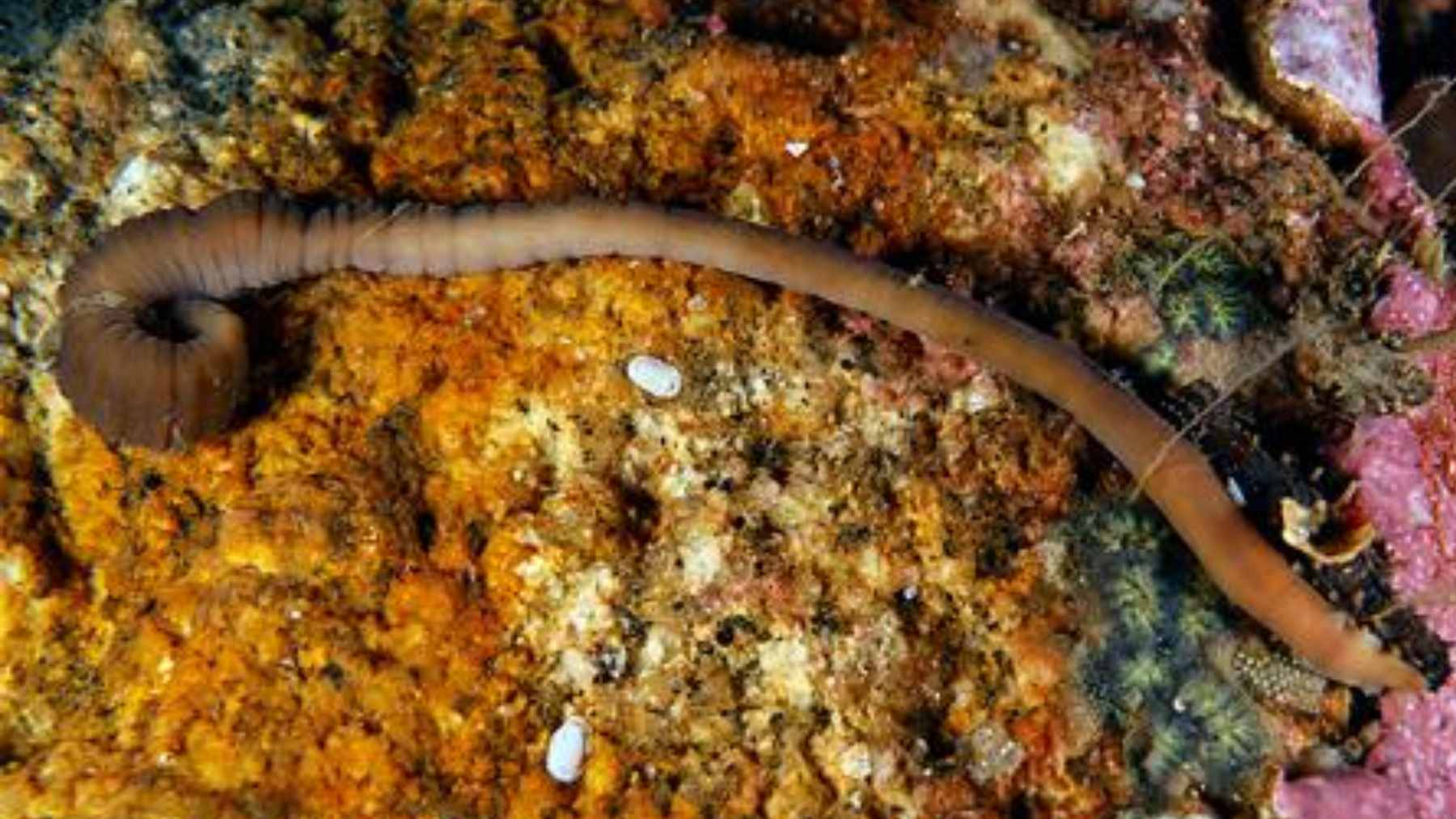
A long, dark ribbon worm from Spain’s northwest coast has turned out to be something scientists had never formally named before. Known now as Pararosa vigarae, it can pull its soft body into tight folds until it is only a fraction of its relaxed length, making it look like an accordion being squeezed shut.
Only six specimens are known so far, found beneath rocks and shells around 98 feet under the surface in Galicia’s Ría de Arosa. That is what makes the discovery so striking. In a European estuary visited by divers and researchers, a strange animal was still hiding in plain sight.
Meet the accordion worm
In its relaxed state, Pararosa vigarae is brown to dark green and measures about 4.3 to 9.8 inches long, while its width is only about 0.12 to 0.16 inches. When disturbed, it can contract to about one-quarter or one-fifth of that length.
What does that look like in real life? Imagine a soft ribbon suddenly pulling itself into a neat stack of rings. The largest known specimen had about 60 ring-like marks along its body, and those marks stayed visible as shallow grooves even after the animal stretched out again.
Why ribbon worms are easy to miss
Ribbon worms belong to the phylum Nemertea, a group of mostly marine animals with long, soft bodies and an extendable hunting organ called a proboscis. The University of Alcalá notes that these worms can use that proboscis to release venom that paralyzes prey.
For the most part, they are not the kind of animals people notice on a beach walk. They live tucked under stones, in mud, or among seafloor growth, doing their work far from the surface and far from the noise of boats, swimmers, and crowded summer shorelines.
Scientists currently recognize about 1,300 nemertean species around the world, but researchers suspect that number only captures part of their real diversity. The official study also describes ribbon worms as especially difficult for taxonomy because they often lack obvious external features.
DNA untangled the mystery
For decades, identifying ribbon worms was a slow job. Researchers often had to examine internal anatomy in great detail, and even then, two animals could look frustratingly similar from the outside.
That is where modern DNA work changed the story. “To describe the new species, we sequenced the worm’s DNA and performed phylogenetic analyses that allowed us to confirm that it is a new genus,” Aida Verdes, a researcher involved in the project, said in a translated statement.
The team studied several genetic markers, including 16S rRNA, 18S rRNA, 28S rRNA, COI, and histone H3. Those sequences showed that the six specimens formed a distinct branch within the Lineidae family, which meant scientists were not just looking at a new species, but a new genus as well.
A name tied to Galicia and a wedding
The genus name Pararosa points back to the Ría de Arosa, the Galician estuary where the specimens were found. The species name vigarae honors Rosa Vigara, the wife of senior author Juan Junoy, as a gift for their golden wedding anniversary.
It is a small human detail inside a very technical discovery. Still, it fits the story nicely. A creature hidden under stones for who knows how long now carries both the name of its home and a family tribute.
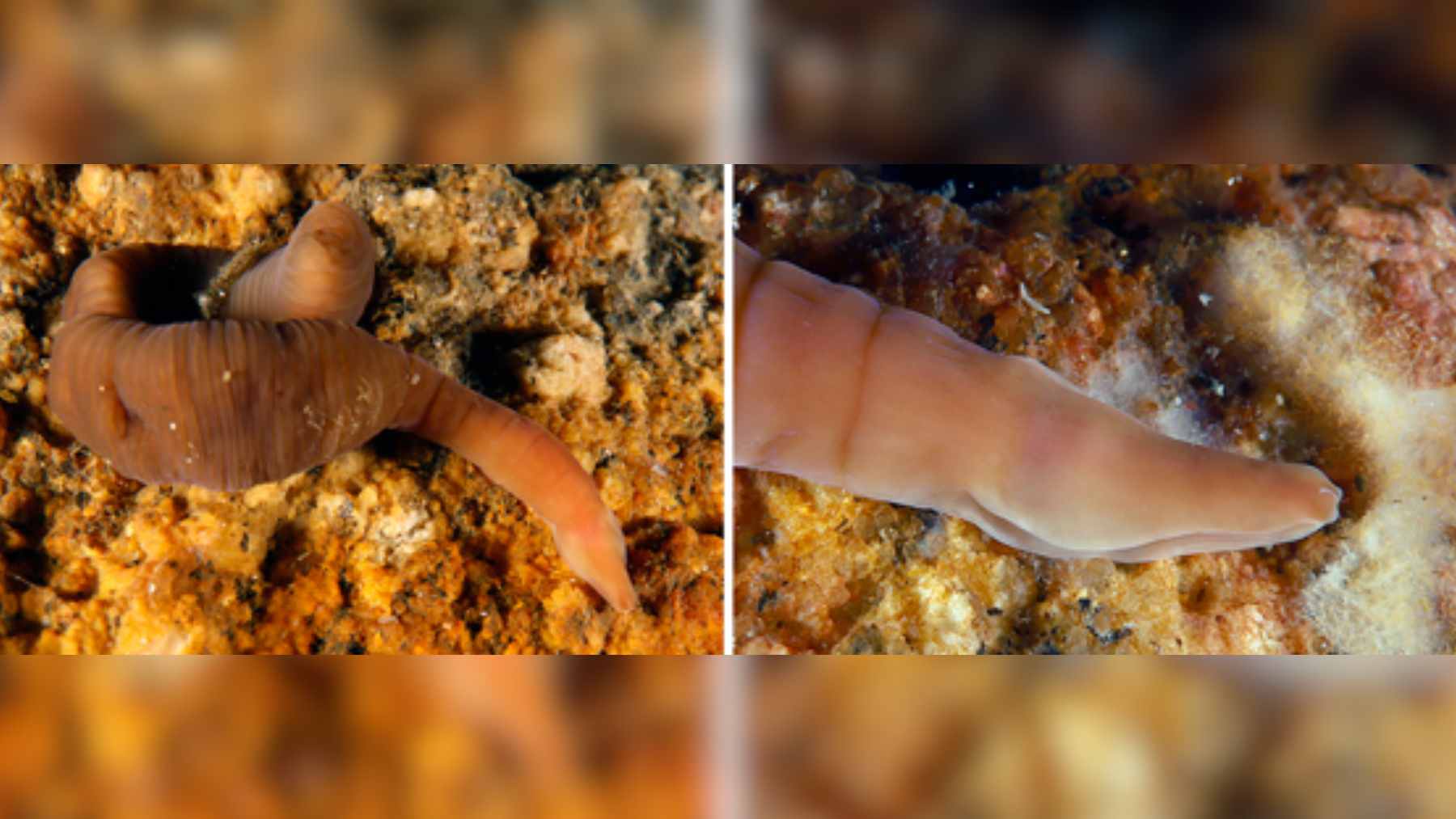
Juan Junoy described the worm as uncommon because, despite its size, it has only been found on two occasions in the Ría de Arosa. That does not mean the animal is necessarily rare everywhere. It means scientists have only just begun to understand where to look.
What this tiny animal tells us
The accordion worm adds just one name to the scientific catalog, but the bigger message is harder to ignore. Even in coastal waters that are not exactly remote, the seafloor still holds animals that can escape notice for years.
That matters because biodiversity is not only about whales, forests, coral reefs, or the species that make headlines. Sometimes it is about a soft-bodied predator less than 10 inches long, curled under a shell, waiting for someone to turn over the right rock.
The discovery also shows why live photographs and DNA are becoming so important in modern species work. Preserved animals can lose color and shape, while genetic data can reveal relationships that the eye alone might miss.
A small discovery with a big ocean lesson
The accordion worm is not just a biological oddity. It is a reminder that the ocean’s hidden life is still being mapped, one strange body plan at a time.
In practical terms, that means local estuaries, rocky bottoms, and diving sites deserve more attention, not less. The next unknown species may not be in some distant abyss. It may be sitting under a stone, just beyond the reach of everyday sight.
The study was published in Royal Society Open Science.