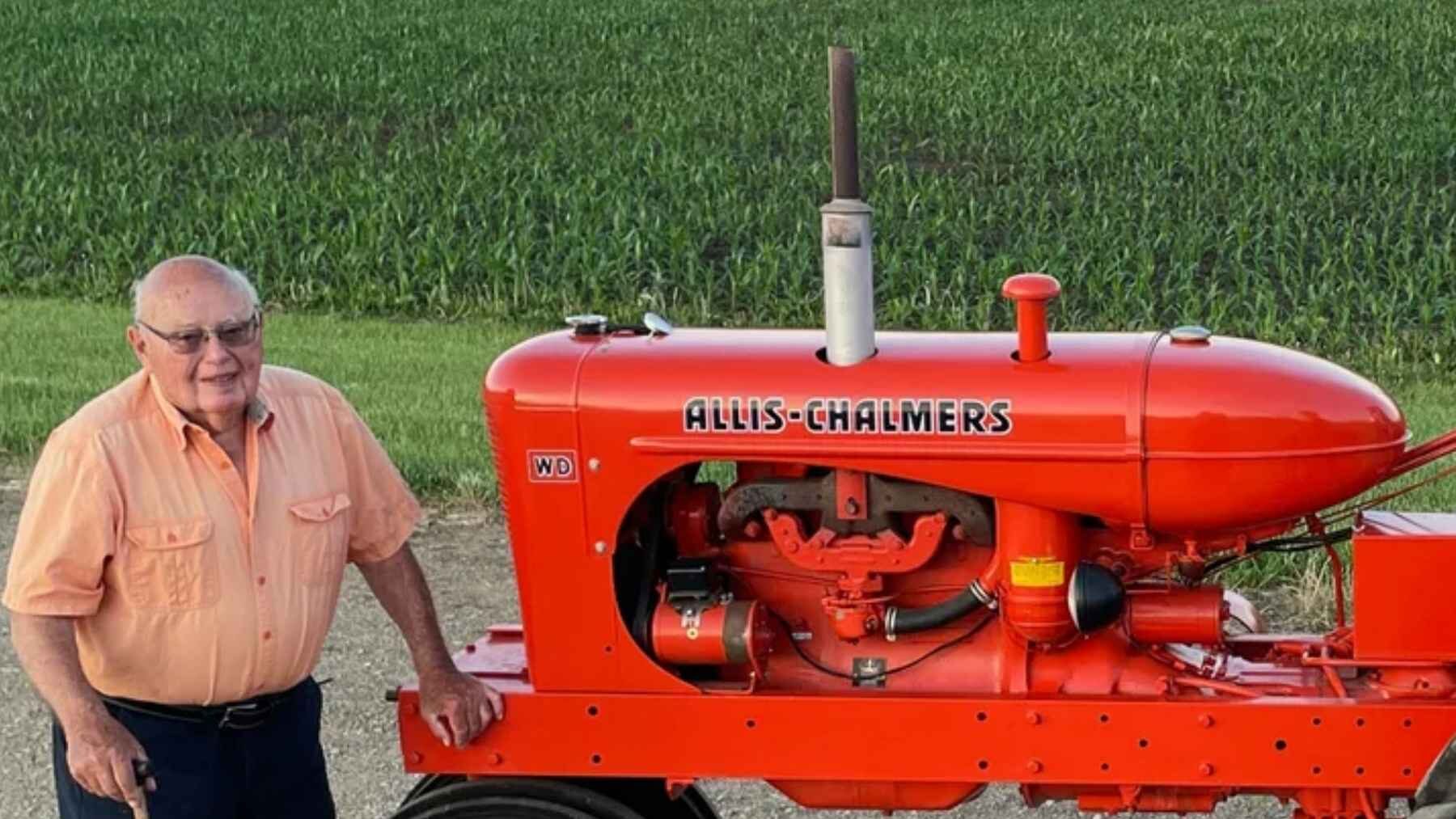
A newly published farm profile has brought fresh attention to a 1953 Allis-Chalmers WD that once hauled tobacco crews across a Wisconsin family farm. Kevin Klahn bought the machine in 2015, exactly 62 years after his grandfather Robert paid $2,200 for it new, then spent a year bringing it back to working condition.
Some online retellings say the tractor was sold repeatedly and rediscovered after decades with strangers. The original account is quieter and, in some ways, more powerful. It stayed within the Klahn family, passed to an uncle after Robert died, and eventually returned to Kevin in rough condition.
A tractor built for work
Robert Klahn purchased the new WD from Hanley Implement Co. in 1953 for use at Klondike Farms near Brooklyn, Wisconsin. Its main job was hauling wagons filled with workers during the tobacco harvest.
Kevin grew up around the tractor and learned to operate it as soon as he was tall enough. “Once I could reach the pedals, I started driving the WD,” he recalled, while other family members gathered and loaded tobacco plants.
The farm also raised corn, oats and hay, along with 26 Holstein cows, pigs and chickens. The WD worked beside a Farmall M and a Ford 9N fitted with a loader, making it one part of a small fleet that handled everyday chores.
One of the final WDs
A WD was a row-crop tractor, a machine designed with the clearance and wheel layout needed to work around planted rows. Historical records place its production from 1948 through 1953, when the more powerful WD45 began replacing it.
That timing matters because the Klahn tractor came from the WD’s final production year. It should not be confused with the WD45, a different model introduced in 1953 and produced for several more years.
The original WD used a two-clutch power control system. In practical terms, an operator could stop the tractor’s forward movement while allowing attached equipment to keep running. The University of Nebraska Tractor Test Laboratory formally tested the model in 1950, preserving an official performance record from the period.
It never really left
When Robert died in 1985, the tractor went to his son Ron. It then spent about 30 years mainly raking hay, rather than passing through a string of unknown owners.
In 2015, Kevin bought the tractor for $2,000. What do you do with a machine that carries that much family memory? For Klahn, the answer was to rebuild it.
That distinction gives the story its real weight. This was not a chance discovery at an auction or in an abandoned barn. It was a familiar machine that had grown worn while continuing to serve the same farming family.
A year under repair
Over the next 12 months, Kevin fixed oil leaks, installed new tires and a new fuel tank, and replaced the seat and radiator grille. The reported repair bill reached $4,500, on top of the $2,000 he paid to acquire the tractor.
Based on those figures, the documented cash outlay reached at least $6,500 before counting Kevin’s labor. Once the mechanical work was complete, his friend Dale Martinson of Stoughton, Wisconsin, repainted the tractor.
Fresh paint came last. First came the less visible work that determines whether a vintage machine can start, move and operate reliably after decades in the field.
More than old machinery
Wessels Living History Farm reports that more than 145,000 Allis-Chalmers WD tractors were built during the model’s six-year run. That production total helps explain why the WD remains familiar to collectors, but it does not explain why this particular tractor matters.
Photojournalist Harlen Persinger described the restored machine as a link across four generations. Today, it appears in a couple of parades and is displayed at the farm’s annual landowner appreciation event, which draws about 250 people.
Klahn said the tractor had provided “many sentimental memories” and believed his grandfather would be happy to see it restored to mint condition. Machines wear out. Family stories do not have to.
The original report was published by Farm Progress.