Kilauea's 57th lava fountain lasted almost six hours and reached about 650 feet, and USGS scientists say another episode is likely in the coming weeks
The Kilauea summit switched to inflation as soon as the fountain stopped, and its lava covered about half of the Halemaʻumaʻu crater floor.

· 3 min read
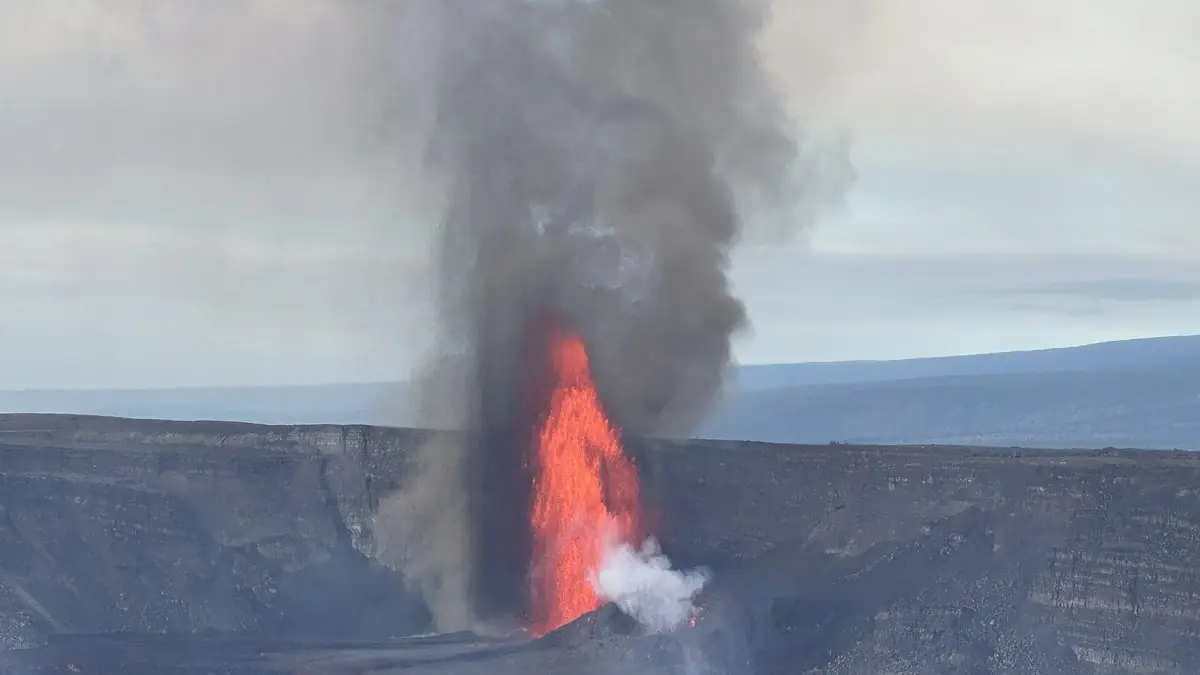
Kilauea erupted again early Monday, November 23, with its fifty-seventh lava fountaining episode. The fountain began around 12:15 a.m. Hawaii time from the north vent in Halemaʻumaʻu crater and stopped abruptly at 6 a.m., after five point eight hours. It peaked at about 650 feet around 1:30 a.m., and the gas plume rose to roughly 20,000 feet above sea level. Lava covered about half of the crater floor, with an estimated 7.7 million cubic yards erupted in total. Almost a day earlier, the volcano had started spilling lava from its north and southwest vents, giving scientists clear warning. Once the fountain stopped, the summit shifted from deflation to inflation, and tremor bursts returned. The observatory says another episode is likely in the coming weeks, though it's too early to say exactly when. The alert level dropped from Watch to Advisory, and the aviation color code went from orange to yellow.
Key points
- Lava overflowed 21 times in the day before the fountain.
- An estimated 7.7 million cubic yards of lava erupted.
- The alert level dropped from Watch to Advisory after the episode.
- Kilauea has erupted in episodes since December 23, 2024.
Kilauea erupted again early on Monday, November 23, right inside the window scientists had set. The volcano's 57th lava fountaining episode began around 12:15 a.m. Hawaii time and stopped abruptly at 6:00 a.m., after 5.8 hours of continuous fountaining.
Before it began, the USGS Hawaiian Volcano Observatory had forecast a November 22 to 26 window for episode 57. The fountain came from the north vent in Halemaʻumaʻu crater, at the volcano's summit inside Hawaiʻi Volcanoes National Park.
It reached its maximum height of about 650 feet (200 meters) around 1:30 a.m., according to the observatory's status report. The gas plume rose to roughly 20,000 feet above sea level.
Nearly a day of warning signs
The fountain did not come out of nowhere. Lava started spilling over from both the north and southwest vents at 1:21 a.m. on November 22, nearly a day before fountaining began.
The observatory counted 21 of these overflows, 14 from the north vent and 7 from the southwest vent. They became nearly continuous in the evening, and the final one began at 10:35 p.m. from both vents.
The southwest vent's flow stopped after about 15 minutes as lava drained back into it. The north vent kept overflowing, and about 1.7 hours after that last overflow began, its surging dome fountain turned into the full lava fountain.

How big it was
At its peak, the north vent poured out about 600 cubic yards of lava per second. The average over the whole episode was about 275 cubic yards per second, the report says.
In total, an estimated 7.7 million cubic yards of lava erupted. It covered about half of the Halemaʻumaʻu crater floor, and the flows may keep creeping forward for several days.
The southwest vent did not fountain this time. The Uēkahuna tiltmeter recorded about 18 microradians of deflationary tilt during the episode.
A fast, sudden ending
The fountain stayed 500 to 600 feet high for most of the morning. It began dropping around 5:00 a.m. and fell rapidly to about 300 feet by 5:45 a.m., while the plume dropped to about 14,000 feet.
By 5:55 a.m., the fountain was under 100 feet high and oscillating quickly. It stopped at 6:00 a.m. after about a minute of jetting that sent spatter several hundred feet into the air.
Winds from the northeast carried gas and tephra, including fine ash and Pele's hair, toward the southwest. Most tephra fell in the closed area of the park, southwest of the vents.
What the instruments show
Since the episode ended, the Uēkahuna tiltmeter has recorded 1.3 microradians of inflation, and other summit tiltmeters show the same shift. Seismicity returned to its usual pattern of low-level tremor with bursts every 5 to 10 minutes.
Four earthquakes were located in the summit region over the past day, according to the daily update. The observatory's gas sensors measured about 1,200 metric tons of sulfur dioxide per day on November 22, the day before the fountain.
Away from the summit, seismicity and ground deformation remain low in the East Rift Zone and Southwest Rift Zone. Sulfur dioxide emissions from the East Rift Zone are below the detection limit.
What happens next
As soon as fountaining ended, the summit switched from deflation to inflation. That pattern, along with continued glow from the vents and the return of tremor bursts, indicates that another episode is likely in the coming weeks, the observatory said in its daily update.
It is too early to forecast exactly when, scientists added. The alert level dropped from Watch to Advisory and the aviation color code from orange to yellow after the episode ended.
Kilauea has been erupting episodically since December 23, 2024, from two main vents in Halemaʻumaʻu. Episodes generally last less than 12 hours and are separated by pauses of two weeks or more.
Volcanic gas from the eruption reacts in the air to form vog, a haze that can cause breathing problems downwind. The observatory also warns that tephra can irritate skin, eyes and lungs, and it asks residents to report where it falls.
All the activity since December 2024 has stayed inside a closed area of the park. Still, the observatory notes that recent intrusions show the location of the eruption could change, and intrusions can trigger earthquakes, ground cracks and small landslides. It remains in contact with the park and the Hawaiʻi County Civil Defense Agency.
Photo: USGS/M. Patrick
Jordi Company
Writer at ECOnewsJordi Company is a well-known figure in Catalan publishing and a pioneer of the free press model, with 40 years of experience in television, radio and print. He has founded and led several media groups and today heads ECOticias.com, an environmental news outlet read in Spanish and English around the world and an audience leader since 2004. He is a member of the International Network of Writers for the Earth (RIET), among other organisations.
More from Jordi CompanyComments · 0
Rules ›No comments yet. Be the first to share your view.