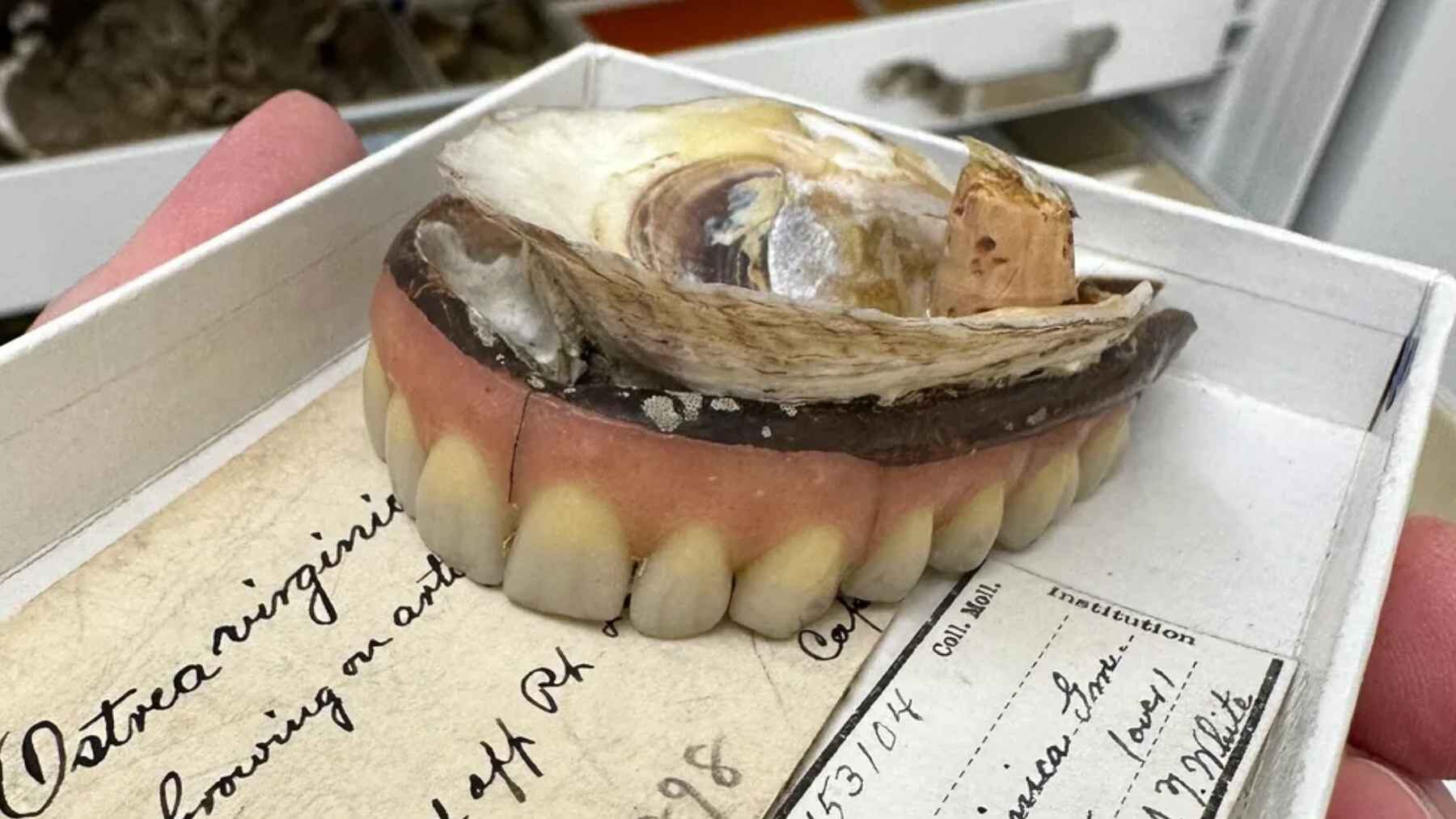
What if I told you that in 1898 a dredging boat took from the very bottom of the Chesapeake a set of upper false teeth with an eastern oyster (Crassostrea virginica) totally cemented to it? What happened was very simple: when baby oysters swim freely around searching for a firm place to stay for their whole lives, if they cannot find rocks or old shells, they get stuck to whatever they find. And maybe for that oyster that denture was the perfect place it found to stay. As John Pfeiffer said: “If an oyster finds a hard substrate, it will frequently just grow on it”.
The specimen, of course now, is preserved and held in the Smithsonian’s National Museum of Natural History. This is not just something just about curiosity. It captures a moment when Chesapeake oysters were already declining—a collapse that has now left only around 1 percent of the bay’s historic native population.
How an oyster chooses a home
Young oysters begin life swimming freely with tiny hairlike structures called cilia, and after a few weeks they develop a kind of temporary foot that allows them to crawl around the bottom of the ocean. So what are the best places that oysters could choose as a home? Any firm place where they can settle and stay attached.
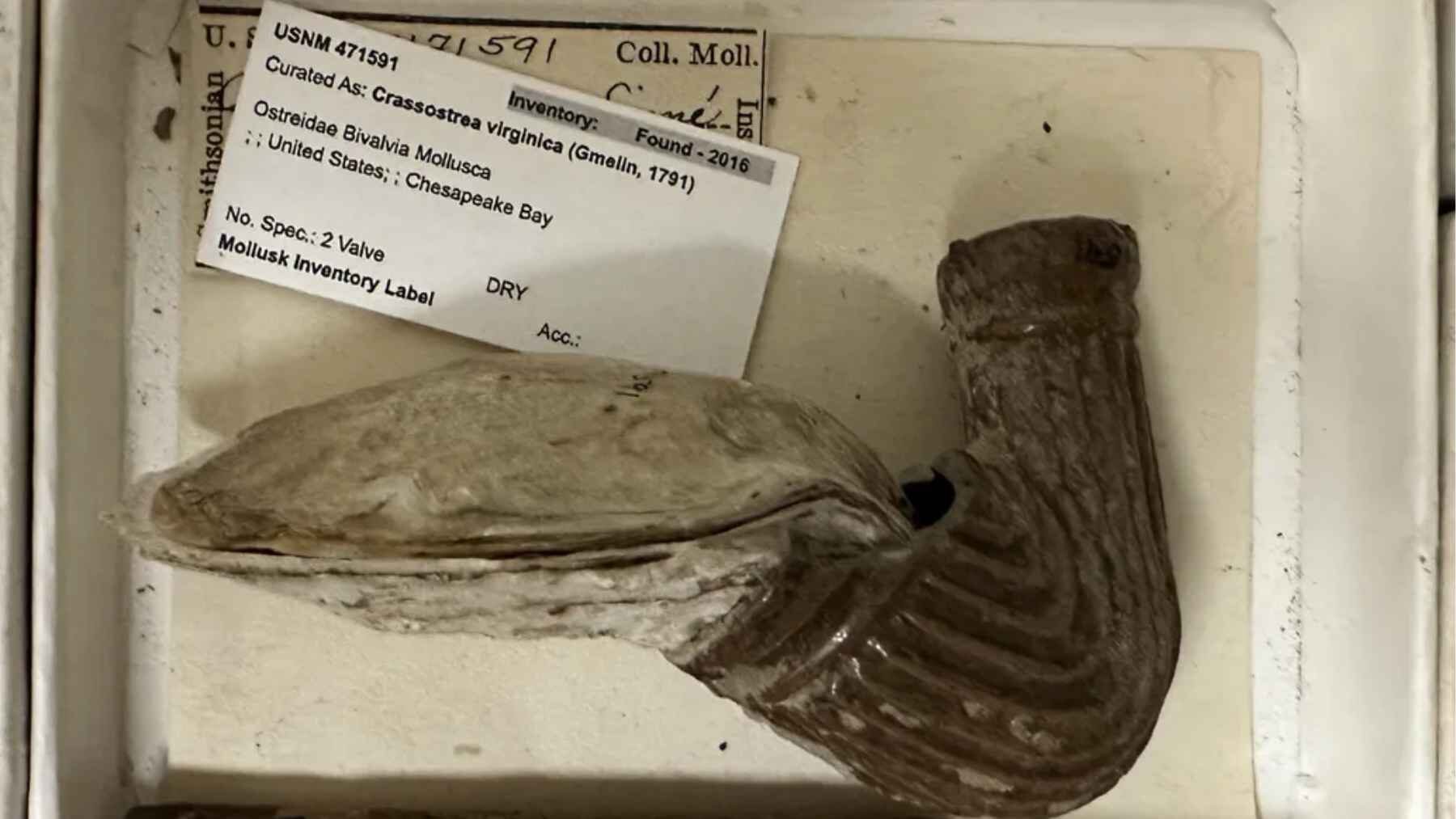
Once they find their home, they produce a “natural glue” that keeps them attached for their whole lives. As was said before, rocks and older oyster shells are common choices, but Smithsonian specimens also include Chesapeake oysters attached to random things inside the water such as smoking pipes and a teapot lid.
A relic from a fuller bay
For you to have an idea, oysters once were such a big community that they even supported Indigenous communities around Chesapeake Bay, and their reefs were so extensive that early boats had to try to avoid them so as not to run around while they were navigating.
But it was with the intensive harvesting, dredging, disease, overfishing, pollution and contamination that they not only destroyed the reefs, but also unfortunately this brought the loss of their habitat. The true bad and sad news is that NOAA says only about 1 percent remains.
What disappeared with the reefs
Something amazing and really surprising about oysters is that they filter algae and suspended material from the water. What if I told you that one single oyster can process up to 50 gallons a day under certain conditions? This brings clearer water that allows and helps underwater grasses grow, while at the same time reefs give to species the famous hiding places for fish and crabs.
According to the Chesapeake Bay Program, when the oyster population was not drastically and sadly reduced they could filter a volume of water equal to Chesapeake Bay in about three or four days. But today’s reality is totally different and for you to have an idea about how the population was reduced, it now takes more or less a year to process that same equivalent volume.
There are also good news and some progress now. NOAA and its partners could restore oyster reefs in 10 Chesapeake by the end of 2025 and now there are more than 2,400 acres of healthy reefs.
Why the strange specimen matters
This oyster preserved at museums is not only to showcase animals bodies one more time, but also a way – in this particular case- to record oysters’ natural behaviors, human history, and the ecological transformation of Chesapeake Bay.
The Chesapeake Bay community reinforces the importance of rebuilding the bay, because this means not just restoring the oysters, but also the marine life that once shaped the ecosystem.
The official Smithsonian article was published on Smithsonian Voices.